



Did you know that the first U.S. income tax law was passed in 1861 to fund the Civil War? Back then, the entire taxpayer instruction pamphlet was four pages long. Today, the Internal Revenue Code approaches 75,000 pages.
Needless to say, it’s all become a little more complex.
And while April 2027 may feel like a long way off, the smartest thing a high-net-worth individual, business owner, or professional can do right now is start preparing. What you do – or don’t do – between now and December 31, 2026 (and also just after the start of 2027) will directly determine what your tax bill looks like when you file.
Whether you prefer meeting with us in Gold River, our Roseville office, or virtually, short- and long-term tax planning are opportunities to preserve your wealth. In fact, proactive tax planning could save you as much year-over-year – in pure percentage terms – as a great investment strategy might provide in returns.
The new tax rules for 2026 bring real changes:
· new bracket thresholds
· and a senior deduction that some clients are still not aware of
If you’ve been wondering what tax changes are expected for 2026, this guide covers the ones most likely to affect you.
What Tax Year Are We Filing for in 2026 – and When Does It All Start?
A question I hear often: what taxes will I be filing in 2026, and what tax year does that cover? Right now, in 2026, you are earning income that will be reported on the tax return you file in early 2027. That return covers the 2026 tax year – January 1 through December 31, 2026.
The 2026 tax filing deadline for individuals is approximately April 15, 2027. As for when tax filing starts in 2026 – the IRS typically opens the filing season in late January and announces the official start date in early January 2027, so that’s worth watching for.
Everything in this guide – the contribution limits, the deduction thresholds, the planning strategies – applies to income and decisions you are making right now, in 2026. That is exactly why acting early matters. Every month that passes is a month of planning runway you do not get back.

Key IRS Tax Filing Deadlines for 2026 – Put These on Your Calendar Today1
A few of these dates fall well before the April 2027 filing season even opens, so missing them can be genuinely costly – so this list is worth knowing.
Deadlines During 2026 (Acting Now Saves Money Later)
• June 15, 2026: Q2 2026 estimated tax payment due. If you are self-employed, have rental income, investment income, or other income without withholding, this payment is required to avoid penalties.
• September 15, 2026: Q3 2026 estimated tax payment due.
• December 31, 2026: Final day to take your 2026 Required Minimum Distribution (RMD) if you are age 73 or older. This deadline cannot be extended.
• December 31, 2026: Deadline for Solo 401(k) employee deferrals for the 2026 tax year. Employer contributions can be made later, but employee deferrals must be made by year-end.
• December 31, 2026: Last day to complete Roth conversions, tax-loss harvesting, charitable giving, and other year-end planning moves that affect your 2026 return. Once the calendar flips, this window closes permanently.
Deadlines in Early 2027 (For Your 2026 Return)
• January 15, 2027: Q4 2026 estimated tax payment due. This is the final quarterly estimated payment for the 2026 tax year.
• Late January 2027: The IRS typically opens the filing season in late January. Watch for the official announcement – this is when the agency begins accepting 2026 tax returns.
• January 31, 2027: Employers and financial institutions must issue W-2s and most 1099 forms for the 2026 tax year.
• Mid-February 2027: 1099-B, 1099-R, 1099-DIV, and 1099-MISC forms for investment and retirement accounts typically arrive.
• April 15, 2027 – Tax Day: The expected federal filing and payment deadline for 2026 individual income tax returns (Form 1040). Also, the last day to make a retroactive IRA or HSA contribution for tax year 2026.
• April 15, 2027: Deadline to request a tax filing extension (Form 4868). An extension gives you until October 15, 2027, to file – but taxes owed are still due April 15.
• October 15, 2027: Extended filing deadline for those who filed Form 4868.
What Are the 2026 Tax Brackets?
Knowing where your income lands in the bracket structure is one of the most actionable things you can do. The 2026 tax brackets for married filing jointly are listed below – and my ProsperPlan Co-founder Chris Grellas, CFP®, MFSA, and I help clients see exactly where they sit each year so we can identify what moves might shift that picture in their favor.
The seven-bracket structure – 10%, 12%, 22%, 24%, 32%, 35%, and 37% – was made permanent under the One Big Beautiful Bill Act (OBBBA) signed July 4, 2025. For income you earn in 2026, here are the thresholds that matter most:
Married Filing Jointly (2026 Tax Year)2
• 10%: Up to $24,800
• 12%: $24,801 – $100,525
• 22%: $100,526 – $201,050
• 24%: $201,051 – $403,550
• 32%: $403,551 – $487,450
• 35%: $487,451 – $768,700
• 37%: Over $768,700
A threshold I always flag with clients: the jump from 24% to 32% happens at $403,550 for married filers. That is an 8-percentage-point jump, and strategic retirement contributions, charitable giving, and income timing can sometimes keep you in the lower bracket (meaning that planning could help you pay substantially less in taxes). That is exactly the kind of approach Chris and I do mid-year – and not in a panic come April. And with brackets now indexed more consistently for inflation under OBBBA, modest salary increases are less likely to trigger bracket creep over time.
“I talk to clients all the time who assume their tax situation is fixed – that the bracket they are in is just the bracket they are in. But that’s rarely true. With the right combination of retirement contributions, Roth conversions, and timing around income events, we can often shift the picture in ways that add up to tens of thousands of dollars over just a few years. The key is having that conversation before year-end, not after.”
– ProsperPlan Wealth Co-founder & Financial Advisor, Chris Grellas, CFP®, MFSA
The 2026 Standard Deduction
A higher standard deduction isn’t just a number – it’s a direct reduction in your taxable income, and it changes the calculus around whether itemizing is worth the effort.
For the 2026 tax year (returns filed in 2027), standard deduction amounts by tax filing status are:
• Single filers: $16,100
• Married filing jointly: $32,200
• Heads of household: $24,150
These reflect a roughly 2.2% inflation adjustment from 2025. About 90% of taxpayers take the standard deduction – though for California clients with significant state and property taxes, the expanded SALT cap (more on that below) may make itemizing worthwhile again.2
The $6,000 Senior Deduction – Still Available in 2026
This one is worth highlighting – I still encounter clients who haven’t heard about it, and for those who qualify, it’s significant.
If you or your spouse are age 65 or older, you may qualify for the OBBBA senior bonus deduction – an additional $6,000 per qualifying individual ($12,000 for married couples filing jointly) on top of whatever deduction you’re already taking. This provision runs from 2025 through 2028, and it is available whether you itemize or take the standard deduction.
Income phase-out thresholds:
• Single filers: Full deduction below $75,000 MAGI; phases out above
• Married filing jointly: Full deduction below $150,000 MAGI; phases out above
For a married couple both over 65, total deductions could reach $48,300 or more. If you qualify and we haven’t yet talked about how this interacts with your Social Security income or RMDs, let’s make sure we do.
2026 Retirement Contribution Limits: Maximize Them Now
Good news: the 2026 contribution limits went up across the board. The retirement account remains the best tax planning tool available to most people – not complicated, not aggressive, simply using what’s already there. Below are the 2026 limits.3
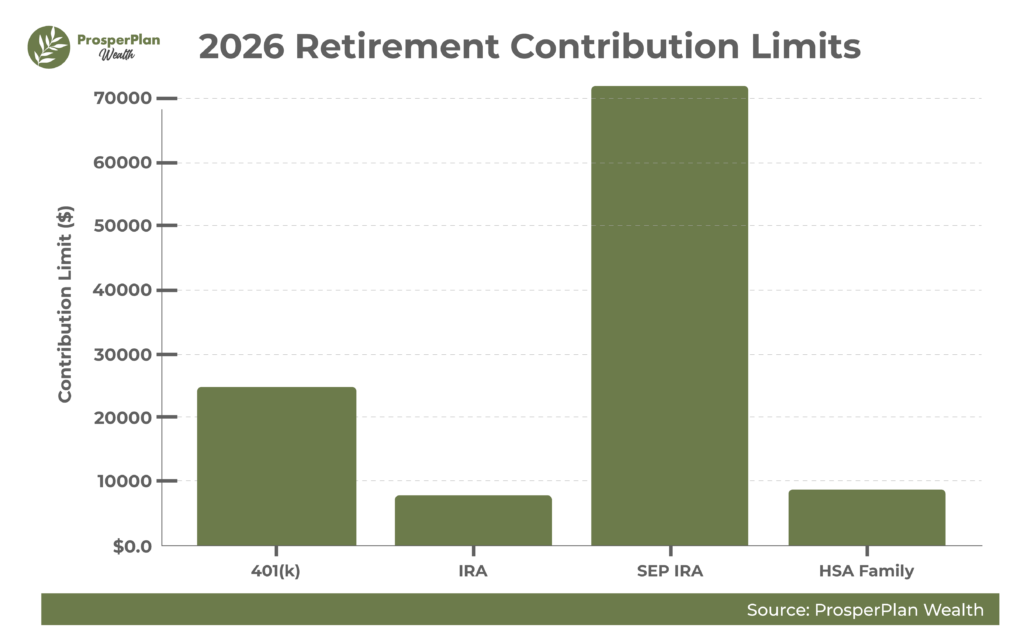
2026 Contribution Limits
• 401(k), 403(b), 457 plans: $24,500 (up from $23,500 in 2025)
• 401(k) catch-up (age 50–59 and 64+): $32,500 total
• Super catch-up (age 60–63): $34,750 total under SECURE 2.0
• Traditional and Roth IRA: $7,500 (up from $7,000 in 2025)
• IRA catch-up (age 50+): $8,600 – the first inflation adjustment to the IRA catch-up since 2006
• SEP IRA: Lesser of 25% of compensation or $72,000
• HSA (individual): $4,400; Family: $8,750
• FSA: $3,400
Two things to note: IRA and HSA contributions can be made retroactively until April 15, 2027, but 401(k) and Solo 401(k) employee deferrals must be completed by December 31, 2026 – do not wait on those. And if you’re between ages 60 and 63, the SECURE 2.0 super catch-up lets you contribute up to $34,750 to a 401(k) this year – a temporary window we should make sure to capture together.3
Other Key 2026 Tax Provisions to Know
SALT Deduction Cap: Now $40,400 for Joint Filers
This is a big one for California clients, and I’ve been talking about it a lot this year. The State and Local Tax (SALT) deduction cap increases to $40,400 for most married filing jointly filers in 2026, up from the prior $10,000 cap. If you have significant state income taxes and property taxes, this change may make itemizing worthwhile again for the first time in years. The cap increases by 1% annually through 2029, then reverts to $10,000 – so the window is real, but it won’t last forever.
No Tax on Tips and Overtime (Through 2028)
Eligible workers in qualifying occupations can deduct tip income from their taxable income. The extra “half pay” portion of overtime is also deductible. Both provisions phase out for higher earners and run through 2028.
Car Loan Interest Deduction
If you purchased or plan to purchase a qualifying new vehicle for personal use in 2026 using a loan originated after December 31, 2024, you may be able to deduct the interest paid. This phases out for married filing jointly filers above $200,000 MAGI.
Capital Gains Rates (2026)
The three long-term capital gains rates remain in place:
• 0%: Married filing jointly with income up to $98,900
• 15%: Income $98,901 – $613,700
• 20%: Income above $613,700
A 3.8% Medicare surtax also applies to net investment income above $250,000 MAGI for joint filers. If you have significant investment portfolios, planned asset sales, or RSU/ESPP events in 2026, please talk to us before acting – timing and sequencing matter a great deal.
Estate Tax Exemption
The federal estate tax exemption for 2026 is $15,000,000 per individual ($30,000,000 for married couples). If estate planning is part of your broader picture – and for many of the families I work with, it should be – this is a key planning figure.
How to Organize Yourself Now – A Step-by-Step Guide
The clients who have the best tax outcomes are almost always the ones who treat tax filing for 2026, and beyond, as a year-round habit rather than a January fire drill. You don’t need to have everything perfect – you just have to start. Here’s how:
Step 1: Create a Digital Filing System for 2026
Create a new folder on your computer labeled “2026 Taxes.” Inside that, create subfolders for:
· Income
· Deductions
· Investments
· Social Security
· Healthcare
· and Retirement
If you prefer physical copies, a clearly labeled accordion folder works just as well.
Step 2: Track Everything as It Happens
Starting now means capturing things in real time – rather than trying to reconstruct a year’s worth of activity come January. For ongoing tracking, I personally recommend Quicken Simplifi or Monarch Money. If you have rental properties, RSUs, ESPP shares, or business income, keep running records now. Missing a cost basis, a depreciation schedule, or a contribution date is far easier to prevent than to fix.
Step 3: Know What Documents You’ll Need
• Income: W-2s, 1099s (1099-INT, 1099-DIV, 1099-R, 1099-B, 1099-NEC, 1099-K, 1099-DA for digital assets), K-1s
• Social Security: Form SSA-1099 (issued in January 2027)
• Healthcare: Form 1095-A, 1095-B, or 1095-C depending on your coverage
• Deductions: Charitable receipts, property tax statements, Form 1098 (mortgage interest), medical expenses
• Retirement : IRA and HSA contribution statements, RMD documentation
• Business owners: Income statements, expense ledgers, payroll records, 1099s issued to contractors, depreciation schedules, asset purchase, and sale records
• Equity compensation: RSU vesting records, ESPP purchase and sale data, option exercise documentation
Step 4: Track Charitable Donations and Deductible Expenses
For charitable contributions of $250 or more, keep written acknowledgment from the organization confirming the amount and that no goods or services were received in return. For non-cash gifts, document a description and estimated value.
And if you’ve been giving through a donor-advised fund, make sure contributions are funded by December 31, 2026, to count for this tax year. It’s a detail that sometimes gets missed, and it matters.
Step 5: Year-End Planning Moves – Don’t Wait Until December
The best tax planning conversations happen in May, June, and September – not December, when options narrow quickly. Between now and year-end, please review:
• Roth conversion opportunities based on your current bracket position
• Tax-loss harvesting in taxable investment accounts
• Charitable giving strategies, including donor-advised funds
• RSU and ESPP vesting timing and concentration risk
• Whether you are on track to maximize your 401(k) and IRA contributions by the appropriate deadlines
• RMD planning if you are age 73 or approaching it
Step 6: Share Your Folder with Your Tax Preparer Early
Once your documents are compiled – even partially – share your “2026 Taxes” folder with your advisor, CPA, and/or tax preparer ahead of your meeting. The earlier we see the full picture, the more runway we have to find opportunities and address issues. Early sharing is a sign of smart planning, not disorganization.
Important Tax and Financial Birthdays
These “birthdays” function like gifts – new tools, new options, new opportunities that open at specific ages. If any of these milestones fall in 2026 for you or your spouse, let’s make certain we are capturing them.
• Age 50: Eligible for catch-up contributions to IRAs and 401(k)s
• Age 55: Penalty-free withdrawals from 401(k)s may be allowed if retired
• Age 59½: Penalty-free distributions available from IRAs and qualified plans
• Age 60–63: SECURE 2.0 super catch-up: contribute up to $34,750 in a 401(k) this year
• Age 62: Early Social Security retirement benefits available, at a reduced amount
• Age 65: Medicare enrollment begins three months before your birthday – don’t delay
• Age 65+: Eligible for the $6,000 senior bonus deduction (2025–2028) – confirm your MAGI qualifies
• Age 67: Full Social Security retirement benefits available for those born in 1960 or later
• *Age 73: Required Minimum Distributions must begin. Your 2026 RMD must be taken by December 31, 2026
A note on RMDs and the planning opportunity hiding inside them: It can be tempting to leave retirement money growing until RMDs kick in at 73 – but the IRS formula is designed to draw that balance down quickly, and large future distributions can push you into a higher bracket than you’re in today. For some clients, beginning distributions or completing Roth conversions earlier makes a meaningful difference. It’s not the right move for everyone, but always worth modeling. Please reach out before making any decisions here.
The ProsperPlan Approach to Tax Planning
At ProsperPlan Wealth, taxes are more than an annual obligation – they’re a key part of your overall financial strategy. Chris and I are fiduciary advisors, which means every recommendation we make is 100% in your best interests. We specialize at the intersection of tax planning and financial planning, and in my experience, that’s exactly where the most meaningful outcomes happen.
We focus on reducing your tax burden over a lifetime, not just a single year – from maximizing retirement contributions and optimizing charitable giving to evaluating every 2026 provision that applies to your situation and coordinating closely with your CPA.
You don’t need to have everything figured out to reach out. Many of the best conversations I have start with someone saying, “I’m not sure if I’m doing this right.” That’s exactly the right place to start – and the best time to do it is now, not January.
If you have questions about the 2026 tax year or are ready to get started, please reach out today for a complimentary planning consultation.
Together, we’ll turn tax season into an opportunity to build clarity, confidence, and lasting financial success.