



Early retirement isn’t just a dream reserved for a lucky few – it’s a math problem, and every math problem has a solution that’s just waiting to be found.
I’ve sat across the table from hundreds of clients who walked in convinced that leaving work before 65 simply wasn’t in the cards for them, only to discover that with the right early retirement planning strategies and an honest look at their numbers, the finish line was so much closer than they’d imagined.
The gap between where you are today and where you want to be is real, but I promise you it is absolutely bridgeable. Let’s walk through it together.
Why Starting Early Is the Single Most Powerful Move You Can Make
One of the most frequent questions I hear is: why is it important to begin planning for retirement early? The answer comes down to one word: compounding.
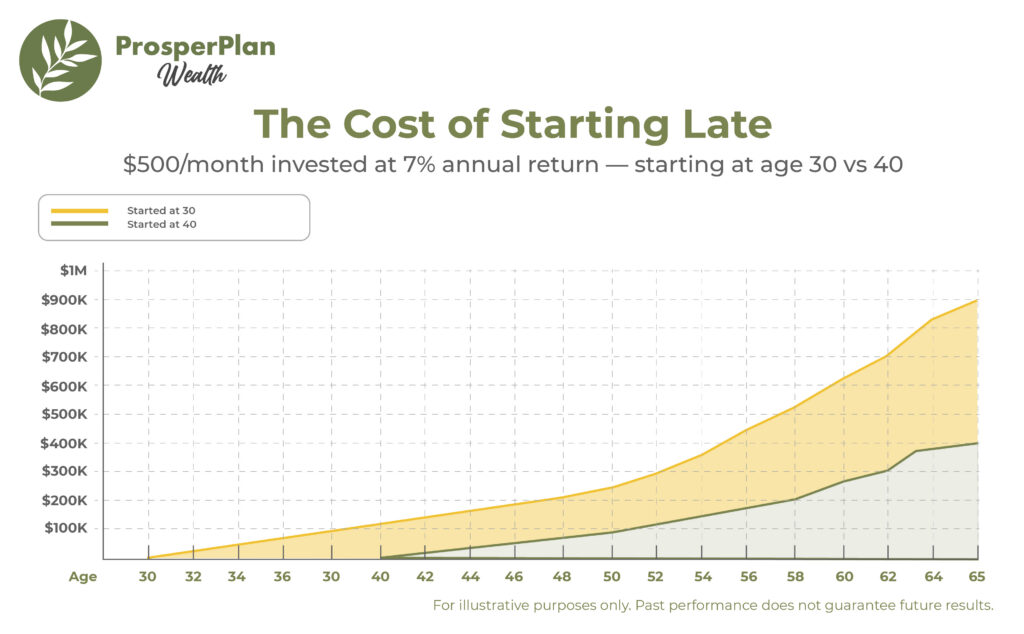
When you invest early, your money earns returns. Then those returns earn returns. Over decades, that snowball effect grows in ways that feel almost magical. For example, a 30-year-old who invests $500 a month at a 7% average annual return will have roughly $1.2 million by age 65. A 40-year-old doing the exact same thing ends up with about $567,000, which is less than half.
That ten-year difference does not just cost you time; it costs you over $600,000.
Early retirement planning also gives you something invaluable: flexibility. You have more years to course-correct if the market dips, more time to build tax-advantaged accounts, and more options when it comes to healthcare, Social Security strategy, and withdrawal sequencing. The earlier you start planning for early retirement, the more levers you have to pull. If you are reading this and thinking you have already waited too long, you haven’t. The second-best time to start is right now.
If you’d like a partner to help you map out those next steps, that’s exactly what our retirement planning services are designed for.
Know Your Number: What Does “Enough” Actually Look Like?
Before you can bridge a gap, you need to know how wide it is. That means getting clear on two figures: how much you’ll want to spend in retirement, and how much you need saved to make that happen sustainably.
Here’s a foundational concept I walk virtually every client through: the 4% rule.
To be clear, the 4% rule is far too simple to build your entire future on. But it does offer a really useful lens.
So, what is the 4% rule for early retirement? Originally known as the “Safemax” rate, it emerged from the landmark Trinity Study and suggests that if you withdraw 4% of your portfolio in your first year of retirement and adjust for inflation each year after, your savings have a high probability of lasting 30 years. For most traditional retirees, that’s plenty of runway. But for early retirees – say, someone leaving work at 50 or 55 – you may be looking at a 40- or even 50-year retirement horizon, which changes the picture quite a bit.
For that reason, many financial planners (myself included) recommend that early retirees consider a slightly more conservative withdrawal rate of 3% to 3.5%, or plan for a dynamic withdrawal strategy that adjusts based on portfolio performance. The 4% rule is a powerful starting framework, but it’s exactly that – a starting point, not an end-all or a ceiling.
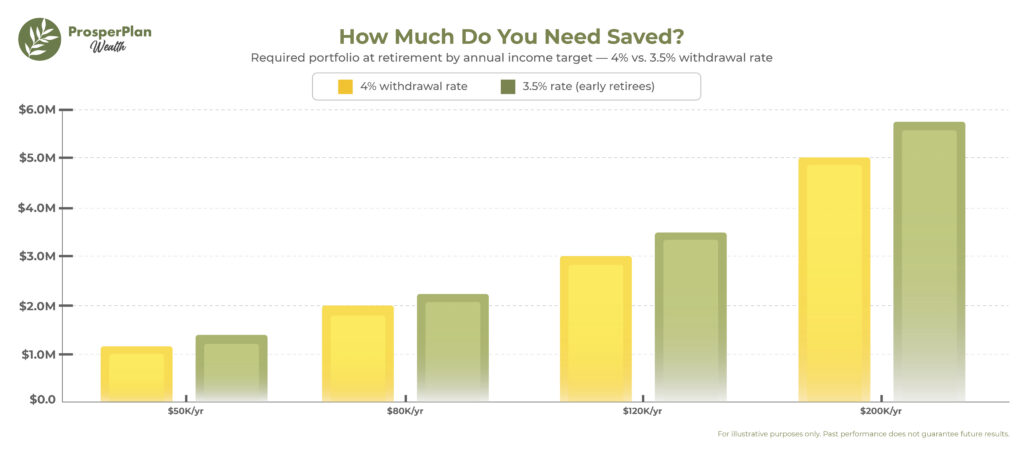
To put it in concrete terms: if you need $80,000 a year in retirement, you’re targeting a portfolio of $2 million at a 4% withdrawal rate ($80,000 ÷ 0.04). If you’re being conservative at 3.5%, your target climbs to roughly $2.3 million.
“The 4% rule was designed for a 30-year retirement. If you’re leaving work at 52, you could easily have a 45-year horizon ahead of you. That changes everything — and it’s the reason we always model multiple scenarios before giving a client a retirement date.”
– Chris Grellas, CFP®, MSFA | Co-founder & Financial Advisor, ProsperPlan Wealth
The 30-30-30-10 Rule: A Simple Framework for Allocating Every Dollar
So many of our clients come to us feeling genuinely overwhelmed by budgeting. They’re not sure how much to save, how much to spend, or how much to keep accessible. That’s where a simple allocation framework can cut through the noise and bring some real clarity.
You may have heard of the 50/30/20 budget rule, but for retirement-focused households, I often introduce a more nuanced breakdown: the 30-30-30-10 rule for retirement. Here’s how it works:
- 30% toward living expenses — your housing, food, utilities, transportation, and everyday costs
- 30% toward retirement savings and investments — maxing out your 401(k), IRA, brokerage contributions, and other long-term vehicles
- 30% toward debt reduction and financial goals — paying down the mortgage, student loans, or other obligations that would otherwise follow you into retirement
- 10% toward lifestyle and giving — vacations, hobbies, charitable giving, and the things that make today worth living, too
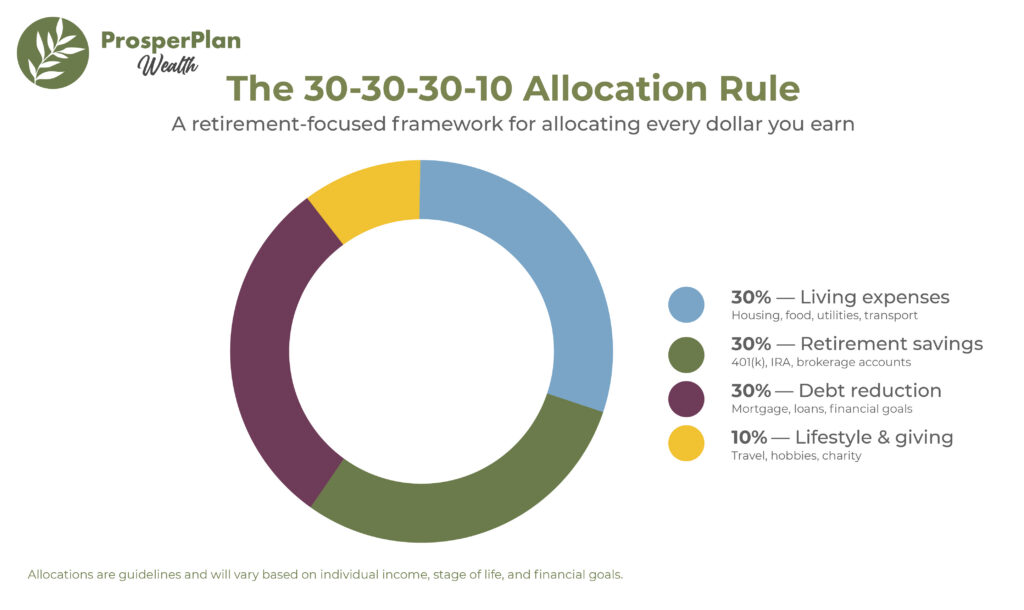
This isn’t a rigid prescription – your numbers will shift based on income, stage of life, and goals – but just like the 4% rule, it’s a wonderfully useful mental model to come back to. If you’re earning $150,000 a year, this framework would have you directing $45,000 annually toward retirement savings. That’s aggressive and intentional, which is exactly what early retirement planning requires.
The Retirement Savings Reality Check: Where Does America Actually Stand?
Here’s something that genuinely surprises most people I talk to: very few Americans are sitting on the kind of wealth we associate with retirement security. A common benchmark question I hear is, how many Americans have $1,000,000 in retirement savings?
The answer, according to recent data from Vanguard and Fidelity, is roughly 10–15% of retirement account holders, and that’s among people who have retirement accounts at all. When you look at the broader population, the numbers are more sobering. The Federal Reserve’s Survey of Consumer Finances consistently shows that the median American household near retirement age has saved far less than what most financial planning models suggest they’ll need.
I share this not to discourage you, but to normalize the gap you may be feeling right now. Most people are behind – and most people don’t have a structured plan. The fact that you’re here, thinking critically about this, already puts you ahead of the curve. With intentional financial planning services for early retirement, you have a real and meaningful opportunity to land in that minority of genuinely prepared retirees.
“Most people overestimate what they’ll save in the next few years and drastically underestimate what they’ll need over a 30-year retirement. That gap — between projection and reality — is exactly what we build our planning process around closing.”
— Chris Grellas, CFP®, MSFA | Co-founder & Financial Advisor, ProsperPlan Wealth
Retiring on $80,000 a Year: What You Actually Need at 60
Let’s get specific because specificity is truly where real plans come to life.
If your goal is to retire at 60 on $80,000 per year, there are a few important things to account for: your expected lifespan, Social Security timing, healthcare costs before Medicare eligibility at 65, and whether that $80,000 is in today’s dollars or future dollars.
Using the 4% rule as our baseline, retiring on $80,000 a year requires a portfolio of $2 million. At 3.5% (a more conservative rate appropriate for early retirement), you’re looking at approximately $2.3 million. And that’s before factoring in taxes. If you’re drawing from pre-tax accounts like a traditional 401(k), your gross withdrawal needs to be higher to net $80,000 after taxes — potentially closer to $100,000–$110,000 gross depending on your effective tax rate, pushing your target portfolio to $2.5 million or more.
A few factors that can meaningfully bring that number down:
- Social Security income, which you can begin collecting at 62 (though at a reduced benefit) or delay to 67 or 70 for a larger monthly check
- Part-time or consulting income during your early retirement years
- A paid-off home, which dramatically reduces your fixed monthly expenses
- Geographic flexibility — some clients cut their cost of living significantly by relocating domestically or internationally
The bottom line: if $80,000 a year is your target and you’re aiming to retire at 60, a portfolio in the $2 million to $2.5 million range is your bridge to get there.
Retiring on $200,000 a Year: The Higher-Income Equation
For higher earners who’ve built a more expansive lifestyle, the numbers scale accordingly — and the planning gets more nuanced.
If you’re asking, how much money do I need to have saved to retire on $200,000 a year at 60? — here’s the straight answer.
At a 4% withdrawal rate, you need $5 million. At 3.5%, the target is roughly $5.7 million. Again, if you’re drawing from pre-tax accounts and expect a meaningful tax bill, your gross withdrawal may need to be $240,000–$260,000 to net $200,000 after federal and state taxes, pushing your portfolio target to $6 million or higher.
At this income level, early retirement planning strategies become particularly sophisticated. Roth conversion ladders, which involve converting traditional retirement funds to Roth accounts over multiple years during lower-income periods, can significantly reduce your long-term tax burden. Taxable brokerage accounts become more important since Roth and 401(k) accounts have early withdrawal penalties before age 59½ (with some exceptions). And sequence-of-returns risk — the danger of a major market downturn in the early years of retirement — deserves extra attention.
“One of the most underestimated risks for early retirees isn’t market volatility — it’s sequence of returns. A 30% downturn in year two of retirement is devastating in a way that the same downturn in year fifteen simply isn’t. Your first decade of withdrawals is when your plan is most fragile, and that’s where we spend the most time stress-testing.”
— Chris Grellas, CFP®, MSFA | Co-founder & Financial Advisor, ProsperPlan Wealth
One practical early retirement planning tip I always share with high-income clients: don’t underestimate your lifestyle creep going into retirement. So many people assume they’ll naturally spend less when they stop working. In reality, especially during the early “go-go” years of retirement when health and energy are at their peak, they often spend the same or more. Build your plan around real, honest spending – not wishful thinking.
The Gap Analysis: Mapping Where You Are to Where You Need to Be
This is the heart of the work I do with clients, and honestly, it’s something you can begin on your own today. A gap analysis for early retirement planning looks like this:
Step 1 — Nail down your retirement income target. What does your ideal retirement actually look like? Travel? A paid-off home? Being there for your kids or grandkids financially? Get honest and specific – this is your north star.
Step 2 — Calculate your target portfolio. Use the 4% rule (or 3.5% for longer horizons) to determine the savings you need. Divide your annual income target by your withdrawal rate.
Step 3 — Know where you stand today. Add up all retirement accounts, taxable brokerage accounts, and any other investable assets. This is your starting point.
Step 4 — Project forward. Using a conservative 6–7% average annual return, estimate what your current savings will grow to by your target retirement age. Online compound interest calculators make this straightforward.
To make this step easier, run your numbers through our retirement savings calculator and get a clear projection in just a couple of minutes.
Step 5 — Identify the gap. The difference between your projected balance and your target number is your gap. Now the real planning begins: increasing contributions, adjusting the timeline, reducing expected expenses, or some combination of all three.
Step 6 — Build your bridge. Your bridge is the specific, actionable plan to close that gap. Maxing your 401(k) and IRA every year, investing in taxable accounts, aggressively paying down debt, and making strategic career moves all become tools in that bridge-building process.
Early Retirement Planning Tips That Actually Move the Needle
After years of walking alongside clients at every stage of this journey, here are the early retirement planning tips I’ve seen make the most consistent, lasting difference:
Automate everything. Set your contributions to max out before you ever see the money hit your account. Willpower is finite; automation is forever.
Tax diversify your accounts. You want money spread across pre-tax accounts (traditional 401k, IRA), Roth accounts (Roth 401k, Roth IRA), and taxable brokerage accounts. This trifecta gives you the flexibility to manage your tax bracket throughout retirement.
Build a bridge account. Because Roth and 401(k) funds are restricted before 59½, early retirees need a taxable brokerage account they can draw from without penalty. This is the literal financial bridge between early retirement and traditional retirement account access.
Don’t neglect healthcare. Retiring before 65 means navigating the years before Medicare kicks in. Budget $1,000–$2,000+ per month for marketplace health insurance premiums depending on your situation – this is the expense that blindsides more early retirees than almost anything else.
Run stress tests. What happens to your plan if the market drops 30% in year two of retirement? What if you live to 95? What if inflation runs hot for a decade? A plan worth having is one that holds up under pressure – not just in ideal conditions.
Your Next Step: Make the Gap Visible, Then Make It Smaller
Early retirement is not a fantasy reserved for the extraordinarily wealthy or the exceptionally lucky. It is a math problem — and like all math problems, it yields to the right approach. The clients I’ve seen retire early aren’t necessarily the ones who earned the most; they’re the ones who planned the most deliberately.
Your job right now is beautifully simple: make the gap visible. Write down your target. Calculate where you stand. Find the distance between the two. Then start building your bridge, one intentional step at a time.
If you’d love some help running the numbers for your specific situation, we’re here for you. At ProsperPlan Wealth, we specialize in exactly this kind of planning — mapping out a clear, realistic, and deeply personalized path from where you are today to the retirement you’ve always envisioned. Because the gap isn’t the obstacle. The gap is just the beginning of the plan.
FAQs on Early Retirement Planning
Why is it important to begin planning for retirement early?
Starting early lets compounding do the heavy lifting — a 30-year-old investing $500/month at 7% ends up with around $1.2 million by 65, while a 40-year-old doing the same lands at about $567,000. Early planning also gives you more flexibility to course-correct, build tax-advantaged accounts, and optimize healthcare and Social Security strategy.
What is the 4% rule for early retirement?
The 4% rule suggests you can withdraw 4% of your portfolio in your first year of retirement and adjust for inflation each year after, with a high probability your savings will last 30 years. For early retirees facing 40- or 50-year horizons, a more conservative 3% to 3.5% withdrawal rate is often recommended.
What is the 30-30-30-10 rule for retirement?
It’s an allocation framework that directs 30% of income to living expenses, 30% to retirement savings and investments, 30% to debt reduction and financial goals, and 10% to lifestyle and giving. It’s a flexible mental model rather than a rigid prescription, designed to keep retirement-focused households intentional with every dollar.
How many Americans have $1,000,000 in retirement savings?
According to recent Vanguard and Fidelity data, roughly 10–15% of retirement account holders have reached $1 million — and that’s only among people who have retirement accounts in the first place. The broader population sits well below the savings levels most planning models suggest are needed.
How much do I need to retire on $80,000 a year at 60?
Using the 4% rule, you’d need a $2 million portfolio; at a more conservative 3.5% rate, that climbs to roughly $2.3 million. Factoring in taxes on pre-tax account withdrawals can push the target to $2.5 million or more, though Social Security, part-time income, or a paid-off home can meaningfully reduce that figure.