



Building Legacies for Families and Retirees with Sacramento’s favorite fee-only fiduciary advisors.
You may have heard about “Trump Accounts” in the news – maybe a quick mention of a $1,000 government contribution for newborns, but not much else, as they were part of a huge news cycle.
Politics aside, most news reports barely scratched the surface of what these accounts can do for you if you have children under 18 years of age.
As fiduciary financial advisor, our job is to help you understand the full scope of legislation such as this so you can make confident decisions for your family.
With that in mind, I’m going to walk you through what a Trump Account can do, who it’s for, and why the real opportunity has nothing to do with that initial $1,000.
What is a Trump Account?
Created under the Working Families Tax Cuts legislation, a Trump Account is a new type of tax-deferred custodial investment account for children. It is designed to give your family a head start on long-term savings in the form of a dedicated investment vehicle in your child’s name that not only grows over time but is sheltered from taxes until withdrawals begin. (If you have experience with a traditional IRA, some of this will feel familiar.)
Different from IRAs, however, Trump Accounts have their own unique set of rules around contributions, permitted investments, and how the money eventually gets withdrawn. Just think of them as a “purpose-built” vehicle for giving your child an amazing financial running start – one that can be supercharged with the right planning down the line.
Who qualifies for a Trump Account?
For starters, your child is eligible for a Trump Account if they meet all three of these conditions:
- They are a U.S. citizen
- They have a valid Social Security number
- They are under the age of 18 (this is not limited to only babies!)
Additionally, only one Trump Account may be opened per child, and you as a parent or legal guardian must be the one to open it.
Now, about that $1,000.
The federal seed contribution is available for children born between January 1, 2025 and December 31, 2028. (And even better, this seed money does not count toward any annual contributions you as a parent happen to make.)
You can, of course, contact us (or your accountant) to walk you through it, but the flyover logistics are that, to open one, You’ll need to first file IRS Form 4547 (you can still file one for the 2025 federal tax year) or use the online portal at trumpaccounts.gov for the 2026 tax year.
Lastly, at least on the logistical side, contributions cannot be made until July 4, 2026, so while that date is fast approaching, there is no rush to act this very second. (There are, however, some serious advantages to understanding what your options are right now.)
Who can contribute and how much?
While the government offers $1,000 in seed money (imagine even that invested for 20 years) for children born in the three-year window that is open right now, you, your family members, and friends can contribute up to a total of $5,000 per year to your child’s account, with that limit being indexed for inflation after 2027.
Here is how the different contributor types break down:
- You and your family members can contribute up to the $5,000 annual cap per child.
- If you own an S-Corp or other business, you can contribute up to $2,500 per employee per year through the business. Conversely, that means that if you are an employee, your employer can contribute up to $2,500 per year on your behalf. Think about that during your next round of salary negotiations. (Note that this limit is per employee, not per child, but these contributions are tax-deductible to the business and excluded from your taxable income as the employee, which is pretty fabulous.)
- If your state or local government, or a qualified nonprofit, contributes to a broad group of children in your area, those contributions do not count against your $5,000 annual family limit.
- The federal $1,000 pilot contribution and any qualified rollover transfers do not count toward the annual cap.
What can your child’s account invest in?
A Trump Account is not an open-ended brokerage account. Your investment options are currently restricted to:
- A low-cost, broadly diversified U.S. stock index fund or ETF
- With an expense ratio capped at 0.10%
That means no international funds, bonds, individual stocks, or alternative investments.
For many families, this is perfectly fine. A low-cost total market index fund is a sound long-term holding, and the expense cap helps keep your child’s account efficient.
Simply put, these accounts work best alongside your other savings vehicles rather than as a standalone solution.
We like to think of this as part of a “Comprehensive Investment Plan” for the next generation:
- The Trump Account serves as the retirement savings vehicle.
- A 529 plan is still the most effective tool for education funding.
- An UTMA account is often best suited for goals like a first home down payment or a first car purchase.
When can your child access the money?
With some exceptions, no withdrawals are permitted before January 1 of the year your child turns 18. At 18, the account evolves to function similarly to a traditional IRA, and the following rules kick in:
- Withdrawals are subject to ordinary income tax.
- With few exceptions, a 10% early withdrawal penalty may apply to non-qualified distributions taken before age 59½.
You’re probably wondering: what circumstances qualify for the exceptions?
Penalty-free withdrawals may include:
- Qualified higher education expenses
- First-time home purchase (up to a $10,000 lifetime limit)
- Standard IRA exceptions, such as:
- Disability
- Certain unreimbursed medical expenses
The Roth conversion strategy: now here’s the real opportunity
When your child turns 18, their Trump Account can be converted into a traditional IRA, which can then be converted into a Roth IRA. That particular sequence matters a lot.
This is the ideal progression:
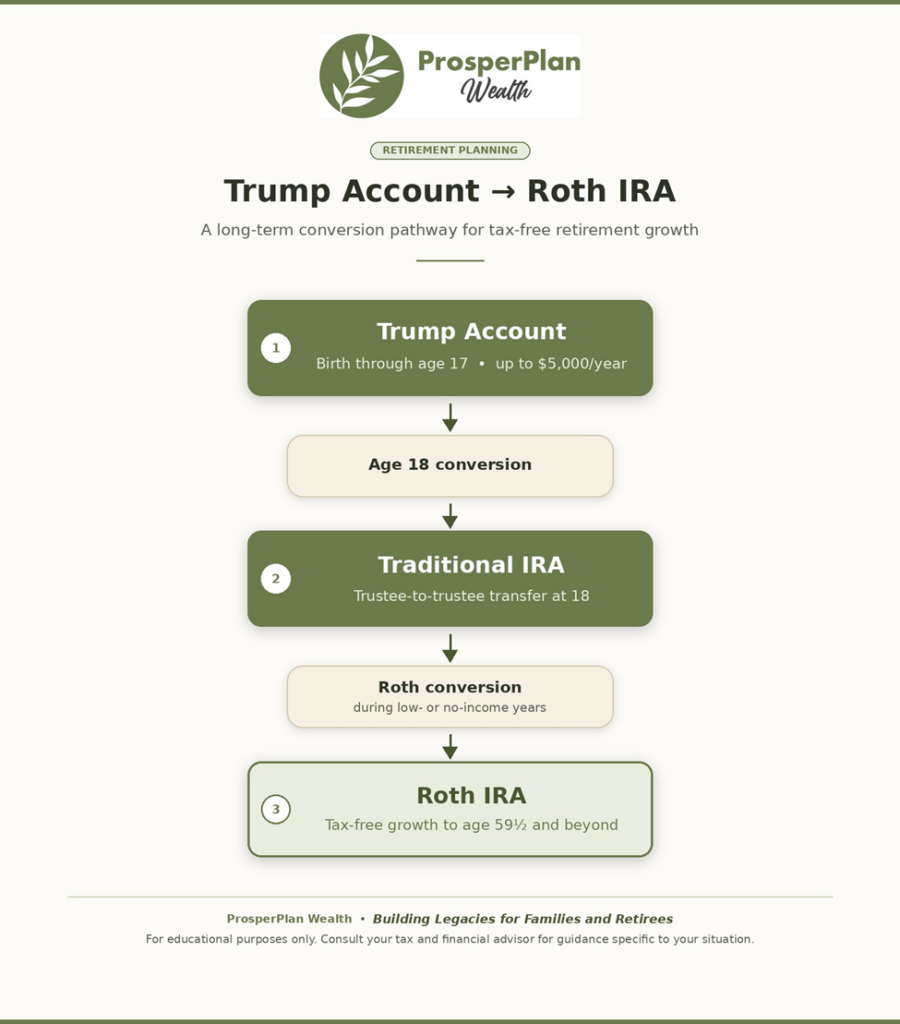
A Roth IRA is one of the most valuable accounts in the tax code. Money grows tax-free, and qualified withdrawals after age 59 1/2 are also completely free from taxes. The age-old challenge is that your child needs earned income to contribute to a Roth IRA directly. But a Trump Account sidesteps that requirement entirely, allowing tax-deferred savings to build from birth with no earned income required, then converting at 18.
As an aside, the best time to convert is right after your child turns 18. At that stage, many young adults have little or no taxable income. So with careful planning – particularly spreading the conversion across two or three years to stay at or under the standard deduction – you can potentially move the entire balance into a Roth IRA with little to no federal tax hit.
One planning note worth understanding: the “Kiddie Tax” applies to unearned income for children under 19, as well as for full-time students under 24 who do not provide more than half their own support. (Roth conversions count as your child’s income under this rule.) Some families will choose to “gift” the resulting tax cost to their child to keep the full balance inside the Roth so it can compound without interruption. This is worth modeling out with your advisor.
For Roth conversions under age 59 ½, withholding taxes from the conversion will result in a premature penalty, as taxes paid to the state and IRS are considered a taxable distribution. You can complement this strategy with a secondary brokerage account used to services the taxes to avoid premature penalties, if any exist.
What do the numbers actually look like?
What could a Trump Account look like in terms of value down the road? Here are some assumptions for growth projections:
- You can contribute $5,000 per year from your child’s birth through age 17
- You earn a 7% average annual return
- You engage in a full conversion to a Roth IRA at age 18
- You make no additional contributions after the conversion
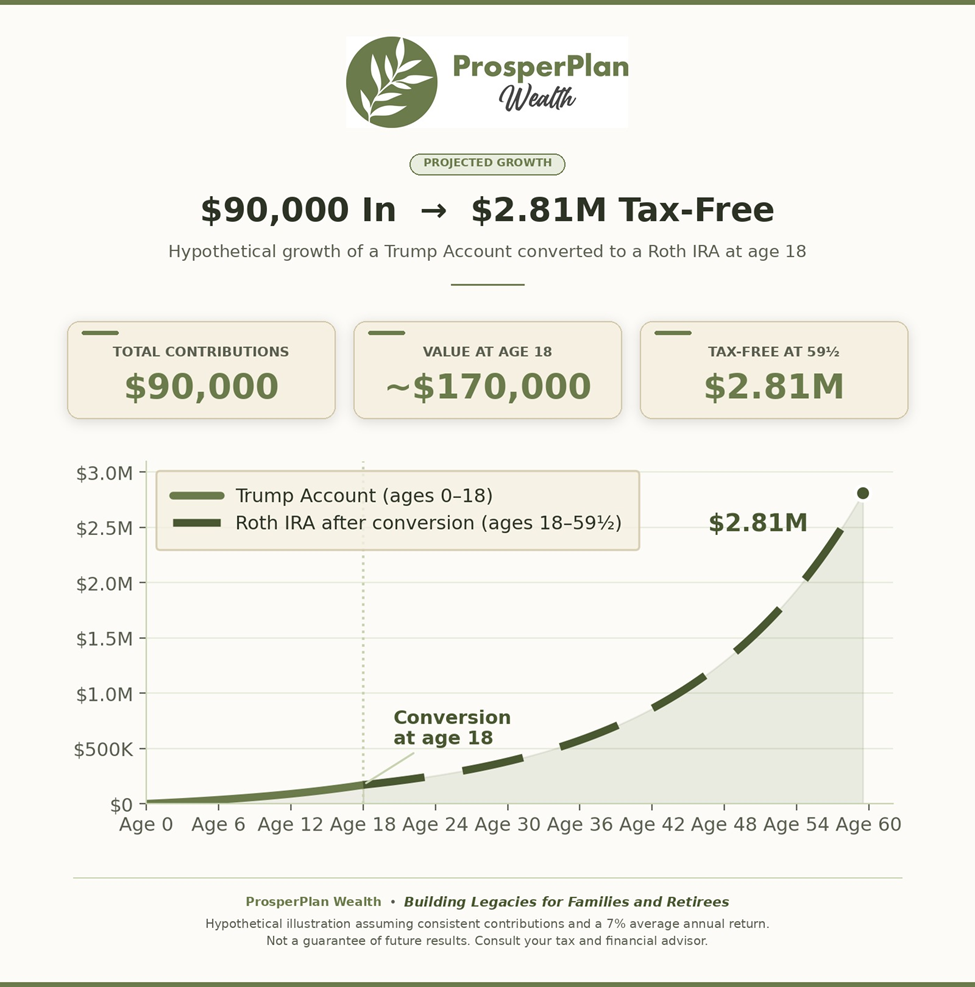
As you can see above, those 18 years of contributions total $90,000 and grow to roughly $170,000 by your child’s 18th birthday. Left invested as a Roth IRA through age 59 ½ at 7%, that balance grows to over $2.81 million – entirely tax-free.
That is not only a feasible (though not guaranteed) assessment, but a crystal-clear example of starting early combined with a perfectly timed Roth conversion.
Simply, the contributions are relatively modest. The outcome is not.
How this fits with the rest of your legacy plan
While a Trump Account is a useful new tool, it is just one tool, not a complete plan. A few things worth keeping in mind as you think about your bigger picture:
- The $5,000 annual cap means this account will not cover major education costs on its own. If paying for college is a priority for your family, an equally beneficial 529 plan still makes a lot of sense in addition to a Trump Account.
- UTMA and UGMA custodial accounts offer more investment flexibility and no withdrawal restrictions (when used for children), making them useful for different goals you may have for your child.
- If you are already working with more sophisticated estate planning structures, the Trump Account should settle in alongside those tools, not in place of them.
The smartest approach is usually to layer these vehicles together, matching each one to a specific goal your family is working toward.
The bottom line
The $1,000 federal seed contribution is a great conversation starter. But the best reason to pay attention to Trump Accounts is the Roth conversion opportunity they create, which turns faily modest but consistent contributions into a substantial tax-free asset your child can carry well into adulthood.
Details are still being finalized by the IRS and Treasury, and my ProsperPlan Co-founder, Chris Grellas, CFP®, MSFA, and I will continue monitoring them as all this evolves. But make no mistake – families who understand and embrace this crafty tool early will be best positioned to use it most advantageously.
Simply, it’s a potentially fabulous tool. It’s also one of the biggest federal government breakthroughs, in support of saving money for the future, in a long while.
While many legacy planning conversations focus on passing assets in the distant future, strategies like these – centered on long-term growth and the power of starting early – are exactly the conversations to prioritize while we’re actively involved in the lives of young children.
Please don’t hesitate to give us a ring for a conversation about how this will help you build a legacy for your family.
Sources: IRS IR-2025-117, Notice 2025-68, trumpaccounts.gov. This article is for general educational purposes and does not constitute tax or legal advice. Please consult a qualified fiduciary financial advisor at ProsperPlan Wealth regarding your individual circumstances.