



If you’ve ever felt wealthy on paper but constrained in practice, you’re not alone.
Many people, including business owners, tech professionals, and healthcare executives, reach a point where their balance sheet looks great, but their day-to-day flexibility doesn’t feel as free as they might rightfully expect.
While this disconnect can be frustrating, it’s important to remember that it’s almost always solvable.
This is where liquidity planning becomes essential. When done thoughtfully, it allows your financial life to feel as strong and supportive in practice as it appears on paper. It’s a core part of effective liquidity financial planning, and for many high-net-worth families, it’s the bridge between accumulation and true financial ease.
What Is Liquidity Planning?
Before diving into strategies, it helps to step back and define what we’re really talking about, because liquidity planning is easily misunderstood.
At its core, liquidity planning ensures money is available when you need it, but without disrupting long-term goals. It goes beyond maintaining cash reserves and instead focuses on understanding which assets can be accessed, how quickly, and at what cost.
For most high-net-worth households, this includes:
- 3–6 months of living expenses in accessible cash
- Funds aligned with near-term liquidity needs (1–3 years)
- A strategy for accessing longer-term assets in a tax-efficient way
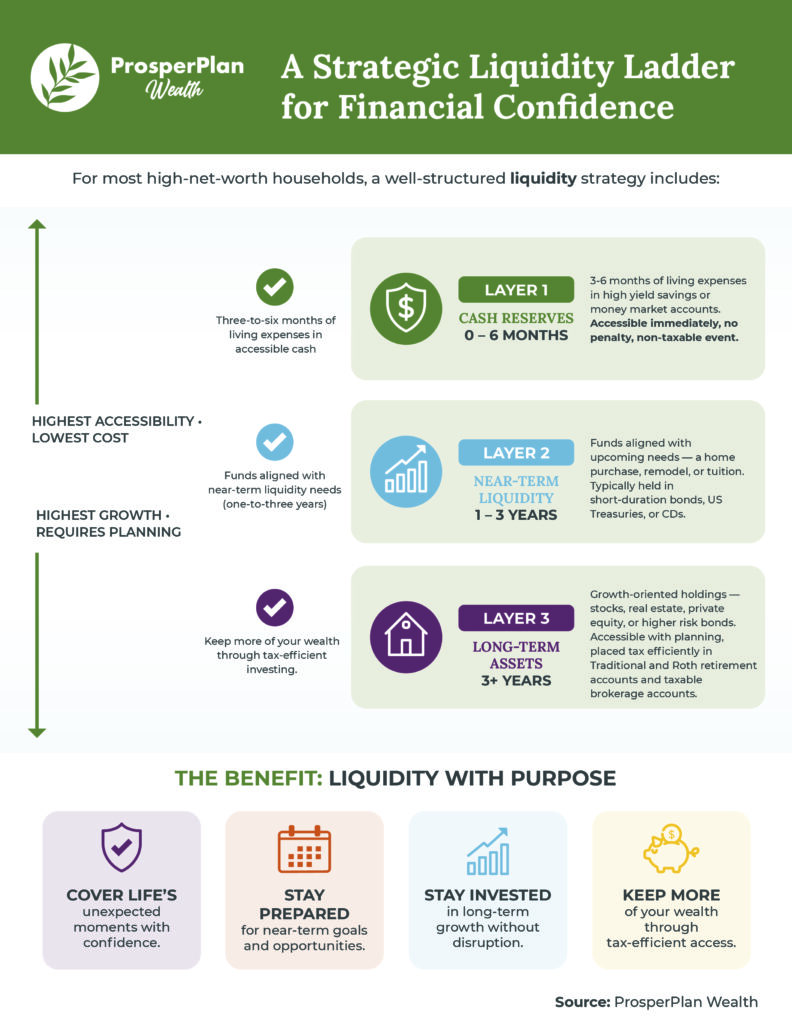
To be sure, the goal isn’t holding excess cash, it’s achieving thoughtful liquidity optimization so your resources are working for you, not sitting idle or locked away.
The Primary Goal
When we speak with clients about liquidity, the conversation almost always comes back to one feeling: confidence.
The purpose of liquidity financial planning is to create that confidence, so you know you can meet both expected and unexpected liquidity needs without being forced into hasty or reactive decisions.
When wealth is concentrated in real estate, equity compensation, or retirement accounts, even substantial net worth doesn’t guarantee access to cash. Strategic liquidity optimization bridges that gap, making wealth usable today while preserving long-term growth.
“Liquidity planning isn’t about hoarding cash, it’s about building flexibility so clients can say yes to life when it matters most.”
Chris Grellas, CFP®, MSFA
The High-Net-Worth Liquidity Challenge
One of the most common things we see is thoughtful, disciplined savers who have done nearly everything right, but who still feel a subtle tension around money.
Consider a typical scenario: a professional with RSUs, a maxed 401(k), ESPP shares, and real estate.
On paper? They’re wealthy. But in practice? They’re cash constrained.
This is where thoughtful liquidity planning becomes essential. Without it, wealth can remain in a kind of holding pattern: growing in value, but difficult to use.
Simply, while identifying and addressing liquidity needs early is one of the most empowering steps in a financial plan, it’s also one of the most misunderstood and overlooked.
The Four Types of Liquidity
To really understand liquidity, it helps to look at it from a few different angles. It’s not just how much cash you have, but how your entire financial structure functions.
A well-rounded liquidity financial planning strategy considers:
- Market Liquidity – Ease of buying/selling assets
- Funding Liquidity – Access to cash or credit
- Accounting Liquidity – Ability to meet obligations
- Asset Liquidity – Ease of converting assets to cash
When these elements are aligned, liquidity optimization becomes much more achievable, and your financial life tends to feel smoother and more resilient.
The 5 Liquidity Ratios
For clients who appreciate a more analytical lens, liquidity ratios can offer helpful perspective (though they’re best used as guideposts and not fixed rules).
Liquidity ratios help evaluate short-term financial strength and support liquidity forecasting:
- Current Ratio – Measures whether your short-term assets can cover your short-term liabilities
- Quick Ratio – A stricter version of the current ratio that excludes fewer liquid assets, focusing on what can be accessed quickly
- Cash Ratio – Shows how much of your short-term obligations can be covered using only cash and cash equivalents
- Operating Cash Flow Ratio – Indicates whether your ongoing income (cash flow) is sufficient to meet near-term obligations
- Net Working Capital Ratio – Reflects how much of your total assets are available to support short-term financial needs
Used thoughtfully, these tools help anticipate future liquidity needs instead of reacting under pressure, and that brings more clarity into decision-making.
What Is a Good Liquidity Ratio?
A natural follow-up question is: what does a “good” (or “healthy) liquidity ration actually look like?
A current ratio above 1.0 indicates that short-term assets exceed short-term liabilities, while a range of 1.5–3.0 is generally considered even better, because that means you have a comfortable liquidity buffer without holding excessive idle cash.
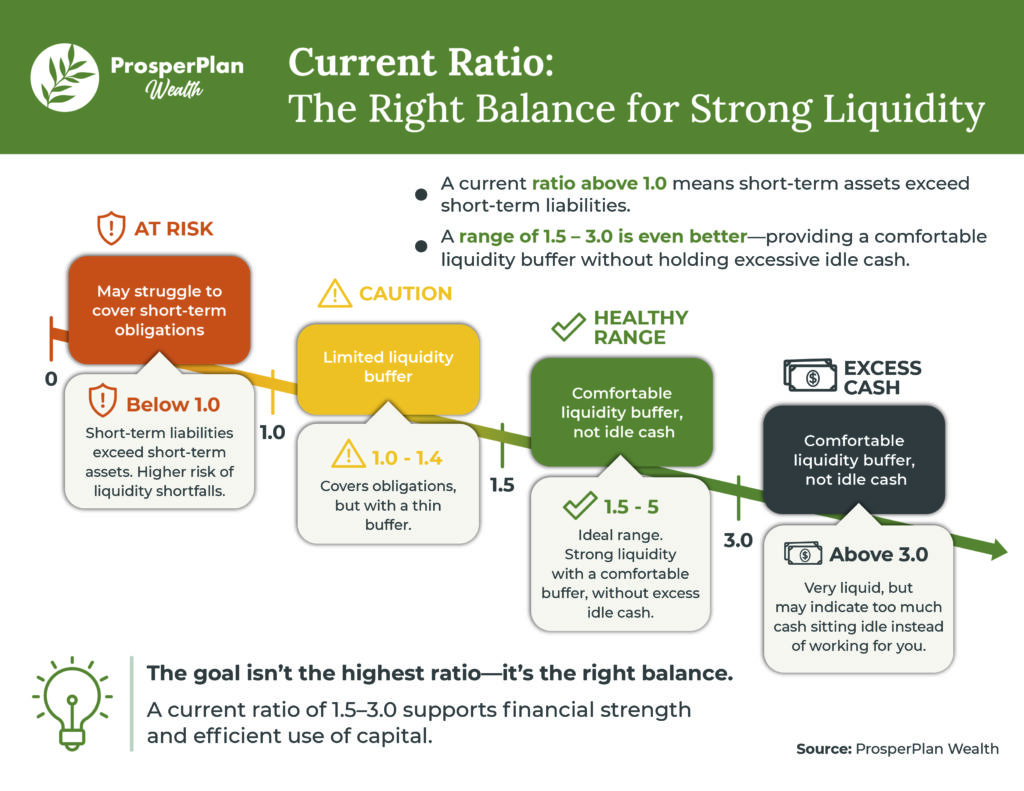
But it’s important to understand that these are merely ratios and that effective liquidity planning is deeply personal. A retiree drawing income, a tech executive approaching a vesting event, and a business owner planning a transition will all have vastly different liquidity needs.
For example, a 32-to-70 ratio (~46%) may indicate limited accessible assets: highlighting an opportunity for improved liquidity optimization without sacrificing long-term growth.
“Clients often feel frustrated because they’ve done everything right, yet money still feels tight. That’s usually solvable.”
Lauren Williams, CFP®, CRPC®, MBA
Strategy 1: Liquidity Forecasting
Before making changes, a good first step is simply gaining visibility.
Strong liquidity forecasting is the foundation of any plan.
This includes:
- Mapping income, expenses, and asset timing
- Incorporating vesting schedules and major financial events
- Projecting cash flow across 1-, 3-, and 5-year horizons
For many families, this step alone brings relief, because it reveals future liquidity needs early when there’s still time to act thoughtfully.
(This is especially important in planning for family business succession, where timing and access to capital can shape long-term outcomes.)
Strategy 2: Borrowing Against Assets
When liquidity is needed, selling assets isn’t always a great first step.
One of the more flexible approaches in liquidity financial planning is borrowing against assets you already own.
Options include:
- Securities-Based Lines of Credit (SBLOCs) – A line of credit that lets you borrow against your investment portfolio without selling your securities
- Home Equity Lines of Credit (HELOCs) – A revolving line of credit secured by your home’s equity, allowing you to access funds as needed
- Asset-backed lending solutions – Loans secured by assets such as real estate, investments, or other holdings, used to access liquidity without liquidating those assets.
These strategies support liquidity optimization while helping you avoid unnecessary taxes or disruption to your long-term plan.
“Access to capital on your own terms is one of the quiet advantages of thoughtful financial planning.
Chris Grellas, CFP®, MSFA
Strategy 3: Managing Equity Compensation
For many professionals, equity compensation represents both opportunity and complexity.
Without a plan, it can quietly create tension around liquidity needs.
A more intentional approach may include:
- Gradual, tax-aware sales – Selling assets over time in a way that helps manage and potentially reduce the overall tax impact.
- Charitable giving strategies – Structuring donations to maximize tax benefits while supporting causes that matter to you.
- Tax-loss harvesting – Selling investments at a loss to offset gains elsewhere, helping reduce overall taxes owed.
- Risk management techniques – Strategies used to reduce exposure to potential losses, such as diversification or protective investment tools.
These strategies improve flexibility while supporting long-term liquidity optimization.
Strategy 4: Leveraging Life Insurance
Some effective liquidity tools are also the most overlooked.
For some high-net-worth individuals, permanent life insurance can play a meaningful role in liquidity financial planning, because it offers tax-efficient access to funds through policy loans.
This becomes especially valuable for family business succession, where liquidity can help avoid forced sales, support transitions, and create balance across generations.
Strategy 5: Intentional Rebalancing
Rebalancing is often viewed purely through a risk lens, but it can also be a powerful liquidity tool.
When done intentionally, it becomes part of a broader liquidity planning strategy.
- Trim appreciated assets – Sell a portion of investments that have increased in value to lock in gains and rebalance your portfolio.
- Generate cash in a controlled way – Create liquidity through planned, strategic actions rather than reactive or forced decisions.
- Plan ahead for illiquid holdings – Anticipate how and when less-liquid assets (like real estate or private investments) can be accessed or converted to cash.
This approach supports steady, ongoing liquidity optimization without disrupting your long-term direction.
Tax Planning: The Connecting Thread
And yet, if there’s one element that ties all of this together, it’s tax awareness.
Effective liquidity financial planning works best when tax strategy is integrated and not layered on afterward.
Key elements include:
- Coordinating taxable, tax-deferred, and tax-free accounts
- Timing income and liquidity events
- Using strategies like Roth conversions and charitable giving
These decisions can significantly influence long-term liquidity optimization and overall outcomes.
From Paper Wealth to Real Freedom
At the end of the day, this conversation is about more than numbers. It’s about how your financial life feels.
Liquidity planning turns wealth into usability. It helps ensure that what you’ve built supports the life you want to live, both now and in the future.
“Our job is to ensure your wealth supports your life today, and not just someday.”
Lauren Williams, CFP®, CRPC®, MBA
We’d Love to Hear from You
As it has with so many individuals, if the above resonates – even in a small way – you don’t need to have everything organized before reaching out.
At ProsperPlan Wealth, we help clients clarify their liquidity needs, align their strategy, and build a plan that creates flexibility and confidence.
Your wealth should feel like freedom. Let’s work together to help you feel more prosperous and make freedom your reality.