



I love a good rule of thumb. When life is busy and money feels complicated, a simple formula can feel like a deep, relaxing breath.
And relieving worry and stress is exactly why the 50/30/20 rule has become one of the most popular budgeting methods in America.
But here’s what I’ve learned after years of sitting across the table from clients: simple doesn’t always mean it’s right for you. Today’s housing costs, childcare bills, and retirement goals look quite different than they did when this rule first caught on. So, let’s talk honestly about what the 50/30/20 budget does well, where it falls short, and how to make it work for your real life.
What Is the 50/30/20 Rule?
Let’s start with the basics because a durable foundation makes everything else easier.
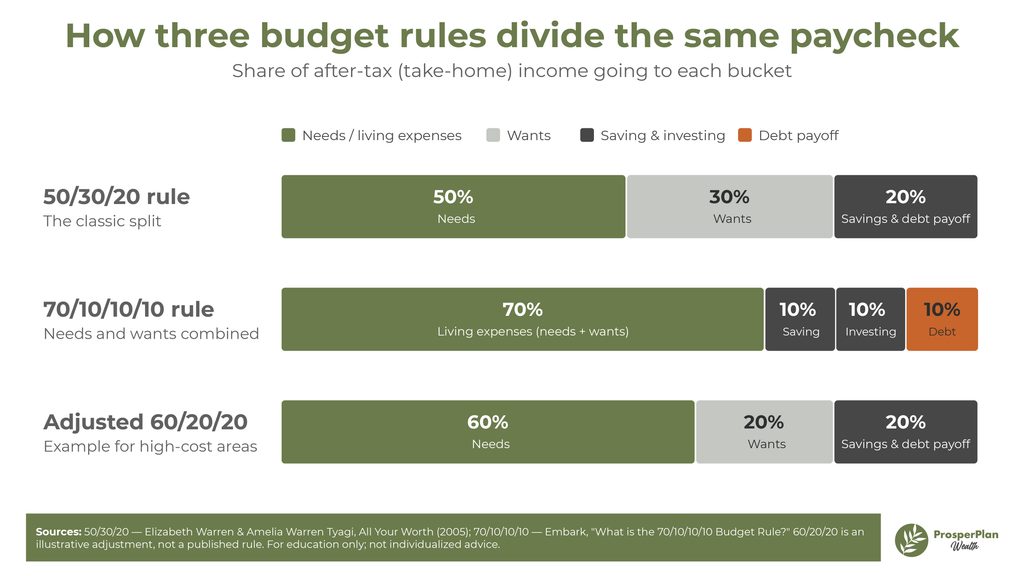
The 50/30/20 rule is a budgeting framework that splits your after-tax income into three buckets: needs, wants, and savings. It was popularized by Elizabeth Warren and her daughter, Amelia Warren Tyagi, in their 2005 book All Your Worth: The Ultimate Lifetime Money Plan.
The beauty of the 50-30-20 rule is that you don’t have to track every latte. You only need to know which bucket each dollar belongs in. You may also see it called the 50/20/30 rule. Same idea, just the numbers are merely listed in a different order.
How Is Money Divided Using the 50-30-20 Method?
This is where the rule really shines, so let’s walk through it together with real numbers.
Imagine your take-home pay is $6,000 a month after taxes. Here’s how the 50/30/20 budget would divide it:
| Bucket | Share | Monthly amount | What it covers |
| Needs | 50% | $3,000 | Rent or mortgage, utilities, groceries, insurance, car payment, minimum debt payments |
| Wants | 30% | $1,800 | Dining out, travel, streaming, hobbies, shopping, gym memberships |
| Savings & debt payoff | 20% | $1,200 | Emergency fund, retirement contributions, investing, extra debt payments |
A quick tip: if you contribute to a 401(k) through payroll, that money never hits your checking account. Be sure to count it toward your 20% so you get credit for the saving you’re already doing.
Is the 50/30/20 Rule a Good Idea?
I’ll be honest with you: for many people, it’s a wonderful place to start.
If you’ve never had a budget, or every budget you’ve tried felt like a diet you couldn’t stick to, the 50/30/20 rule gives you structure without overwhelm. It also does something I really appreciate. It builds in permission to enjoy your life. That 30% for wants isn’t a loophole. It’s what keeps a budget sustainable.
Here’s what it does well:
- It’s easy to remember. Three numbers, three buckets.
- It makes saving automatic. Twenty percent goes to your future before you spend on extras.
- It’s flexible. You decide what counts as a want, not a spreadsheet.
Still, a rule of thumb is a starting point, not a finish line.
“A budget rule is like an off-the-rack suit. It fits a lot of people reasonably well, but the people who get the best results are the ones who have it tailored to their income, their goals, and the season of life they’re in.”
– Chris Grellas, CFP®, MSFA, Co-Founder & Financial Advisor, ProsperPlan Wealth
When Might the 50/30/20 Rule Not Be the Best Saving Strategy to Use?
This is the part I most want you to hear, because if the rule hasn’t worked for you, it may not be your fault at all.
When your needs are more than 50%. In high-cost areas like Sacramento and much of California, rent or a mortgage alone can take a huge bite of your take-home pay. Add childcare, insurance, and a car payment, and needs can easily push past 50%. If that’s you, you’re not failing at budgeting. The math simply wasn’t built for your zip code.
When you’re behind on retirement. If you started saving later or took time off to raise kids or care for a parent, 20% may not be enough to catch up. Many of my clients in their 40s and 50s need to save more aggressively to reach their goals.
When you have high-interest debt. Credit card balances charging 20% or more deserve extra attention. In that season, it often makes sense to shrink the wants bucket and throw more at debt.
When your income is irregular. Commission earners, business owners, and freelancers can’t always count on a steady paycheck. A percentage-based budget can feel shaky when the base number changes every month.
When you earn a high income. On the flip side, if you earn well, spending 30% on wants may mean leaving real wealth-building on the table. Saving 30% or more can dramatically change your timeline to financial independence.
Other Budget Rules Worth Knowing
If the 50/30/20 split doesn’t quite fit your reality, you have options. Here are two other popular rules that I’m often asked about.
What Is the 70-10-10-10 Budget Rule?
The 70-10-10-10 rule divides your after-tax income into four parts: 70% for living expenses, 10% for saving, 10% for investing or paying down debt, and 10% for giving. I love that it makes room for generosity. Just keep in mind that 70% for all living costs leaves less cushion for retirement than many families need.
What Is the 3-6-9 Rule of Money?
The 3-6-9 rule is about your emergency fund rather than your whole budget. It suggests setting aside three, six, or nine months of essential expenses, depending on how stable your situation is:
- 3 months if you have a steady job and a dual income
- 6 months if you’re a single earner or have dependents
- 9 months if you’re self-employed, have variable pay, or work in a volatile industry
The 3-6-9 rule pairs beautifully with any budget. Think of it as the safety net that keeps your plan intact when life surprises you.
How Many Americans Have $1,000,000 in Retirement Savings?
I want to share a number with you. It isn’t meant to scare you. It shows why a one-size-fits-all budget often isn’t enough.
Based on the Federal Reserve’s Survey of Consumer Finances, only about 2.5% of Americans have $1 million or more in retirement accounts. Even among retirees, just 3.2% have crossed that line1. Meanwhile, Americans now believe they need about $1.46 million to retire comfortably, according to Northwestern Mutual’s 2026 Planning & Progress Study.2
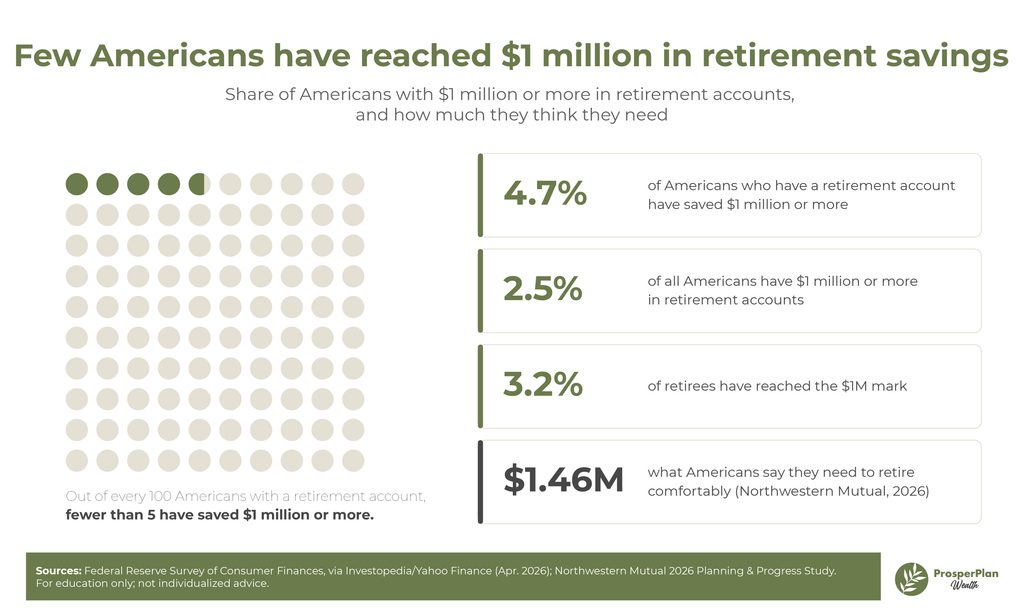
You may not need a million dollars. Your number depends on your lifestyle, your Social Security, any pension, and when you want to stop working. But that gap is a gentle reminder that saving “20% of whatever is left” may not get you where you want to go. Your savings rate should come from your goals, not from a generic formula.
Curious where you stand? Our retirement savings calculator is a great first step to see whether your current savings rate is on track.
How to Make the 50/30/20 Rule Work for You
The good news? You don’t have to throw the rule out. You can simply make it yours.
- Track one month of real spending. See where your money actually goes before you set targets.
- Adjust the percentages. A 60/20/20 or 50/20/30 split may fit your life better. What matters is that the savings number is intentional.
- Pay yourself first. Automate retirement and savings contributions so they happen before you’re tempted to spend.
- Revisit it every year. Raises, new babies, paid-off loans, and empty nests all deserve a fresh look at your plan.
- Connect it to the bigger picture. A budget works best when it’s tied to your investments, taxes, and retirement timeline.
Common 50/30/20 Budget Questions
Should I Budget From Gross or Net Income?
Use your net income, the amount that lands in your account after taxes. If your employer takes out health insurance premiums or 401(k) contributions before you’re paid, add those amounts back in. Health insurance goes in your needs bucket, and your 401(k) contributions count toward your 20%.
Do Minimum Debt Payments Count as Needs or Savings?
Minimum payments on credit cards and student loans belong in your needs bucket. Skipping them leads to late fees and credit damage, so they aren’t optional. Anything you pay above the minimum counts toward your 20%, because that extra money pays the debt off faster and frees up cash for the future.
How Does the 50-30-20 Rule Work for Couples?
Most couples apply it to their combined take-home pay. Shared costs like the mortgage and childcare come out of the 50%, and you decide together how the 20% splits between joint goals and each person’s own retirement accounts. It can also help to give each partner a set amount from the wants bucket to spend without checking in first. That small bit of independence can head off a lot of minor money arguments.
Does the 50/30/20 Rule Still Apply in Retirement?
Not in the same way. Once the paychecks stop, the savings bucket usually shrinks, and your income comes from Social Security, a pension, or withdrawals from your savings. Sorting needs from wants is still useful. But the bigger questions become how much you can safely withdraw each year and which accounts to draw from first. A retirement income plan answers those better than any budget rule.
Let’s Build a Plan That Fits Your Real Life
If you’ve made it this far, I hope you feel a little lighter. The 50/30/20 rule is a lovely starting point, but you deserve a plan built around your income, your family, and your dreams.
At ProsperPlan Wealth, we’re a fee-only, 100% fiduciary firm. That means we’re legally and ethically bound to put your interests first, and we never earn commissions on products we recommend. Through our financial planning services, we help you turn a simple budget into a complete roadmap. Our investment management services then put the savings you’ve worked so hard for to work toward your goals.
Ready to find the right balance for you? Schedule a conversation with our team today. We’d love to help you take the next step.
1 Investopedia via Yahoo Finance
2KUTV
This article is for educational purposes only and is not individualized investment, tax, or legal advice.