



You’re worried about money and you can’t sleep.
You get up and go to your computer. Or you roll over and you pick up your phone.
If you’ve ever typed “How much do I need to retire?” into a search bar late at night, you’re probably not even the only one on your street asking that exact question at that moment.
And if after some searching, you’ve wondered if maybe there isn’t a simple way to get to the root of that complex question, and so then you’ve typed (or asked), “What about the 4% rule?”
Well, here’s your answer.
The 4% rule is a wonderful middle ground for your research. That’s because it’s simple, it’s memorable, and it gives you a number to strive for.
So, let’s talk about it together: what the 4% rule really says, where it came from, where it can fall short, and how to find the number that fits your life.
How the 4% Rule Works
The 4% rule says that you can withdraw 4% of your retirement savings in your first year, then adjust that dollar amount for inflation each year after, with a “decent” likelihood that your money will last at least 30 years, based on U.S. market history.
If you have $1 million saved, that means about $40,000 in year one.
But it also works in reverse, which is why some people use it to set a savings goal. Multiply the annual income you’ll need from your portfolio by 25, and you have your “4 percent rule” target. Do you need $50,000 a year from your investments? The rule points you toward $1.25 million.
(Just as an aside, you may also hear it called the “4 rule for retirement,” “the 4 retirement rule,” or simply a “safe withdrawal rate,” but you get the idea: a steady, inflation-adjusted paycheck from your savings with the goal being to never run dry.)
Where the 4% rule came from
The rule wasn’t invented on a whim. In about October of 1994, financial planner William Bengen (you’ll hear this name a lot) published a study in the Journal of Financial Planning that tested withdrawal rates against U.S. market history going back to 1926. He modeled a portfolio of 60% large U.S. stocks and 40% intermediate-term government bonds (60/40), and asked a simple question: what’s the most a retiree could have withdrawn in the first year, adjusted for inflation every year, without running out of money in 30 years?
If that seems straightforward, it is.
Because for even the unluckiest retiree in Bengen’s data, say, someone who retired in the late 1960s just before years of high inflation and weak markets, the answer was a little over 4%. (Bengen called that worst-case figure “SAFEMAX.”)
A few years later, in 1998, three PhDs at Trinity University reached a similar conclusion in what’s now known as the Trinity Study, finding that withdrawal rates of 3% to 4% held up generally well across most stock-and-bond mixes.
And that’s at the very heart of the safe withdrawal rate 4 percent rule: it was built to survive history’s hardest stretches, which is both its strength and, as you’ll see, part of its limitation.
Why This Rule May Not Fit Your Retirement
The 4% rule retirement guideline is a helpful starting point, but it was designed for hypothetical retirees, and not for you personally. Here are the circumstances where I consistently see it fall short.
1. Even the “experts” don’t agree on the “right” number anymore
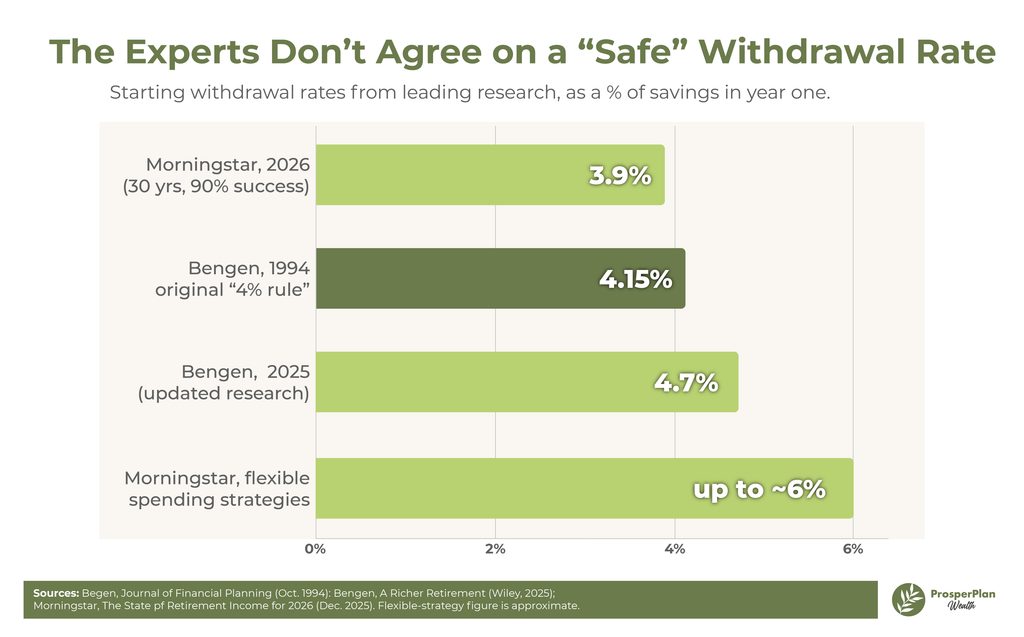
Thirty-plus years since its invention, the research has moved in two directions at once. In his 2025 book, A Richer Retirement, Bengen himself raised his worst-case safe rate to 4.7% after adding small-company and international stocks to his model. Meanwhile, Morningstar’s State of Retirement Income for 2026 puts a safe starting rate closer to 3.9% for a 30-year retirement with a 90% chance of success.
That’s a meaningful gap.
On a $1.5 million portfolio, it’s the difference between about $58,500 and $70,500 a year. To clarify, when the experts land that far apart, it’s a sign that the “right” withdrawal rate depends on assumptions only your own plan can answer.
2. Your retirement may last longer than 30 years
The rule was evaluated over exactly 30 years. If you retire at 62 and you’re healthy, that only takes you to 92. According to the American Academy of Actuaries and the Society of Actuaries, a 65-year-old couple has an 84% chance that at least one of them will live to 85, and a 14% chance one will reach 100.
Longer lives are a gift, and they deserve a plan that can keep up.
3. The order of your returns matters as much as the average
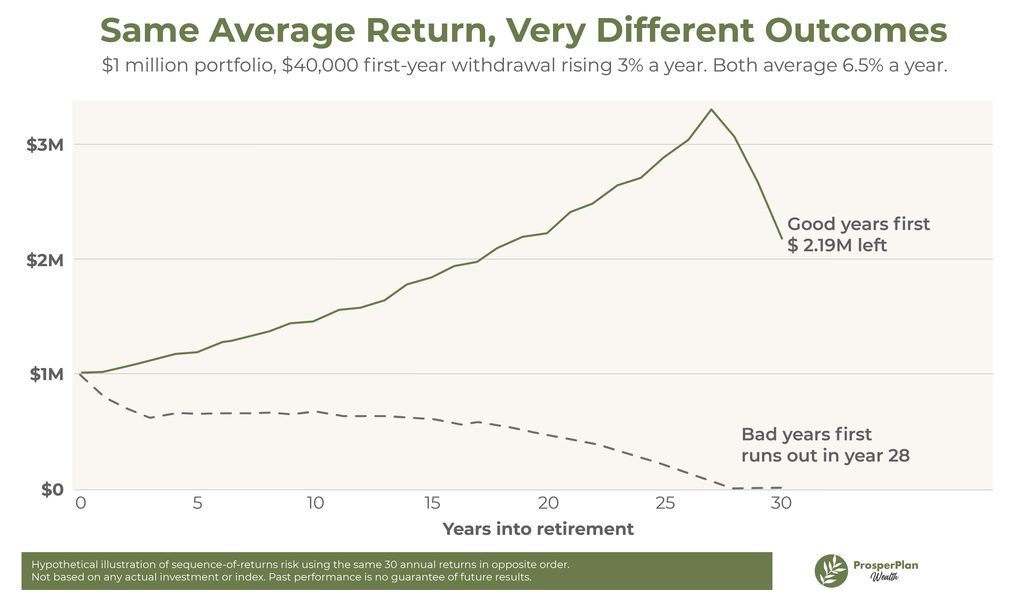
This is called “sequence-of-returns risk,” and it’s a big part of the reason that the 4% rule exists at all. Specifically, a major market decline in your first few years of retirement, at the same time that you’re also withdrawing money, can do far more lasting damage than the same decline ten years in.
Does that make sense? Two people with identical average returns can end up in very different places for no better reason than timing.
“None of us can control what the market does in the first five years of your retirement. What we can control is how prepared you are for it: enough cash set aside so you’re never forced to sell low, and a clear plan for when to tighten your belt and when to loosen it.”
Chris Grellas, CFP®, MSFA, Co-Founder & Financial Advisor, ProsperPlan Wealth
4. It ignores taxes and fees
Bengen’s original research assumed withdrawals came from a tax-advantaged account, so taxes weren’t factored in. In real life, a withdrawal from a traditional IRA or 401(k) is taxable income, and that $40,000 may only feel like $33,000 or $34,000 once taxes are paid. Where your money sits (taxable, tax-deferred, or Roth) can change your sustainable spending as much as the withdrawal rate itself.
5. Real spending isn’t a straight line
The 4% rule assumes you’ll spend the same inflation-adjusted amount every single year. Most of the retirees I partner with don’t live that way. Many spend more in their active, travel-filled early years, slow down in their 70s, and then see healthcare costs rise later on. Fidelity estimates that a 65-year-old retiring in 2026 may spend an average of $185,500 on healthcare and medical expenses throughout retirement, and that’s before long-term care.
6. It treats your whole life like a portfolio
The rule only looks at your investments. It doesn’t account for Social Security, a pension, rental income, an inheritance, divorce, or the home you might downsize. Those pieces can dramatically change how much you actually need to save.
None of this means the 4% rule is wrong. It just means that it’s a rule of thumb.
So, How Much Do You Actually Need to Retire?
Here’s the approach I walk through with clients. It keeps several key parts of the 4% rule and builds the rest around your actual life.
Step 1: Start with the life you want, not your current paycheck
You’ll often hear that you need 70% to 80% of your pre-retirement income to keep the standard of living you’ve grown used to. I’d rather you picture an ordinary Tuesday in retirement. Where are you living? Who are you spending time with? How often do you want to travel, see the grandkids, or try something new? Then estimate what that life costs each year, including taxes, healthcare, and a little room for joy and the occasional splurge.
Step 2: Subtract the income you can count on
Next, add up your guaranteed or reliable income: Social Security, any pension, annuity payments, or rental income. Whatever is left over is your “gap,” the amount your savings need to cover each year. For a lot of the families I work with, this single step shrinks the savings target dramatically.
Step 3: Turn your gap into a savings target
Now the 4% rule becomes useful again. Divide your annual gap by a withdrawal rate that fits your situation. Here’s how much you’d need to cover a $50,000 annual gap at different rates:
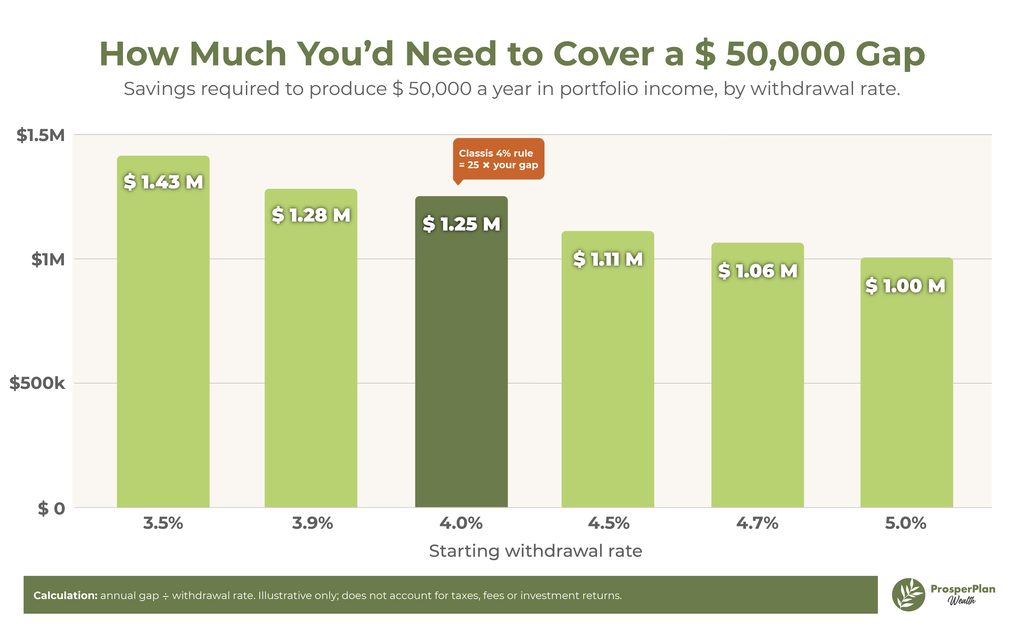
A lower rate gives you more cushion if you retire early, expect a long life (fingers crossed), or don’t want to adjust your spending. A higher rate may be reasonable if you’re retiring later, have strong guaranteed income, or are comfortable trimming spending in down years.
Step 4: Plan for the extras
Set aside separate money for the things a withdrawal rate doesn’t capture well: a new roof, a car, helping a child with a down payment, or future long-term care. Keeping these outside your “paycheck” portfolio helps protect your everyday income.
If you’d like to see where you stand right now, our retirement savings calculator is a lovely place to start.
A real-life example
Let’s meet a hypothetical couple I’ll call Maria and David, ages 63 and 62, living in the Sacramento area. They’d like to spend about $110,000 a year in retirement.
- Their combined Social Security at full retirement age is about $52,000 a year, and Maria has an $18,000 pension. That’s $70,000 of reliable income.
- That leaves a $40,000 gap. Because their withdrawals will come mostly from traditional IRAs, we estimate taxes and plan to withdraw about $47,000 a year to net $40,000.
- Using the classic 4 percent rule, they’d need about $1,175,000. At a more conservative 3.5%, they’d want about $1.34 million. Using Bengen’s updated 4.7%, the target is about $1 million.
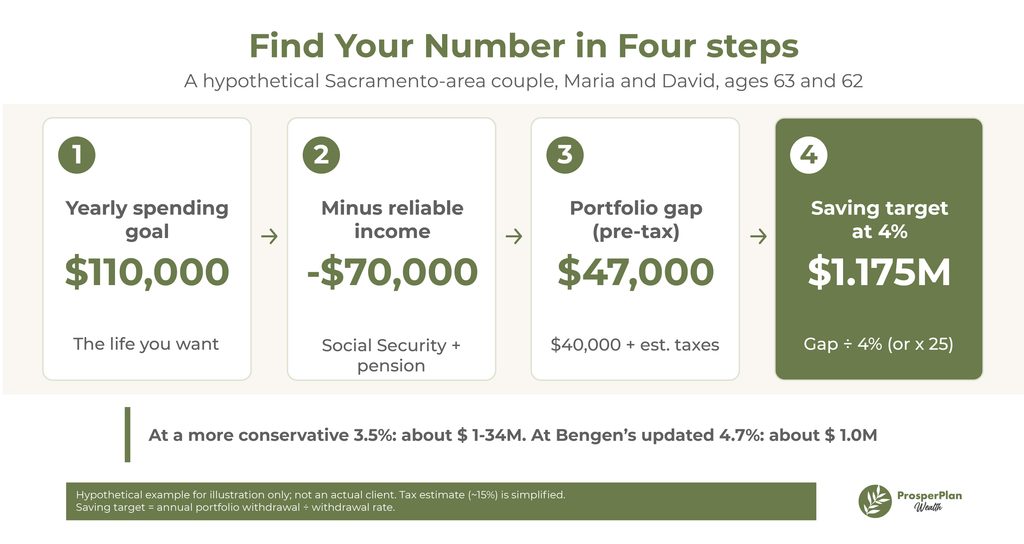
That’s a range, not a single number, and that’s very much okay. The right point in that range depends on things only Maria and David can tell us: how flexible they’re willing to be, how they feel about risk, and what matters most to them.
(This is not financial advice. This example is hypothetical and for illustration only. It does not represent an actual client or guarantee any outcome.)
Smarter Withdrawal Strategies Beyond the 4% Rule
For me, the rule’s biggest limitation is that it asks you to put your spending on autopilot. Real life calls for something a little more thoughtful. Here are some effective approaches we use to help clients spend more confidently.
Guardrails: a little flexibility goes a long way
With a guardrails approach, you start with a set withdrawal rate and agree in advance on when you’ll adjust. If markets do well and your withdrawal rate falls below a lower guardrail, you give yourself a raise. If markets struggle and it rises above an upper guardrail, you modestly trim spending for a while. Morningstar’s research suggests that retirees willing to let their spending flex can often start closer to 6% rather than 4%.
The bucket strategy: peace of mind for down markets
Many of my clients love this one because it feels intuitive. You divide your savings into buckets: one to two years of spending in cash, the next several years in steadier bonds, and the long-term money in stocks. When markets recede, you live on your cash bucket and give your stocks time to recover, which helps protect you from sequence-of-returns risk.
Tax-smart withdrawal order
The order in which you draw from taxable, tax-deferred, and Roth accounts can make a huge difference over a 30-year retirement. Strategically filling lower tax brackets, timing Roth conversions in the years before Social Security and required minimum distributions begin, and managing income to avoid higher Medicare premiums can all help your money last longer.
“The withdrawal rate gets all the attention, but taxes quietly decide how much of that money you actually get to spend. Some of the best opportunities show up in the years between your last paycheck and your first required distribution. That lower-income window is often the ideal time for Roth conversions, and the benefits can last for decades.”
Chris Grellas, CFP®, MSFA, Co-Founder & Financial Advisor, ProsperPlan Wealth
Smart Social Security timing
For some people, delaying Social Security is one way to buy inflation-protected lifetime income. Every year you wait past full retirement age, up to age 70, increases your benefit. Sometimes it makes sense to draw a bit more from savings early on so you can claim a larger, guaranteed check later.
A floor of guaranteed income
If the idea of market swings keeps you up at night, it can help to cover your essential expenses (housing, food, healthcare, utilities) with guaranteed income from Social Security, pensions, or an annuity. Then your investments can fund the wants, and a market dip feels a lot less personal.
How Long Your Retirement Savings Can Last
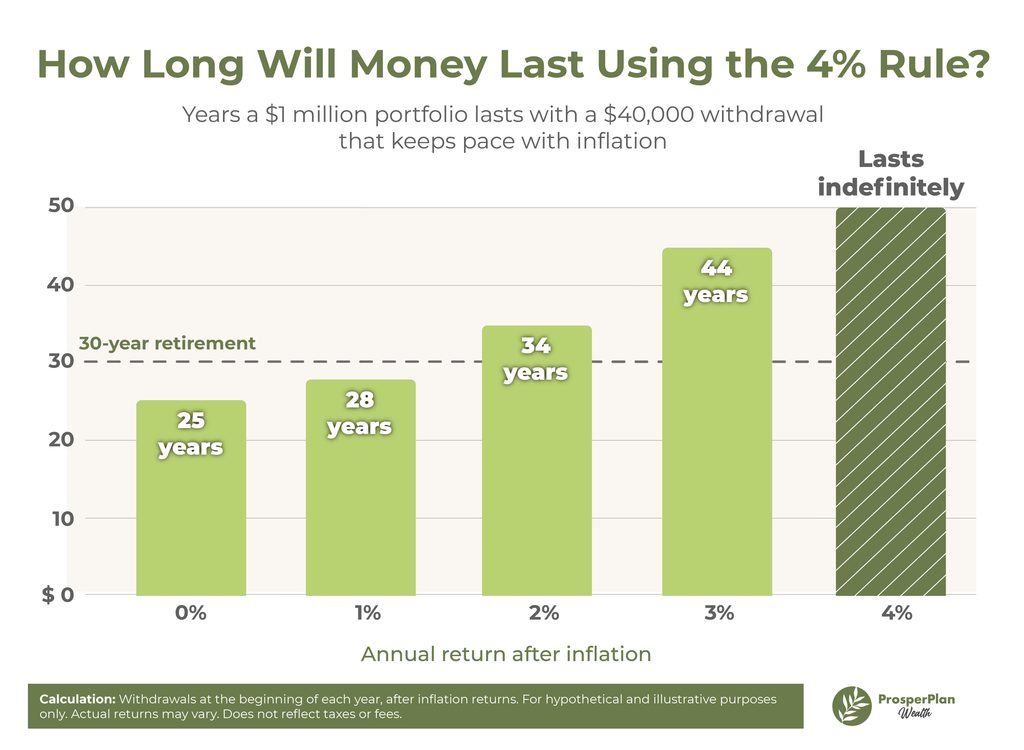
Using the 4% rule, your money is estimated to last at least 30 years, and in most historical periods it actually lasted longer. In Bengen’s research, even a retiree who started at the worst possible time in the late 1960s made it through 30 years. In many other periods, retirees following the 4% rule finished 30 years with substantial savings left over.
To put it simply: if your investments earned nothing at all, 4% a year would last 25 years. Investment growth is what stretches it to 30 years and beyond. That’s why your investment mix, fees, and the timing of market returns all matter so much.
If you’re retiring in your 50s, or you simply want more certainty for a 35- or 40-year retirement, some advisors suggest starting a bit lower, say, closer to 3.5%, or pairing the 4% rule with the flexible strategies above.
Frequently Asked Questions About the 4% Rule
What is the 4% rule in retirement?
The 4% rule in retirement is a guideline that says you can withdraw 4% of your savings in your first year of retirement, then increase that amount with inflation each year. According to the rule, if you do this, your money should last about 30 years. It comes from William Bengen’s 1994 research using U.S. market history. Working backward, it suggests saving about 25X the annual income you’ll need from your portfolio.
How long will money last using the 4% rule?
Using the 4% rule, savings have historically lasted 30 years, even for people who retired just before the difficult markets of the late 1960s and 1970s. In some periods, they lasted far longer. If you expect a retirement longer than 30 years, a slightly lower starting rate or a flexible spending plan can add a margin of safety.
Is the 4% rule still valid today?
It’s still a reasonable starting point, but current research points in different directions. Morningstar puts a safe starting rate around 3.9% for 2026, while Bengen’s updated work supports 4.7%. Your best rate depends on your age, your other income, your investment mix, and how flexible your spending can be.
Does the 4% rule include Social Security?
No. It applies only to your investment portfolio. Social Security, pensions, and other income are separate, which is why it’s important to subtract them from your spending needs before calculating how much you need to save.
Is the 4% rule before or after taxes?
The 4% rule is a pre-tax figure. If your withdrawals come from a traditional IRA or 401(k), you’ll owe income tax on them, so your take-home amount will be lower. Roth accounts and some taxable accounts can stretch your after-tax income further.
Should I use the 4% rule if I retire early?
If you’re retiring in your 50s (or before), your money may need to last 40 years or more. Many planners suggest starting closer to 3% to 3.5% for longer retirements, or building in flexibility to adjust spending during market downturns.
Your Number Deserves More Than a Rule of Thumb
Here’s what I hope you’ll take with you: the 4% rule is a useful North Star, but it was never meant to be your map. The amount you actually need to retire depends on the life you want, the income you can count on, the taxes you’ll pay, and how you’d like to feel when the markets get bumpy.
That’s exactly the kind of conversation we love having. At ProsperPlan Wealth, our retirement planning services start with you: your goals, your worries, and the details that make your situation one of a kind. From there, we build a withdrawal plan that fits, and we stay right beside you to adjust it as life unfolds. If you’d like help with the bigger picture, too, our financial planning services bring your investments, taxes, Social Security, and estate plans together in one place.
You’ve worked so hard to get here. We want to make sure you can enjoy it with confidence.
Schedule your complimentary consultation and let’s find your number together.
Warmly, Lauren Williams
This material is for informational and educational purposes only and should not be considered investment, tax, or legal advice. Hypothetical examples are for illustration only. Investing involves risk, including possible loss of principal, and past performance is no guarantee of future results.
Sources
- Advisor Perspectives, Bill Bengen Boosts the “4% Rule” to 4.7% (Aug. 2025)
- Wikipedia, William Bengen (1994 Journal of Financial Planning study, SAFEMAX)
- Wikipedia, Trinity study (Cooley, Hubbard & Walz, 1998)
- Morningstar, The State of Retirement Income for 2026
- Morningstar, What’s a Safe Retirement Withdrawal Rate for 2026?
- NRMLA, Fidelity Says 2026 Retirees May Spend $185,500 on Healthcare
- American Academy of Actuaries, Longevity