



If you’ve ever opened a Medicare envelope, read a paragraph, and set it back on the counter, you’re in good company.
Medicare at a Glance
- Two main paths: Original Medicare (Parts A and B), often with Medigap and a Part D drug plan, or Medicare Advantage (Part C).
- Key 2027 costs: the Part B premium is projected to rise to about $209.50 a month, up from $202.90 in 2026, with a deductible of about $292. Medicare confirms the final figures in mid-November.
- Key dates: your seven-month Initial Enrollment Period around 65, and Open Enrollment each year from October 15 through December 7.
I work with surgeons, engineers, and retired CFOs, people who run complicated things for a living, and many of them admit Medicare makes their head spin. It isn’t you. Medicare is a 60-year-old program that has been added onto, patched, and renamed so many times that even the alphabet stopped making sense.
So, how does Medicare work? Let’s slow down and walk through it together: what each part does, roughly what it costs, and the handful of dates that matter most.
Think of this as Medicare 101, over a cup of coffee.
How Does Medicare Work? The Big Picture First
Medicare is federal health insurance for people 65 and older (plus some younger people with certain disabilities). You earn it by paying Medicare taxes while you work, and in return you get a foundation of coverage for the rest of your life.
Here’s the part no one tells you up front: Medicare isn’t one plan. It’s a set of building blocks, and the blocks you choose decide what you pay and how much freedom you have.
There are really just two main paths:
- Original Medicare (Parts A and B): Often paired with a Medigap (private) supplement and a Part D drug plan.
- Medicare Advantage (Part C): An all-in-one private plan that replaces Original Medicare’s structure.
Hold onto that picture. Everything else is detail.
What Are the Different Parts of Medicare?
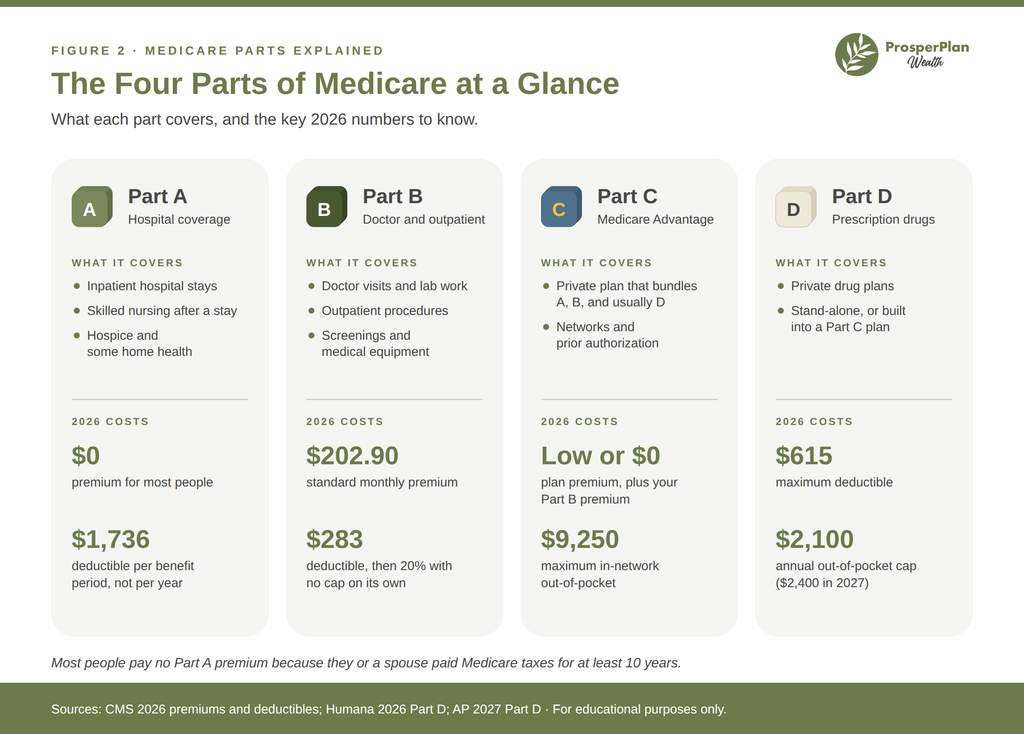
How does Medicare work, piece by piece? It’s built from four parts, each covering something different. Let’s take them one at a time. Once you see Parts A, B, C, and D side by side, they stop feeling like alphabet soup.
Part A: Your hospital coverage
Part A covers you when you’re admitted to the hospital, plus short-term skilled nursing care after a hospital stay, hospice, and some home health care.
Most of you won’t pay a premium for Part A, because you (or your spouse) paid Medicare taxes for at least 10 years. You will have a deductible: $1,736 per benefit period in 2026. That’s per hospital episode, not per year, which surprises a lot of people.
Part B: Your doctor and outpatient coverage
Part B is the everyday coverage: doctor visits, outpatient procedures, lab work, preventive screenings, and medical equipment like walkers or CPAP machines.
In 2026, the standard Part B premium is $202.90 a month and the annual deductible is $283. After that, you generally pay 20% of approved costs. Here’s the catch I always want clients to know: in Original Medicare, that 20% has no ceiling. That’s exactly why so many people add a supplement.
Part C: Medicare Advantage
Part C isn’t extra coverage on top of A and B. It’s a different way to receive them. Private insurers approved by Medicare bundle your hospital, medical, and usually drug coverage into one plan.
Advantage plans often have low or $0 plan premiums (you still pay your Part B premium), and in-network out-of-pocket costs are capped at no more than $9,250 in 2026. The trade-off: most use provider networks and require prior authorization for some care. If you love your doctors, or you split your year between two states, that matters.
Part D: Your prescription drug coverage
Part D covers prescriptions through private plans. For 2026, the deductible can’t exceed $615, and your out-of-pocket drug spending is capped at $2,100 for the year. That cap is genuinely good news: before 2025, people on expensive medications could spend thousands more. For 2027, the cap rises to $2,400 and the maximum deductible to $700.
“The families who feel calm about Medicare aren’t the ones who memorized every rule. They’re the ones who made their decisions early, on purpose, as part of their bigger plan.”
— Chris Grellas, CFP®, MSFA, Co-Founder and Financial Advisor, ProsperPlan Wealth
Medicare Parts Explained: Choosing Your Path
This is the decision that shapes the rest of your Medicare life, so it deserves some room.
Original Medicare + Medigap + Part D gives you the most freedom. You can see any provider in the country who accepts Medicare, with no referrals.
What’s Medigap? Think of it as the friend who picks up the rest of the check. It’s private insurance that works alongside Original Medicare and covers most of what Medicare leaves behind, like the 20% coinsurance and many deductibles, so your bills are easier to predict. Medigap plans are labeled by letters too, with Plan G and Plan N the two most popular. Your premium depends on your age, ZIP code, and insurer, and Medigap only works with Original Medicare, never with Medicare Advantage.
Medicare Advantage usually costs less each month and often includes extras like dental or vision. In exchange, you’ll work within a network, and your costs show up as copays when you use care, up to the plan’s annual limit.
Neither path is right for everyone. It depends on your health, your doctors, how much you travel, and how you feel about trading premium dollars for flexibility. One honest caution: for your first six months on Part B after age 65, no Medigap insurer can turn you down. After that, insurers can usually ask about your health and say no. So, choose at 65 as if you’ll keep it.
Medicare in California: A Few Things Worth Knowing
If you live in California, you have an extra advantage. The state’s Medigap “birthday rule” gives you 60 days, starting on your birthday each year, to switch to a Medigap plan with equal or lesser benefits without medical underwriting. That’s a real chance to shop for a lower premium.
How Much Does Medicare Cost?
For most people, the core 2026 cost is the $202.90 Part B premium, plus whatever you choose for Medigap, Part D, or an Advantage plan. If you’re married, plan for two sets of premiums. That’s something we help clients budget for all the time.
Then there’s IRMAA, which catches many successful retirees off guard. If your income from two years ago was above $109,000 (single) or $218,000 (married filing jointly), you’ll pay a surcharge on Parts B and D. A Roth conversion, a home sale, or a big final-year bonus can trigger it. A little planning goes a long way here, and it’s one reason Medicare belongs inside your full retirement plan.
When to Sign Up for Medicare
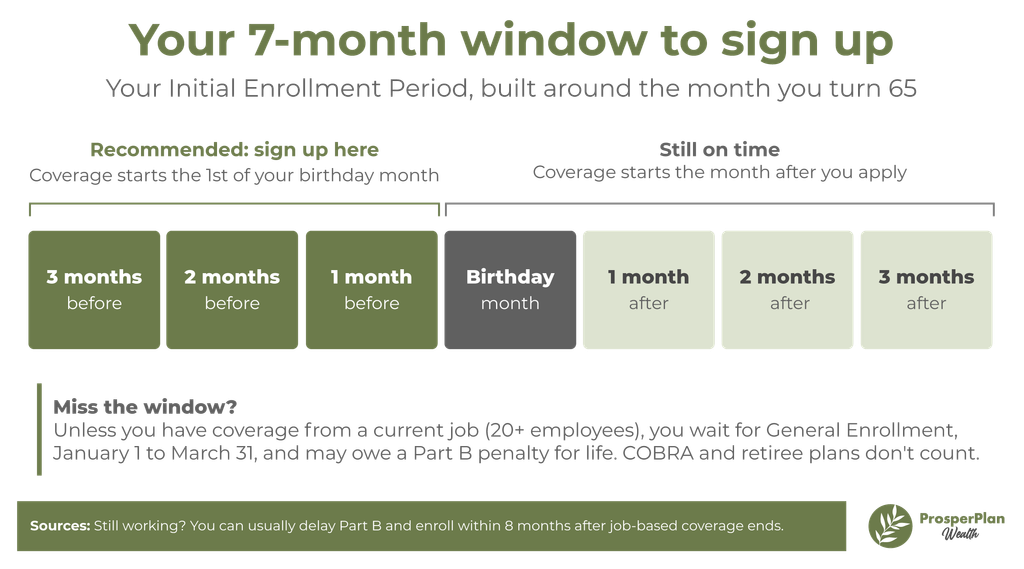
Your Initial Enrollment Period is seven months long: the three months before the month you turn 65, your birthday month, and the three months after. Sign up early in that window and your coverage starts on time.
Still working at a company with 20 or more employees? You can usually delay Part B without penalty and enroll within eight months after that coverage ends. COBRA and retiree coverage don’t let you wait, and many retiree plans, like those from Kaiser Permanente, PG&E, or the UC system, require Part B. Please confirm with your plan before you skip anything.
Retiring before 65 adds another layer. If that’s you, you’ll want to plan for coverage until Medicare starts well before your last day at work.
Once you’re on Medicare, mark your calendar for Open Enrollment, October 15 through December 7 each year. Drug plans and Advantage plans change their costs and coverage annually, so it’s worth a fresh look.

How Does Medicare Work? Frequently Asked Questions
What does Medicare Part A cover?
Inpatient hospital stays, short-term skilled nursing care after a qualifying hospital stay, hospice, and some home health care. Most people pay no premium, and the 2026 deductible is $1,736 per benefit period.
What does Medicare Part B cover?
Doctor visits, outpatient care, lab tests, preventive screenings, and durable medical equipment. In 2026, the standard premium is $202.90 a month and the deductible is $283. For 2027, the premium is projected to rise to about $209.50 a month, with a deductible of about $292. After that, you typically pay 20% of approved costs.
What is IRMAA?
IRMAA (the Income-Related Monthly Adjustment Amount) is a surcharge on Part B and Part D premiums for higher earners, based on your tax return from two years earlier. If your income dropped because of a life-changing event like retirement, you can ask Social Security to reconsider using Form SSA-44.
Medigap vs. Medicare Advantage: which is better?
Neither is better for everyone. Medigap with Original Medicare offers nationwide provider choice and predictable costs, with higher premiums. Medicare Advantage usually has lower premiums and an annual out-of-pocket limit, but uses networks. You can’t have both at once.
How much does Medicare cost?
Most people pay $0 for Part A and $202.90 a month for Part B in 2026, projected to rise to about $209.50 in 2027, plus premiums for any Medigap, Part D, or Advantage plan. Higher incomes add IRMAA surcharges, and deductibles and coinsurance apply when you use care.
When should I sign up for Medicare?
During your seven-month Initial Enrollment Period around your 65th birthday. We usually suggest the first three months, so coverage starts on the first day of your birthday month. If you’re covered by a current employer’s plan (20+ employees), you may delay Part B and enroll within eight months after that coverage ends.
Does Medicare cover long-term care?
Mostly, no. Medicare doesn’t pay for custodial care, like help with bathing or dressing, at home or in a nursing home. It covers up to 100 days of skilled nursing after a qualifying hospital stay, with a $217 daily coinsurance for days 21 to 100 in 2026.
What is the Medicare late enrollment penalty?
If you miss your enrollment window without other qualifying coverage, Part B adds 10% to your premium for each full 12 months you waited, and Part D adds 1% of the national base premium for each month without creditable drug coverage. Both penalties generally last for life.
You Don’t Have to Figure This Out Alone
If you’ve read this far, you already understand Medicare better than most people turning 65. How does Medicare work for you specifically? That comes down to fitting these pieces into your life: your income, your health, your doctors, your timeline.
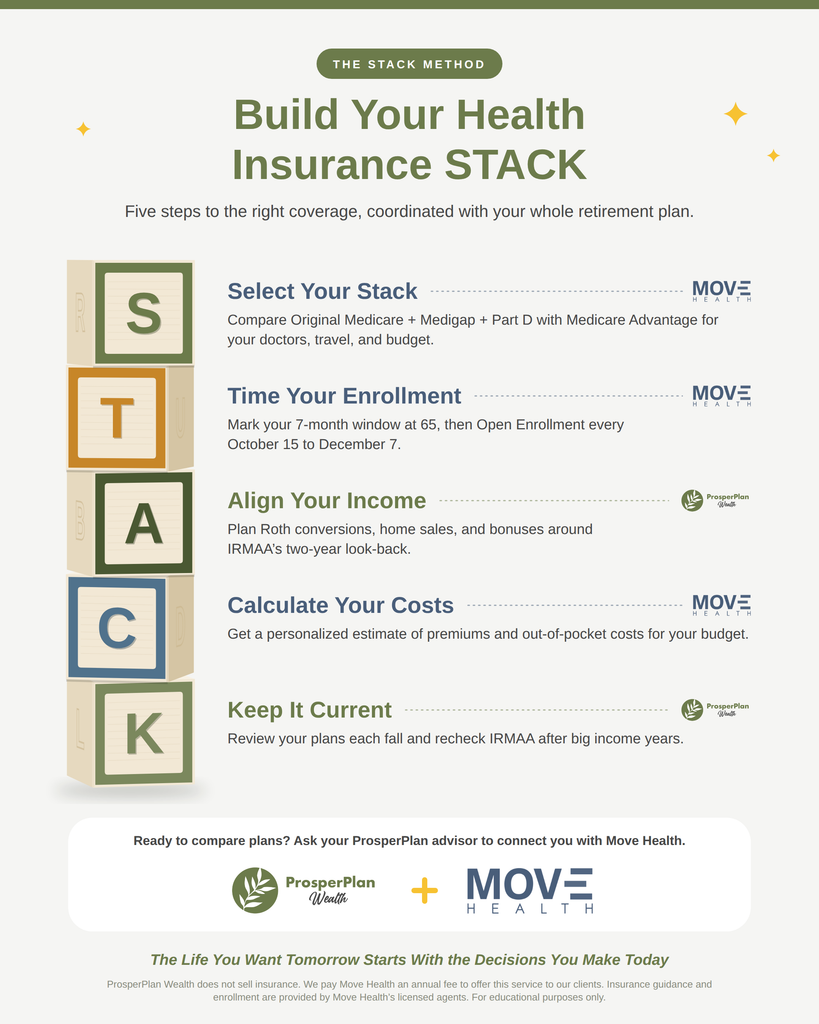
That’s the part we love. As a 100% fiduciary, fee-only firm, we don’t sell insurance or earn commissions. For the insurance side, we’ve partnered with Move Health, an independent agency whose licensed agents help our clients compare and enroll in Medicare plans. We pay Move Health an annual fee to offer this service to our clients. Our only job is helping you make the choice that’s right for you. Whether you need help with Social Security and Medicare enrollment or want to see how Medicare fits into everything else, we’d be honored to sit down with you.
And whenever you want to go deeper on your own, our complete guide, Making Medicare Finally Make Sense, walks through every rule in detail.
Let’s talk about Medicare and your retirement plan. Contact ProsperPlan Wealth
This article is for educational purposes only and isn’t individual tax, legal, or insurance advice. Medicare figures shown are for 2026 unless noted and change each year. This material was prepared with the assistance of AI. All content has been reviewed, edited, and approved by ProsperPlan Wealth prior to use. Investors should understand that working with an advisor that is a fiduciary does not guarantee that they will experience greater investment performance or reduced losses as compared to working with an advisor that is not acting as a fiduciary. This information is not intended to be a substitute for specific individualized tax, legal or investment planning advice as individual situations will vary. This information is not intended to be a substitute for specific individualized guidance on Medicare plans or supplemental Medicare options; please consult a licensed Medicare insurance agent for plan-specific guidance.
CFP Board owns the certification marks CFP®, CERTIFIED FINANCIAL PLANNER™, and CFP® (with plaque design) in the U.S. Move Health does not pay ProsperPlan any compensation or referral fee.
Sources
- CMS: 2026 Medicare Parts A & B Premiums and Deductibles
- LeadingAge: 2026 Part A and B cost summary
- ValuePenguin: 2026 IRMAA brackets
- Humana: 2026 Part D changes
- AP via ABC7: 2027 Part D cap and deductible
- Healthinsurance.org: Medicare in California
- WTOP: Medigap birthday rule by state
- AARP: Part B costs and late enrollment penalty