



I’ve spent some of the most satisfying days of my career working with entrepreneurs, and if there’s one surprising thing that I’ve learned, it’s this: the same instinct and determination that built your business can quietly work against you when it comes to planning your financial future.
Like most successful business owners, you’ve probably spent decades reinvesting in your company, betting on growth, pushing forward, and figuring things out as you go. And that’s exactly why so many business owners reach their 50s and 60s with a comparably thin personal financial plan: You’ve taken care of everything and everyone except your future.
If that sounds familiar, just know that you’re not behind. In fact, few professionals have more options than business owners for making up ground on retirement planning because there’s so many things you can do to prepare yourself for the future you want.
Though, to be sure, because 2026 is a pivotal year for tax policy, exit planning, and wealth transfer rules, that means now is the time to get busy creating a plan.
Let this article serve as both your introduction and your roadmap to what smart financial planning for business owners actually looks like – and why the philosophy of the advisory firm you choose matters more than ever.
Why Your 50s and 60s Are a Financial Planning Inflection Point
There’s a particular moment many business owners hit somewhere in their 50s. The business is humming, the kids are launched (or close to it), and suddenly you find yourself asking a question you’ve been too busy to ask for thirty years: “Where does all of this actually lead?”
This isn’t just about slowing down or retirement, it’s about converting decades of hard work into lasting, transferable wealth. The decisions you make now about your business, your investments, and your legacy will largely determine what your 70s and 80s look like. That’s why financial planning for business owners in this stage needs to look fundamentally different than it did in your 30s and 40s.
“Business owners are excellent at solving today’s problems. The challenge is that retirement and succession aren’t today’s problems … until suddenly they are. Our job is to make sure you’re not surprised.”
~ Chris Grellas, CFP®, MSFA, Co-founder, ProsperPlan Wealth
I say this several times a month: You have more leverage right now than you may realize. That’s because you still have earning years ahead of you, valuable equity in your business, and time to make strategic moves before any major transition. The key is having a financial planner for business owners who understands that your balance sheet and your business are deeply intertwined.
The Concentration Risk Nobody Talks Enough About
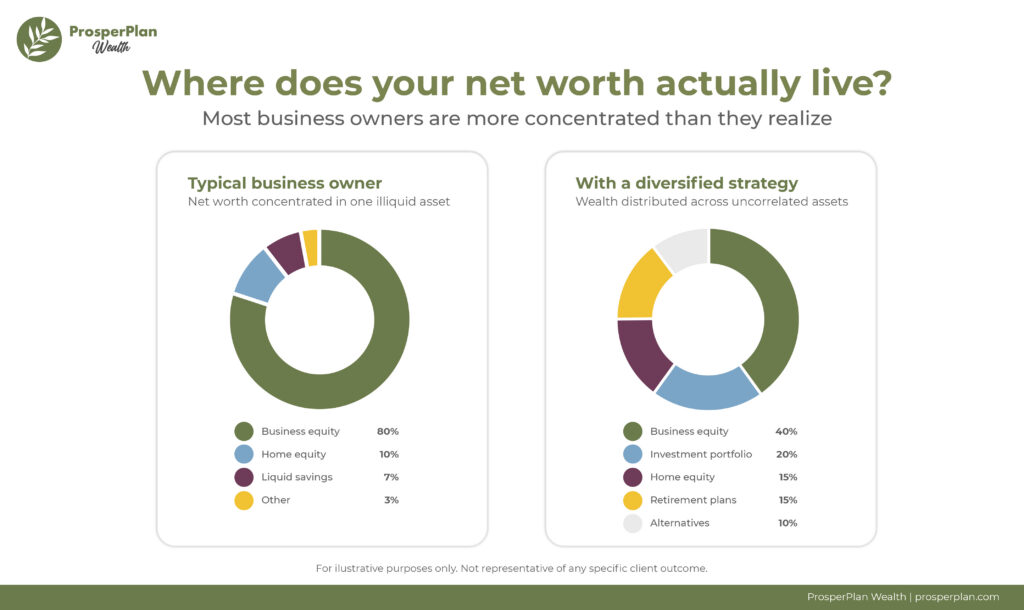
Here’s something that I share with almost every business owner I sit down with: your company is probably your single largest asset, and that’s a problem today, but an opportunity to quickly make up ground that few other people have.
I’m not saying that to scare you – I mention this because it’s fixable, and most entrepreneurs have never had anyone walk with them to discuss what it actually means nor how it’s all done. When the majority of your net worth lives inside one illiquid, undiversified asset that depends entirely on your continued involvement, you’re carrying a level of risk that most of your peers in corporate America simply don’t have. A market downturn, a key employee leaving, a shift in your industry: any of these can simultaneously hit your retirement plan and your paycheck.
Thoughtful wealth planning for business owners means systematically building assets outside the business, even while the business is still your primary focus. That might look like:
- Maximizing retirement plan contributions through vehicles built for owners, like a Solo 401(k), Cash Balance Plan, or Defined Benefit Plan
- Building a diversified investment portfolio that isn’t correlated to your industry
- Considering strategic real estate or other alternative assets
- Creating liquidity events through partial sales, recapitalizations, or bringing on minority investors
None of this requires stepping away from your business. It requires a plan that treats your personal wealth as its own priority, and not as an afterthought to whatever’s left over at year-end.
Tax Strategy: Where Smart Business Owners Win Quietly
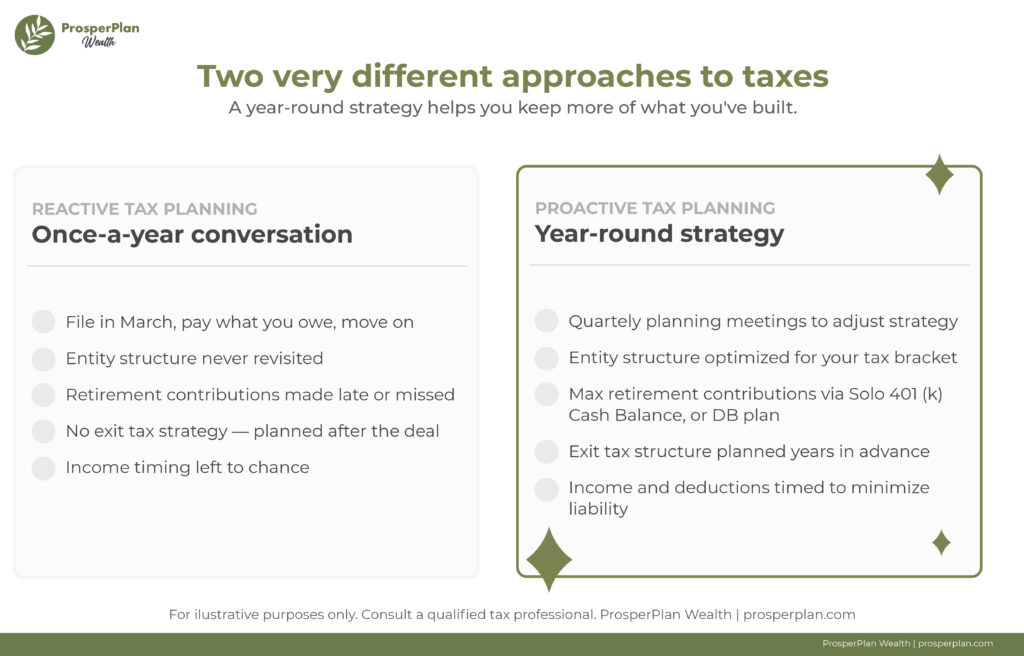
If very little else of anything I say here sparks recognition, then please remember this: taxes are the part of planning where I see the most money get wasted or left on the table. (And it’s never because owners aren’t smart.) It’s because they’re so busy running the business taxes are viewed as an awful (and sometimes scary) part of your calendar, so proactive tax planning falls to later over and over and over again.
For financial planning for small business owners, tax efficiency isn’t a once-a-year conversation with your CPA in March. It’s a year-round strategy that touches your entity structure, your retirement contributions, your timing of income and deductions, and eventually, how you exit. As we head into 2026, several provisions are shifting, and owners who plan ahead of these changes – rather than reacting to them – tend to keep significantly more of what they’ve built.
“I tell clients all the time: a great tax preparer files your return correctly. A great financial plan makes sure there’s less to report and more to put away. Tax preparer? Taxplanner? Those are two very different jobs, and most business owners only have one of them covered.”
– Chris Grellas, CFP®, MSFA
This is where working with financial advisors for small business owners who specialize in this exact stage of life pays for itself many times over. We’re not generalists dabbling in business tax strategy, as business owners ourselves, who advise fellow entrepreneurs, we live in this world every day.
Succession and Exit Planning: Your Business Won’t Sell Itself
Let’s talk about the conversation most owners avoid the longest: what happens to the business when you’re ready to step back.
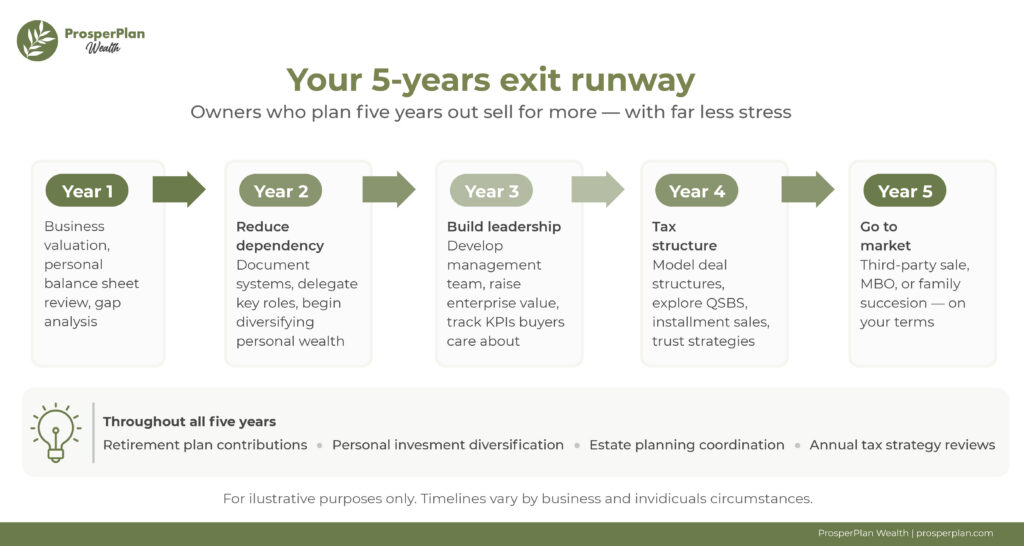
I say this with love, but I’ve watched too many incredible business owners wait until they’re emotionally out the door before they start planning the exit – and by then, they’ve lost years of value they could have built into the sale. A business that’s been groomed for transition for five years sells for meaningfully more, with far less stress, than one that gets thrown on the market because the owner is suddenly ready to be done.
Good financial advice for business owners in this stage starts with a simple but pointed question: is your business actually sellable without you? If the answer makes you wince a little, that’s not only useful information, it’s exactly what an exit plan is for.
A strong exit strategy typically addresses:
- Whether you’re pursuing a third-party sale, a management buyout, or a family succession
- How to reduce owner dependency and build a leadership team that increases enterprise value
- The tax structure of a future sale, including opportunities like an installment sale or a Qualified Small Business Stock (QSBS) exclusion if applicable
- How sale proceeds will be invested and distributed to support your retirement income for decades, not just years
This is precisely why we built our practice around financial planning for business owners as a specialty, not an afterthought. The strategies that make sense for a corporate executive retiring with a 401(k) and a pension look nothing like the strategies that make sense for someone whose retirement is tied up in equity they built from scratch.
Estate Planning: Protecting What You’ve Built Across Generations
If tax planning is where money quietly gets left on the table, estate planning is where entire legacies get left to chance. And for business owners, the stakes are even higher, because your estate isn’t just personal wealth, it’s often a living, breathing company with employees, customers, and your name on the door.
Thoughtful estate planning for business owners goes well beyond a basic will. It should address how your business interest will be valued and transferred, how to minimize estate tax exposure, and how to make sure your wishes – and not probate court – determine what happens next. For owners with family members in the business, it also means having honest conversations now about who wants to lead, who doesn’t, and how to be fair without necessarily being equal.
“The hardest estate planning conversations aren’t about the documents – they’re about the family dynamics underneath them. We help clients have those conversations early, while there’s still time to plan thoughtfully instead of reacting emotionally.”
– Chris Grellas, CFP®, MSFA
We coordinate closely with your estate attorney to make sure that tools like buy-sell agreements, trusts, and life insurance funding strategies all work together, and not as separate documents drafted in isolation.
Why Wealth Management for Small Business Owners Requires a Different Playbook
I sometimes joke with clients that hiring a generalist financial advisor to manage your wealth as a business owner is a bit like hiring a general contractor to perform open-heart surgery; they are talented but they aren’t going to be very good at what you actually need.
Effective wealth management for small business owners requires fluency in business valuation, entity tax structures, qualified retirement plans, succession dynamics, and personal investment management, simultaneously, and in coordination with your other professional advisors. It’s a genuinely different discipline than managing wealth for someone whose income arrives neatly on a W-2.
This is the gap ProsperPlan Wealth was built to close. As co-founders, Chris and I designed our practice specifically around the needs of entrepreneurs and executives, because we saw too many talented business owners receiving cookie-cutter advice for a situation that was anything but straightforward. Our award-winning approach combines deep technical expertise with the kind of relationship where you can actually pick up the phone and talk through a real decision – not just review a quarterly statement.
If you’d like to see what a coordinated plan looks like for your specific situation, our financial planning services are built to bring all of these pieces – tax, investments, succession, and estate planning – into one unified and clear strategy.
Frequently Asked Questions
How do you do financial planning for a business?
Financial planning for business owners typically starts with a comprehensive look at where you stand today: your business structure, personal balance sheet, retirement savings, tax exposure, and long-term goals for both the company and your life outside of it. From there, an advisor builds a coordinated strategy across investments, retirement plan design, tax planning, succession planning, and estate planning — working alongside your CPA and attorney so every piece fits together rather than existing in isolation.
What is the importance of financial planning for a business?
Financial planning matters because it turns the value you’re building in your business into real, protected, transferable wealth. Without a plan, even highly profitable business owners can end up with too much risk concentrated in one asset, missed tax savings, an unsellable business, or an estate that doesn’t reflect their actual wishes. Proactive planning gives you control over outcomes that would otherwise be left to chance — or to whoever happens to be making decisions when a crisis hits.
How do you use financial planning for business growth?
Smart financial planning supports growth by making sure the business has access to the capital, tax efficiency, and retirement structures it needs to reinvest and scale, while simultaneously protecting the owner’s personal financial future outside the business. This might include strategic retirement plan design that benefits both the owner and employees, tax strategies that free up cash flow for reinvestment, and a clear-eyed view of how much risk the owner can responsibly keep concentrated in the company as it grows.
A Smarter Strategy Starts With a Conversation
You’ve built something real. The next chapter is about making sure that hard work translates into the freedom, security, and legacy you actually want — not just whatever happens to shake out. You don’t have to figure this out alone, and frankly, you shouldn’t have to.
Chris and I would genuinely love to sit down and talk through where you are and where you’re headed. Whether you’re five years from an exit or simply ready to stop guessing, our team specializes in financial planning for business owners just like you — and we’d be honored to help you build the plan that matches everything you’ve already built in business.
Reach out to ProsperPlan Wealth today, and let’s start the conversation.