



The biggest threat to most people’s portfolios isn’t a bad stock pick or a poorly timed fund. It’s market psychology. It’s the fear that creeps in when the headlines turn red, and the inevitable anxiety that follows when it feels like everyone around you knows something you don’t.
I’ve watched smart, disciplined people abandon great financial plans because their emotions got the best of them.
It can happen to almost anyone. That’s part of being human.
The ability to remain calm in a storm is one of the struggles at the heart of investing, and it’s why I wanted to write about it directly. Understanding market psychology isn’t just an academic exercise – it’s one of the most practical things you can do to protect and grow your wealth, and to feel more confident about the decisions you make along the way.
What Is Market Psychology?
At its core, market psychology refers to the collective emotions, beliefs, and behaviors of investors that drive buying and selling decisions across the market. It’s the invisible hand behind a lot of what we see in the headlines – rallies that seem to defy logic, sell-offs that feel disproportionate to the actual news, and the hype that drives prices further up or down than fundamentals alone would justify.
Markets are made of people, and people are emotional. We like to think of investing as a purely rational exercise – spreadsheets, ratios, discounted cash flows – but the actual engine behind a lot of that math is human behavior. Fear, hope, excitement, panic, regret. These emotions ripple through millions of individual decisions and, in aggregate, they move markets.
I bring this up with clients constantly, because once you understand that markets are driven as much by psychology as by fundamentals, you can begin making very different – and often more thoughtful – decisions with your own money.
The Psychology of a Market Cycle
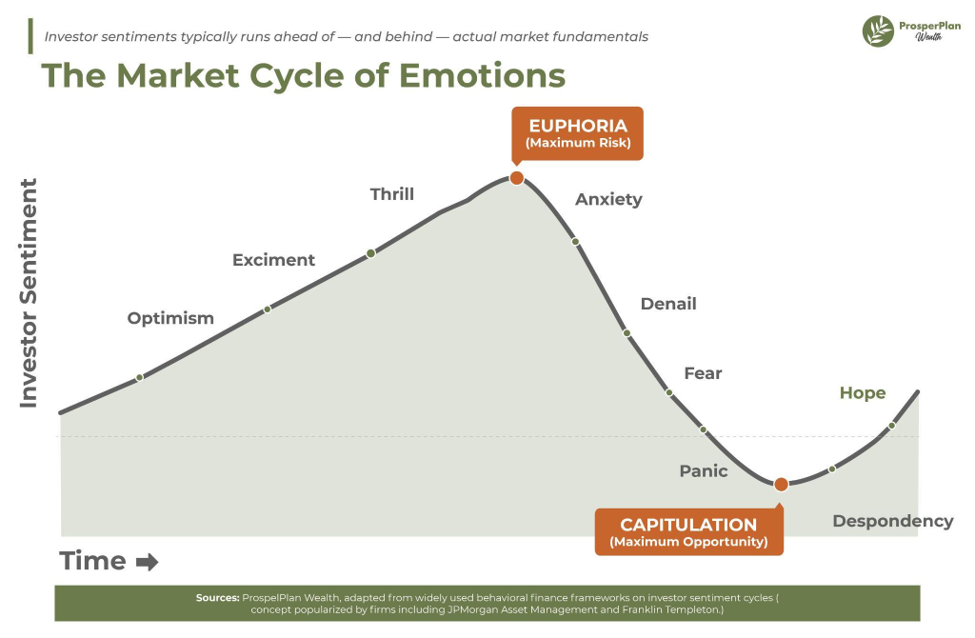
Every market cycle, whether it plays out for months or years, tends to follow a similar emotional arc. I’ve watched this pattern repeat itself through multiple cycles in my career, and it rarely changes its shape – just its speed.
It usually starts with optimism. The market has been climbing, confidence builds, and investors start feeling good about their decisions. That optimism can shift into excitement and then euphoria – the phase where caution disappears, people chase returns, and casual conversations among friends start to turn into stock tips. Even though this can feel like a moment of great opportunity, it’s just as likely to be marked by maximum financial risk.
Then, as these things do, and have for a hundred years, the cycle turns. A market correction begins, and euphoria gives way to anxiety, then denial (“this is just a blip”), then fear, and eventually panic and capitulation: the point where investors sell not because it’s a good decision, but because they simply can’t tolerate the pain anymore.
That reaction is understandable. Watching the value of something you’ve spent years building decline can be deeply uncomfortable. Ironically, however, throwing in the towel tends to happen near the bottom of the cycle, which means the people who most need to stay invested are often the ones who feel the strongest urge to sell and head for the exit.
“The market doesn’t reward the investor with the highest IQ. It rewards the investor with the steadiest temperament,” says Lauren Williams, CFP®, MBA, CRPC®, my business partner and ProsperPlan Wealth co-founder. “I’ve seen brilliant people make devastating decisions simply because they let fear drive the bus.”
After capitulation comes depression, then slowly, hope, relief, and back to optimism as the next cycle begins. If you map investor emotion against a chart of the S&P 500 over any multi-year period, you’ll see this same pattern repeatedly, with different names attached to the news cycle. The names on the headlines change. The psychology of market cycle turns does not.
Stock Market Psychology in Everyday Decisions
You don’t need a recession or a crash to see stock market psychology at work. It shows up in small, everyday decisions too:
- Loss aversion: the tendency to feel the pain of a loss roughly twice as intensely as the pleasure of an equivalent gain. This is why investors often hold onto losing positions far too long, hoping to “get back to even,” while selling winning positions too early to lock in a good feeling.
- Herd behavior: the pull to do what everyone else is doing, whether that’s piling into a hot sector or panic-selling because “everyone else is.”
- Recency bias: assuming that whatever the market has done recently will keep happening, which fuels both euphoria at the top and despair at the bottom.
- Confirmation bias: seeking out information that supports what we already believe about a stock or the market, while ignoring evidence to the contrary.
Investors are human. And none of these are signs of a “bad investor.” They’re natural tendencies that all of us can experience. The challenge is that our brains, which evolved to keep us safe from physical threats, don’t always distinguish well between a genuine emergency and a stock market headline. A 10% portfolio drop can trigger the same fight-or-flight response as something far more dangerous – even though, historically, markets have recovered from nearly every downturn. Recognizing that response can make it easier to pause, return to your plan, and make a decision based on your long-term goals rather than the emotion of the moment.
Market Cycle Psychology and Why It Matters for Your Plan
Here’s the part I really hope you’ll take to heart: understanding market cycle psychology matters because most investment mistakes aren’t made because of a lack of information. They’re made because of a lack of emotional perspective in the moment that perspective is most needed.
And helping people avoid mistakes from which they may not be able to recover is one of the most important things we do as 100% fiduciary financial advisors.
I’ve known people who knew, intellectually, that staying the course was the right move – and still called me asking if they should sell and move to cash during a downturn. That’s not a knowledge problem, and it certainly doesn’t mean they’ve failed as investors. That’s normal psychology. It’s why having a written financial plan, and a trusted advisor to walk through it with you, matters so much more during turbulent markets than during calm ones.
“A good financial plan isn’t just a roadmap for your money — it’s a guardrail for your behavior,” Lauren often reminds our clients. “When the plan is in place before the storm hits, you’re far less likely to make a decision you’ll regret.”
This is where I think a lot of DIY investors get it backwards. They spend enormous energy trying to predict the next move in the market, when the far more valuable use of that energy may be understanding their own psychology and building a plan that accounts for it.
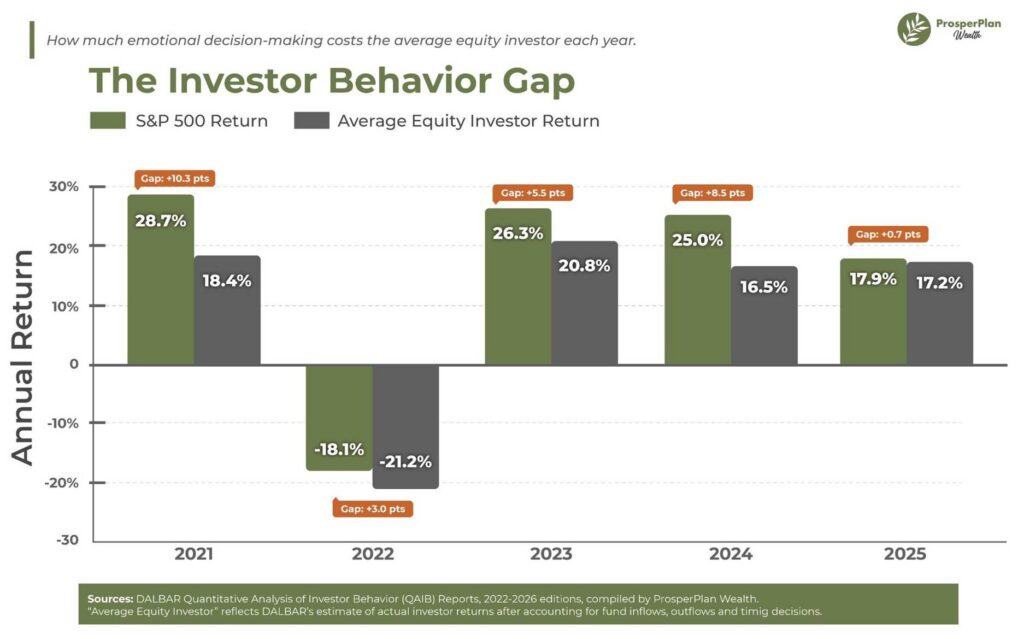
You don’t have to predict every turn in the market to be a successful long-term investor. You need a thoughtful strategy you understand, confidence in why it was built, and the discipline to give it time to work.
How We Help Clients Navigate Market Psychology Cycle Swings
As a 100% fiduciary firm here in the Sacramento region, our job at ProsperPlan Wealth isn’t just to manage investments – it’s to help you manage the relationship between you and your money, especially when emotions run high. A few of the ways we do that:
We build plans designed to withstand emotional pressure, not just market volatility.
A well-diversified portfolio aligned with your actual time horizon (when you’ll need the money) and risk tolerance (how comfortable you are with volatility) is far easier to stick with when markets get rocky. The goal is to create a strategy you can feel confident staying with, not only when markets are rising, but when they inevitably become uncomfortable.
We have the hard conversations before the cycle turns.
Part of our role is helping clients understand, in calm moments, what a 20% or 30% drop might actually feel like – so that when it happens, it’s not a surprise. It’s a scenario they have already considered and prepared for.
We act as a behavioral check.
Sometimes the most valuable thing an advisor does isn’t picking an investment – it’s being the calm, steady voice on the other end of the phone when a client is tempted to abandon a sound strategy out of fear. Sometimes simply having someone there to revisit the plan, put the headlines in perspective, and talk through the decision can make all the difference.
If you’re building or reassessing your investment strategy, our investment management services are built around this exact philosophy – helping you stay invested through the full market psychology cycle instead of reacting to it. And if you don’t yet have a comprehensive plan in place, our financial planning services are the foundation that can make weathering these cycles possible in the first place.
It’s that important.
Frequently Asked Questions
What is the meaning of market psychology?
Market psychology refers to the collective emotions and behaviors – fear, greed, optimism, panic – that drive investor decisions and, in turn, influence the direction and volatility of financial markets.
What is stock market psychology?
Stock market psychology describes how investor emotions and cognitive biases, such as loss aversion and herd behavior, affect buying and selling decisions in the stock market, often independent of a company’s underlying fundamentals.
What is the 90% rule in trading?
The “90% rule” is an informal trading adage suggesting that roughly 90% of traders lose money, often attributed to factors such as emotional decision-making, lack of a disciplined strategy, and poor risk management rather than simply a lack of market knowledge.
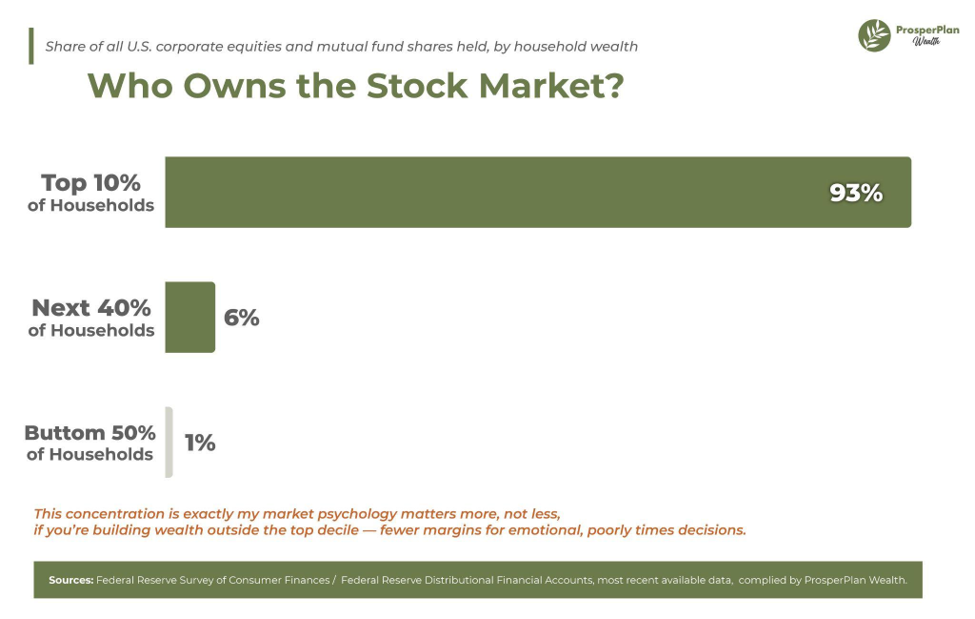
Who owns 93% of the stock market?
Various studies have found that the wealthiest households in the U.S. — often cited as roughly the top 10% — own the vast majority of stock market wealth, a statistic that’s frequently referenced in discussions about wealth concentration and long-term investing access.
The 3-5-7 rule is a risk-management guideline suggesting that individual trade losses shouldn’t exceed 3% of a portfolio, total exposure to any one trade shouldn’t exceed 5%, and overall portfolio risk across open positions shouldn’t exceed 7%.
The Bottom Line
Markets will always cycle through optimism and fear – that’s not going to change. What can change is how prepared you are to navigate those cycles when they come.
Understanding market psychology gives you the self-awareness to recognize when your emotions, rather than your strategy, may be driving the wheel. That doesn’t mean ignoring how you feel. It means recognizing those emotions, putting them in context, and giving yourself the space to make a thoughtful decision.
And having a fiduciary advisor in your corner can give you a steady hand to lean on when that becomes difficult.
If you’d like to talk through how your portfolio and financial plan are built to withstand these cycles, we’d love to have a pressure-free conversation. You don’t have to navigate every market turn on your own. That’s exactly the kind of guidance we exist to provide.