



For almost two full decades, my team and I at ProsperPlan Wealth have had the privilege of building individualized Kaiser Permanente retirement plan strategies for the doctors, nurses, technicians and staff who make Kaiser one of the most admired healthcare providers in the world. If you’re one of them, I want you to know this key point right up front: taking the time to completely understand your Kaiser Permanente employee retirement plan is probably the most valuable action you can take for your future.
Unfortunately, it’s also one of the most easily overlooked.
Let’s be honest: Saving and planning for retirement is already an exhausting and intimidating process. All at once, it requires you to weigh your income, your plan’s options, and your short- and long-term goals.
How do you measure all those things in an hour or even a day?
But here’s something very important that you need to know, and it’s something many Kaiser employees don’t realize until it’s too late: the 60 days before and after your official retirement date are packed with decisions that can shape the rest of your financial life. There is very little room for error. And you need to get these things right so you can set yourself up for the life you want to live.
Again, I am not trying to alarm you, but if you get these filing dates wrong, you can undo years of hard work.
Caring for more than 12 million members, and with a reputation for exceptional service, Kaiser Permanente is one of the nation’s largest not-for-profit healthcare organizations. (Many of us on the ProsperPlan team are Kaiser members ourselves, and happily so.) And while Kaiser’s retirement benefits are similarly considered a cut above what most other organizations offer, those benefits come with a lot of complexity. And that is precisely why I created a dedicated practice around helping Kaiser employees navigate Kaiser Permanente retirement plans, so you can walk into retirement with clarity instead of guesswork.
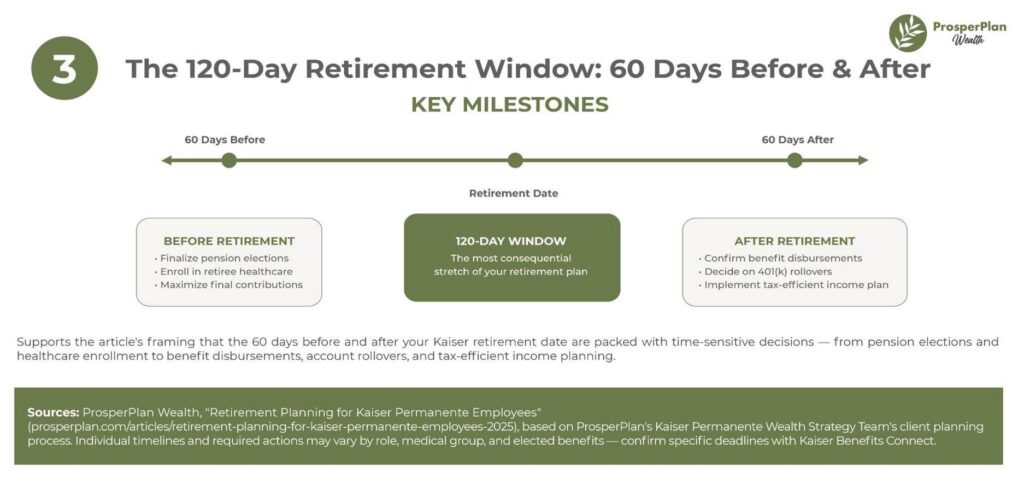
What to do 60 Days Before Retirement
I always tell my Kaiser clients: this is the window where the real work happens. The decisions you make in these 60 days quietly set the tone for the rest of your retirement, so let’s walk through each one together.
Pension Elections
Kaiser Permanente offers defined benefit pension plans that provide retirement income based on your compensation and years of service: which is a genuine rarity in today’s workforce. As part of your Kaiser Permanente employee retirement benefits, you’ll need to choose among a few payout structures:
- Single Life Annuity: monthly payments for the rest of your life.
- Joint and Survivor Annuity: a reduced monthly payment that continues to a beneficiary after you pass.
- Lump-Sum Payment: the entire pension benefit paid out at once.
Because each choice carries its own financial planning and tax consequences, it’s essential to carefully evaluate the available options against your personal goals rather than defaulting to whichever option sounds best at first glance.
Healthcare Enrollment
It’s interesting that a renowned healthcare entity has such complex retirement healthcare choices for its employees. But then, that’s because there are a lot of opportunities.
Take time to review your eligibility for retiree medical benefits, which can include in depth healthcare coverage during retirement. Understanding the costs and coverage details of each option now will save you from surprises later.
Finalize Contributions
Before you retire, review your contributions to your retirement accounts. This is your last chance to maximize any employer matching and capture available tax benefits before the door closes.
60 Days After Retirement
Once you’ve officially retired, the work isn’t finished, it just shifts. This is where we make sure everything you set in motion actually lands the way you intended.
Benefit Disbursements
Once your chosen pension payout begins, double-check that every payment is accurate and matches the option you selected.
Account Rollovers
Decide whether rolling your 401(k) into an IRA makes sense for continued tax-deferred growth and a broader set of investment choices.
Tax Planning
This is the moment to put a tax-efficient income strategy into motion. This considers your pension, Social Security, and any retirement account withdrawals all together in one silo, and not in money-wasting isolation.
Pension Options and Choices
I’ve sat across the table from many dozens of Kaiser employees wrestling with this exact decision, and I understand why it feels heavy: Because it is. Let’s break it down so it feels manageable instead.
Understanding your Kaiser retirement pension options is central to informed retirement planning. Kaiser’s pension is designed to provide steady income, but the choices you make along the way can significantly affect your long-term financial picture.
Defined Benefit Pension Plan
This aspect of the plan calculates your retirement income using a formula based on your compensation and years of service. Kaiser funds it entirely, and you become vested after five years.
Payout options include:
- Single Life Annuity: the highest monthly payment, but it ends when you pass away.
- Joint and Survivor Annuity: a lower monthly payment that continues for a named beneficiary.
- Lump-Sum Payment: full flexibility to manage or invest the benefit yourself.
While full of potential, nothing is perfect. Each of these has real trade-offs. Advantages and disadvantages. A Single Life Annuity maximizes income but leaves nothing for survivors. A Joint and Survivor Annuity protects a loved one but reduces your monthly payment amount. A lump sum offers control but demands disciplined management to make it last.
Kaiser Permanente Retirement Plans Overview
Let me pull back the curtain on the full picture, because my experience has been that most Kaiser employees have only ever seen their own piece of it. Here’s how everything fits together.
If you’re searching for a deeper dive into what Kaiser’s Retirement plan is and how the pieces all fit together, here’s a fuller picture:
Pension Plan (Plan 1)
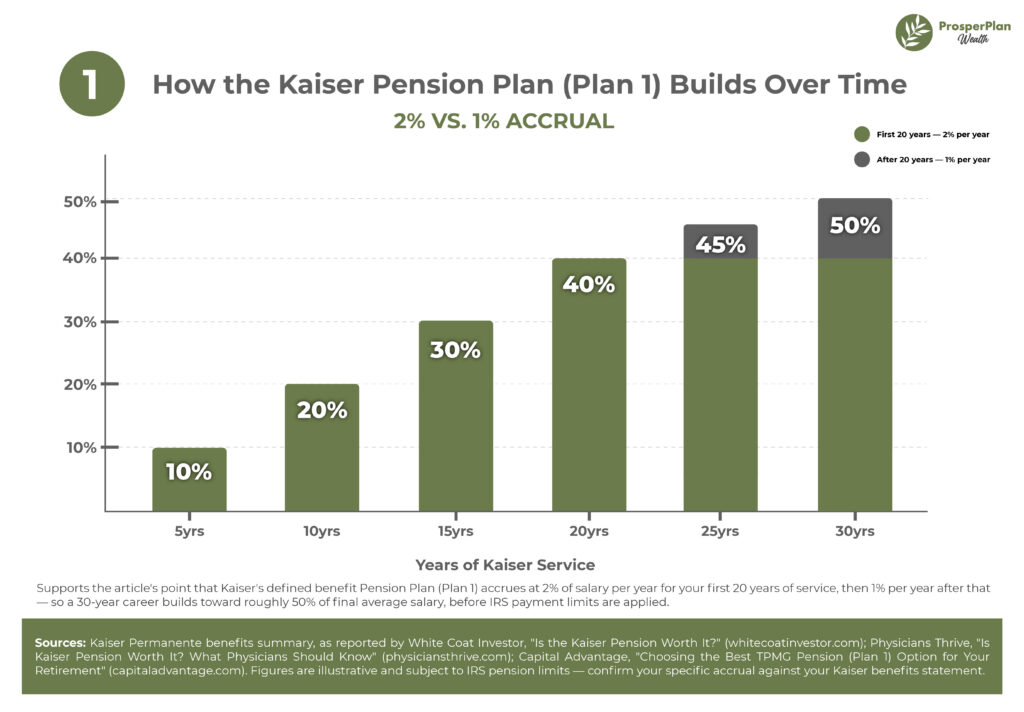
This is a standout benefit. Physicians earn 2% of salary per year for the first 20 years and 1% per year after that (subject to IRS limits). High earners can also expect a supplemental lump-sum payment at age 65 (though that comes with significant tax implications worth planning around well in advance).
Early retirement is available at 60 with full benefits, or at 55 with reduced payouts if your age and years of service combine to equal or surpass 75. It rewards patience and precise planning.
Contribution Plan (Plan 2)
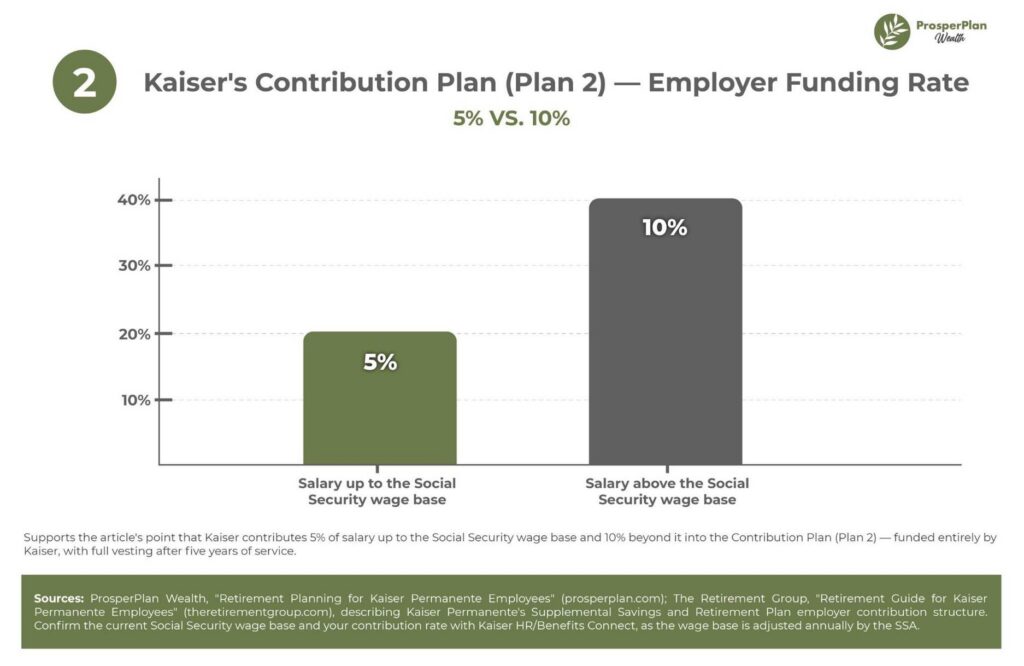
Think of this as a built-in booster to your Kaiser Permanente retirement benefits. Kaiser contributes 5% of your salary up to the Social Security wage base, and 10% beyond that. You’re fully vested after five years, and it adds meaningful value to your overall strategy.
Deferred Compensation Plan (DCP)
The DCP lets high earners defer income to bridge the gap before pension payments start. It’s a powerful tool, but a non-qualified one: This means that it comes with real considerations around timeline and risk tolerance that deserve a candid conversation.
401(k) Plan (Plan 3)
Administered by Fidelity, Kaiser’s 401(k) offers low-cost investment options, including target-date and index funds, with pre-tax, Roth, and after-tax contributions available. For the right candidate, Mega Backdoor Roth conversions can make this plan even more powerful.
Tax Planning and Key Milestones
This is where I see the most value gained or lost, depending on how proactively it’s handled. Let’s make sure it works in your favor.
High earners in particular face meaningful tax exposure, especially around supplemental lump-sum payments at age 65. Strategic moves – Roth conversions, charitable giving, and thoughtful timing – can meaningfully reduce that burden while preserving wealth.
In the critical 60 days before retirement, I help finalize pension elections, maximize contributions, and transition smoothly into retiree medical benefits. After retirement, we build a tax-efficient strategy for managing income streams and rollovers, so absolutely nothing gets left to chance.
Again, while Kaiser’s structured environment offers exceptional benefits, it also demands careful navigation. At ProsperPlan Wealth, we bring nearly two decades of focused experience to help you align every piece of your Kaiser Permanente employee retirement benefits with your personal goals.
“Confidence comes from clarity. I take the time to learn what matters most to each client and build a plan grounded in transparent, conservative assumptions that hold up over time — not empty promises about performance.” — Chris Grellas, CFP®, MSFA, Co-Founder & Financial Advisor, ProsperPlan Wealth
Why Work with ProsperPlan Wealth
Chris Grellas and I started this practice because we believe Kaiser employees deserve an advisor who actually understands what they’re navigating, not a generalist doing their best guess work for anyone who walks through the door.
Here’s what that looks like in practice.
Our Kaiser Permanente Wealth Strategy Team exists for one reason: to help Kaiser physicians, nurses, technicians, and employees make the absolute most of their unique Kaiser Permanente retirement benefits. We combine decades of financial expertise with a deep, specialized understanding of Kaiser’s pensions, 401(k) options, deferred compensation, and retiree medical benefits.
When you work with us, you gain access to a full network of professionals: financial planners, tax strategists, benefits specialists, and family law attorneys, all working in coordination around your plan. That collaborative approach means every piece is optimized, from maximizing contributions and tax planning to navigating the pivotal 60-day windows before and after retirement.
Whether you’re weighing early retirement, managing a lump-sum decision, or aiming for long-term income stability, we’re here to walk through it with you, step by step.
At ProsperPlan Wealth, we don’t just help you retire, we help you retire with confidence.
If you’re ready to dig into the specifics of your Kaiser pension plan, or want a broader look at our retirement planning services, we’d love to have that conversation with you.
Take the First Step
You’ve spent your career caring for others, so now, in return, let us spend some time caring for your financial future.
Retirement is a significant milestone, and you shouldn’t have to navigate Kaiser’s benefits alone. Let ProsperPlan Wealth guide you through the process so every decision supports your long-term goals.
Schedule a consultation today, and let’s start building your personalized plan for retirement success.
Frequently Asked Questions
Here are a few of the questions I hear most often from Kaiser employees.
What is the Kaiser retirement plan?
Kaiser Permanente offers a multi-layered retirement package that typically includes a defined benefit pension plan, a contribution plan funded by Kaiser, a deferred compensation plan for eligible high earners, and a 401(k) administered by Fidelity. Together, these form the backbone of most Kaiser employees’ retirement income.
What are the three retirement plans?
For most Kaiser employees, the core retirement benefits break down into three main pieces: the Pension Plan (Plan 1), the Contribution Plan (Plan 2), and the 401(k) Plan (Plan 3). Higher earners may also have access to a fourth: the Deferred Compensation Plan.
How long do you get a pension after retirement?
With a Single Life Annuity, pension payments continue for the rest of your life. A Joint and Survivor Annuity extends payments (at a reduced amount) to a named beneficiary after your death. A Lumpsum payment, by contrast, is a one-time distribution rather than an ongoing payment stream.
What is the difference between a 401(k) and a retirement savings plan?
A 401(k) is one specific type of employer-sponsored retirement savings plan, typically funded through employee contributions (often with an employer match) and invested for tax-deferred or tax-free growth. “Retirement savings plan” is a broader term that can also include pensions, deferred compensation arrangements, and IRAs — all of which work together, rather than one replacing the other.
What is the best retirement plan out there?
There isn’t a single “best” plan — the right approach depends on your income, timeline, family situation, and risk tolerance. For Kaiser employees specifically, the strongest outcomes usually come from coordinating your pension election, 401(k) strategy, deferred compensation timing, and tax planning as one unified plan, rather than making each decision in isolation.
Lauren M. Williams, CFP®, CRPC®, MBA, is the co-founder of ProsperPlan Wealth and a fiduciary wealth advisor with nearly two decades of experience. She works with families, business owners, and healthcare professionals on retirement, tax strategies, and the challenges of multi-generational wealth. ProsperPlan Wealth is not affiliated with nor endorsed by Kaiser Permanente.