



Turning 50 has a way of transforming retirement into something real. The kids are older, the mortgage is more manageable, and the question of “someday,” is now “How am I actually doing?”
I sit down with people at this stage of life every week, and one of the first questions they ask is a version of, “Is my 401(k) where it should be?” – followed closely by a second question: how does my number compare to the average 401(k) balance at 50?
It’s a fair and important question, but an answer is only possible with context. You don’t need just a number for comparison with others, you need a clear understanding of what that number does and doesn’t tell you.
So, let’s walk through it together, honestly and without judgment. Because wherever you’re starting from, there are meaningful steps you can take to strengthen your retirement preparation.
The Average 401(k) Balance at 50
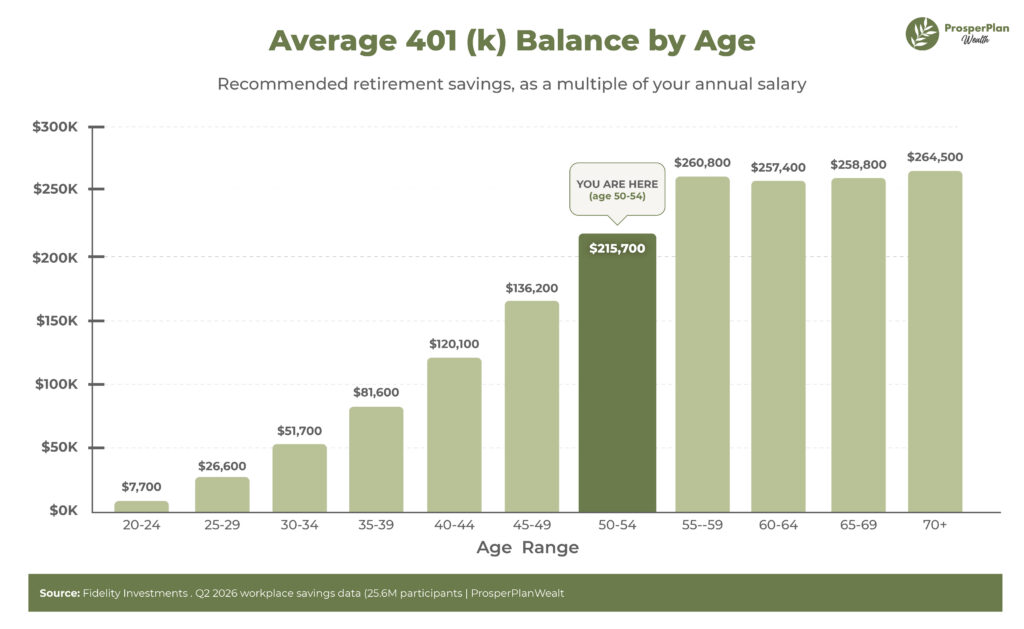
According to Fidelity’s most recent workplace savings data, the average 401(k) balance at 50, measured across savers aged 50 and 54 is $215,700 (this figure was drawn from more than 25 million retirement plan participants).
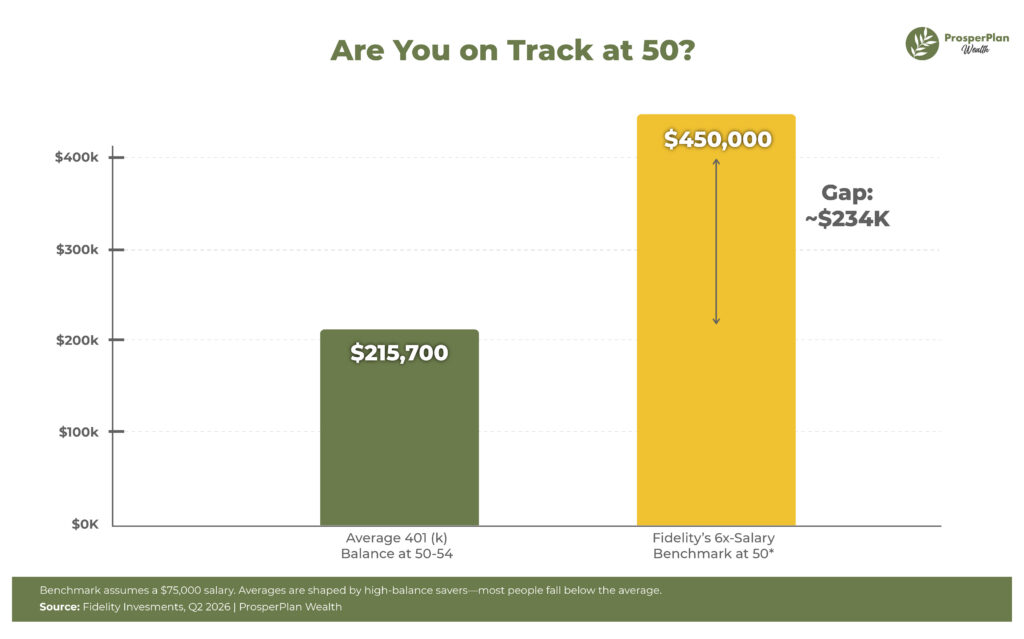
Fidelity also offers a helpful benchmark for this stage of life: by 50, aim to have roughly six times your annual salary saved. For someone earning $75,000, that’s about $450,000.
At first glance, that gap can feel like an arctic blast of freezing air to the face. But it helps you to understand how averages work. Those are pulled upward by high-balance savers – people who started early, received consistent employer matches, or stayed with the same employer for decades. The median balance, at the true midpoint, is considerably lower than the average across most age groups.
In other words, if your balance is below $215,700, you’re not alone. Your current balance is a starting point, and not a referendum on your future.
What You “Should” Have at 50 – And Why the Number Isn’t the Whole Story
I’m always cautious about telling people they “should” have a particular amount by a certain age. The average 401(k) at 50 tells you what a large group of savers has accumulated. It tells you very little about what any one household actually needs. Those benchmarks rarely account for the long life someone has lived, nor do they consider other assets such as home equity, inheritances, or stand alone investments. Besides, someone who took time away to raise children, changed careers, started a business, or supported aging parents will naturally have a different trajectory than someone with a steady salary and 401(k) match since the age 24. Simply put, no path makes you a success or a failure.
Benchmarks are best used as compasses, not scorecards. And, just as a reminder, your 401(k) is also just one piece of your picture; Social Security, a pension, a spouse’s savings, brokerage accounts, home equity, and even part-time income in retirement all factor in. The 401(k) balance gets attention because it’s easiest to measure – but it was never meant to tell your entire story on its own.
“The number itself rarely tells the whole story. I’ve worked with clients who had a below-average balance but a rock-solid plan, and others with an above-average balance who were still anxious about retirement because they’d never mapped out how it would actually translate into income. Context is what turns a number into a plan.” — Lauren Williams, CFP®, CRPC®, MBA — Co-Founder & Financial Advisor, ProsperPlan Wealth
Average 401(k) Balance at Retirement
If 50 feels like a halfway marker, it’s natural to wonder what balances look like closer to retirement. The average 401(k) at retirement is higher, but not dramatically so. Fidelity’s data shows balances continuing to climb through the late 50s and into retirement age, generally reaching the high $250,000s to mid-$260,000s for people in their 60s and beyond – the result of several more years of contributions, employer matches, and investment growth.
But that average is still just a raw dollar figure. The more useful question is whether your savings, Social Security, and other income sources will actually support the retirement you want: which depends on your lifestyle, taxes, healthcare costs, and how long your money needs to last. That’s really the heart of retirement income planning: turning savings into a monthly income strategy you understand and feel confident using.
Starting a 401(k) at 50? Here’s Why It’s Not Too Late
If you’re starting a 401(k) at 50 – whether newly eligible, changing jobs, or simply not having had the chance to save consistently before now – you haven’t missed your window.
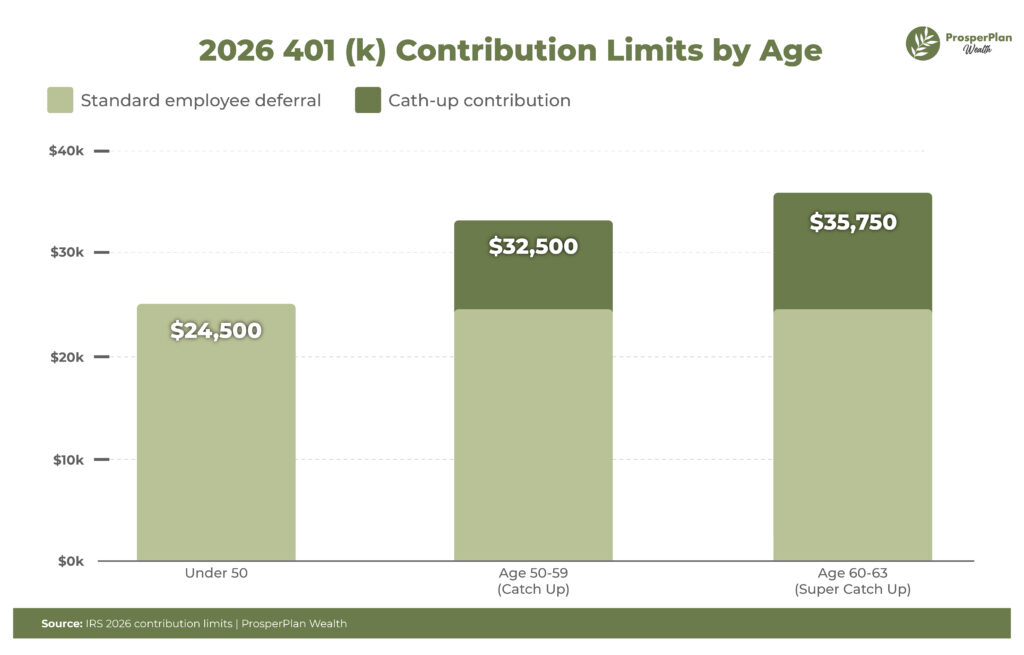
Fifty is a meaningful turning point in the tax code, because it’s when the IRS allows catch-up contributions on top of the standard limit. For 2026, that means savers 50 and older can contribute up to $32,500 total, with those 60-to-63 eligible for even more under the newer “super catch-up” provision.
A few priorities worth focusing on:
- Capture the full employer match – it’s part of your compensation.
- Increase your contribution rate gradually. A 1% annual bump is easier to absorb and still compounds meaningfully.
- Use the runway you still have. Fifteen to twenty years of consistent investing can make a real difference.
The goal isn’t to make up every missed year overnight – it’s to make the strongest use of the years ahead.
How to Estimate Your 401(k) at Retirement
Estimating your 401(k) at retirement comes down to a few moving parts: your current balance, yours and your employer’s ongoing contributions, years left until retirement, and an assumed rate of return. Small adjustments – retiring two years later, bumping contributions by 2%, or revisiting an overly conservative investment mix – can shift your projected balance by tens or even hundreds of thousands of dollars over time.
Our 401(k) calculator can offer a useful starting estimate. Just keep in mind it can’t fully account for Social Security timing, taxes, pension benefits, or withdrawal strategy. A projection shows where you may be headed, but a full financial plan helps you decide whether that destination fits the life you want.
Practical Steps to Catch Up Between Now and Retirement
Your 50s and early 60s are often your highest-earning, highest-savings-potential years, which makes this a valuable time to strengthen your plan. If you are sitting below the average 401(k) balance at 50, this is the decade where that gap can close fastest.
- Max out catch-up contributions where you can. Even partial increases add up meaningfully over a decade, especially when automated.
- Revisit your investment mix. Being too conservative too early can be just as costly as being too aggressive too late. Your portfolio should reflect your time horizon and plan, not just your age.
- Consolidate old 401(k)s thoughtfully. Accounts from past employers can be easy to lose track of and may carry higher fees.
- Build a retirement income plan, not just a savings target. Knowing how your money will translate into monthly income changes how you save today.
“Consistency beats intensity almost every time. A modest, automatic increase to your contribution rate each year will usually outperform someone who waits for the ‘right moment’ to make a substantial change and never quite gets there. Your 50s are a great decade to put that kind of steady discipline to work.” – Lauren Williams, CFP®, CRPC®, MBA | Co-Founder & Financial Advisor, ProsperPlan Wealth
When to Partner with a 100% Fiduciary, Fee-Only Financial Planner
There often comes a point when a spreadsheet isn’t enough. Coordinating a 401(k) with Social Security timing, taxes, healthcare costs before Medicare, and – for many of our clients – a pension is genuinely complex, and the decisions are interconnected: the best time to claim Social Security, for instance, can depend on which accounts you draw from first.
If you’re within five to ten years of retirement, a financial planner can help you answer the questions that matter most: when you can realistically retire, how much you can comfortably spend, when to claim Social Security, and how to reduce unnecessary taxes along the way.
Our retirement planning services are built exactly for this stage of life. And if you’re looking for a broader view of your whole financial picture, our financial planning services team can help bring it all together.
Frequently Asked Questions
Can you change your 401(k) contribution at any time?
In most workplace plans, yes – you can typically increase, decrease, or pause your contribution percentage through your plan’s online portal, with changes taking effect within a pay cycle or two. Some plans have brief restrictions, so it’s worth checking your specific plan’s rules.
Can I retire at 62 with $400,000 in a 401(k)?
It’s possible for some, but it depends on your other income sources, expenses, and how long the money needs to last. A $400,000 balance combined with Social Security at 62 might work for someone with a paid-off home and modest spending; it may fall short for someone with higher expenses or no other savings. Since claiming Social Security at 62 permanently reduces your benefit, it’s worth running the actual numbers before deciding.
Can I retire at 55 with $1 million in a 401(k)?
It’s more achievable than many assume, but early retirement brings real challenges: your money may need to last 35+ years, and you’ll likely face a gap before Social Security and Medicare begin. Withdrawal strategy, healthcare coverage, and tax planning become especially important in this scenario.
How many people have $1 million in a 401(k)?
Still a relatively small group. Fidelity’s data shows roughly 600,000 to 650,000 of its 401(k) accounts have crossed $1 million, out of more than 25 million participants – about 2 to 3% of savers.
How many Americans have $500,000 saved for retirement?
Based on Employee Benefit Research Institute data, about 7% of Americans have $500,000 or more saved across their retirement accounts.
Your Current Balance Is the Beginning of the Plan
If these averages brought up some worry, take a breath. Your 401(k) balance at 50 isn’t a final grade, and it doesn’t determine whether you can have a meaningful, secure retirement.
What matters most is understanding where you stand, identifying what’s in your control, and building a plan around your actual life. The people who feel most prepared for retirement aren’t always the ones who hit a milestone by a certain birthday – they’re the ones who stopped comparing, got clear answers about their numbers, and started making thoughtful decisions with confidence.
At ProsperPlan Wealth, we help people turn retirement questions into a practical, personalized strategy – looking beyond the 401(k) balance to how your savings, Social Security, taxes, healthcare needs, and goals can work together. You don’t need everything figured out before contacting us. That’s what the conversation is for. Ready to see where you stand? Schedule a free consultation with our team.
This article is for general educational purposes and is not intended as personalized investment, tax, or legal advice. Please consult a financial or tax professional regarding your specific situation. Average 401(k) balance figures are sourced from Fidelity Investments’ Q2 2026 workplace savings data and the Employee Benefit Research Institute (EBRI). Past performance is no guarantee of future results.