



I hear a version of the following question almost every week: “I’ve already maxed out my 401(k) and my Roth IRA, so what else can I do?” For a lot of high income earners, the only answer used to be “not that much.”
But today? Thanks to a strategy called the Mega Backdoor Roth, that answer has changed.
If you’ve never heard of it, you’re not alone. It’s one of the most underused tools in the tax code, mostly because it only works if your employer’s 401(k) plan is built to allow it (remember that), and because the specifics can feel intimidating (stick with me) the first time you see them spelled out.
I want to walk you through it the way I would with a client sitting across from me: plainly, and without the jargon hiding what is potentially a fantastic savings tool.
Mega Backdoor Roth Explained
I’m going to begin with the basics, because the name alone tends to scare people off.
A Mega Backdoor Roth is a strategy that lets you move significantly more money into a Roth account than the standard contribution limits normally allow (potentially tens of thousands of dollars more), every single year. It works by using a lesser-known feature inside many 401(k) plans: after-tax contributions.
Here’s the short version. Your 401(k) actually has three separate “buckets” the IRS allows money to flow into:
- Your standard employee deferrals: These are pre-tax or Roth, deducted straight from your paycheck.
- Your employer contributions: These are any match or profit-sharing your company adds.
- Your after-tax contributions: These are the third, most often-overlooked bucket that aren’t subject to the same low ceiling as your regular deferrals.
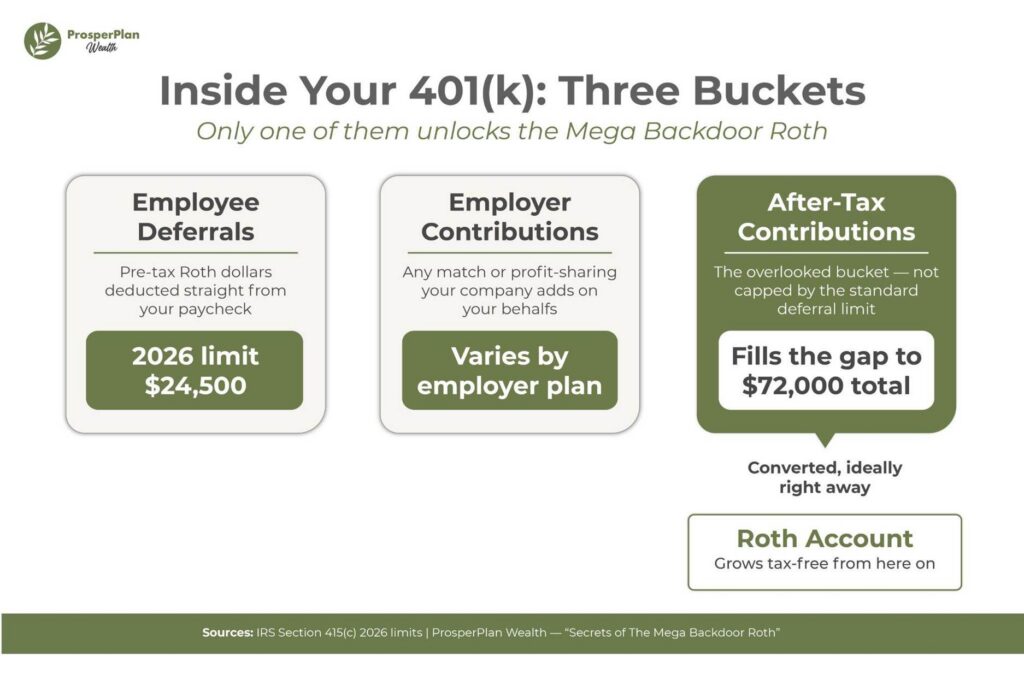
The Mega Backdoor Roth strategy is all about filling that third bucket, then converting those after-tax dollars into a Roth account – either a Roth IRA or the Roth portion of your 401(k) – so they can grow completely tax-free from that point forward.
The Mega Backdoor Roth Limit for 2026
I think this strategy makes a lot more sense once you see the numbers side by side, so let me place them right out on the table.
For 2026, here’s how the limits stack up:
- Standard employee deferral limit: $24,500 (plus an $8,000 catch-up if you’re 50 or older).
- Total combined 401(k) limit (IRS Section 415(c)): $72,000, which covers your deferrals, any employer contributions, and after-tax contributions, all added together.
- Standard Roth IRA contribution limit: $7,500 ($8,600 if you’re 50 or older) and only available at all if your income falls below the phase-out thresholds.
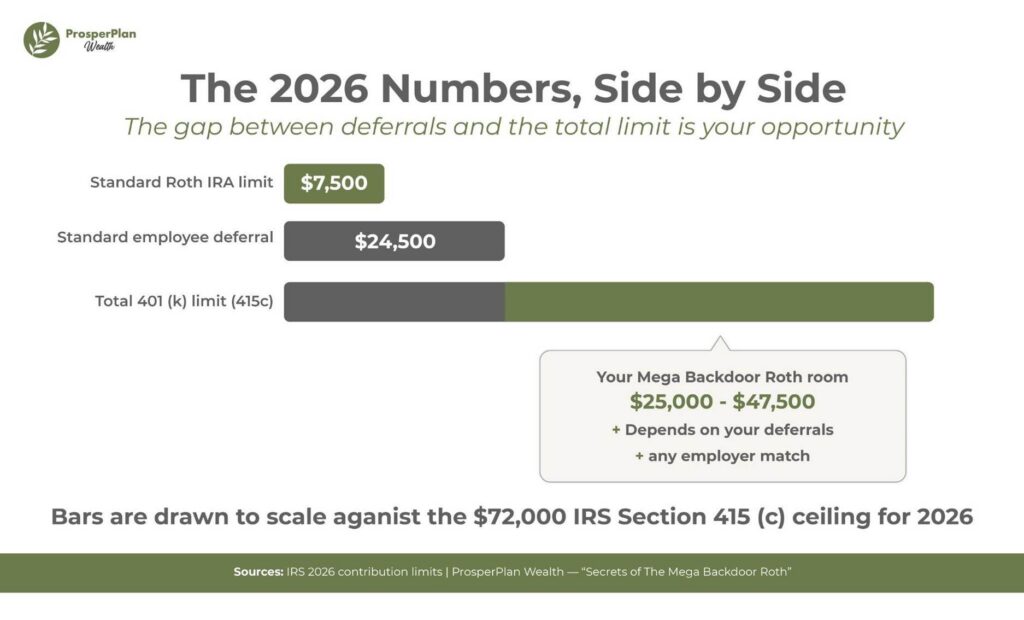
The gap between what you personally defer and that $72,000 total ceiling is your after-tax contribution room, which is often $25,000 to $47,500 or more, depending on your deferrals and any employer contributions. That gap is your effective Mega Backdoor Roth limit, and it’s exactly what this strategy is designed to capture.
If you want to clearly understand how a contribution like this could actually move the needle for your own timeline, our retirement savings calculator is a quick way to run the numbers.
The Mega Backdoor Roth Strategy, Step by Step
Once you understand the “why,” then the “how” is actually pretty simple. Let me break it down into the two moves that make this whole strategy work.
The process itself has two steps:
- You contribute after-tax dollars to your 401(k), beyond your normal pre-tax or Roth deferrals.
- You convert those after-tax dollars into a Roth account, in the best-case scenario, quickly, so that there’s very little to no investment growth sitting in the after-tax bucket when you convert (growth that occurs before conversion is generally taxable).
Once the money lands in the Roth account, it grows tax-free, and qualified withdrawals in retirement come out tax-free, too.
Many of the 401(k) plans I see – including several large employer plans administered by Fidelity – already have the after-tax contribution and in-plan conversion features built in, which is everything a Fidelity Mega Backdoor Roth requires. Some plans even offer an automated conversion option you can elect once and let run in the background. If your plan is Fidelity-administered, it’s worth logging into your account or calling your plan services line to ask directly whether after-tax contributions and Roth in-plan conversions are enabled (because the feature isn’t always obvious from the standard contribution screen).
Mega Backdoor Roth vs. Backdoor Roth: What’s the Difference?
I find this is where most of the confusion starts, so I am going to clear it up directly.
A Backdoor Roth IRA and a Mega Backdoor Roth sound like cousins, and in spirit they somewhat are, because both exist to get money into a Roth account despite normal restrictions.
But they work very differently:
- A Backdoor Roth IRA is for anyone whose income is too high to contribute directly to a Roth IRA. You contribute to a non-deductible Traditional IRA, then convert it to a Roth IRA shortly after. It’s capped at the standard IRA limit: $7,500 in 2026 ($8,600 if 50+).
- A Mega Backdoor Roth operates entirely inside your 401(k) plan and can move substantially more: potentially $25,000 to $47,500 (or more) in a single year, since it’s built on the much larger 401(k) contribution ceiling rather than the IRA limit.
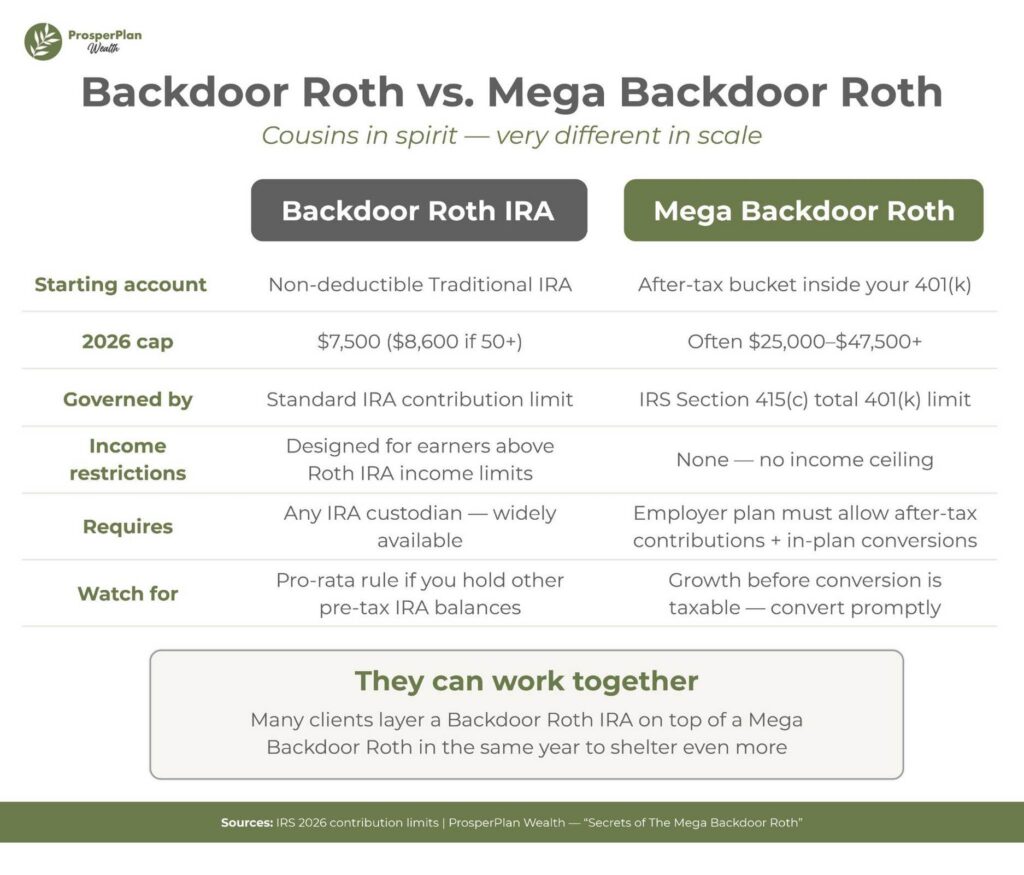
To be sure, both strategies can coexist. The fact is, that many of my clients use both in the same year, layering a Backdoor Roth IRA on top of a Mega Backdoor Roth to maximize what they’re sheltering from future taxes.
Mega Backdoor Roth Withdrawal Rules
This is a detail I make sure every client understands before we implement anything, because it changes depending on where the converted money ends up.
- If converted to a Roth IRA: Your original contributions can generally be withdrawn at any time and without tax or penalty. However, converted amounts are each subject to their own five-year clock before they can be withdrawn penalty-free if you’re under age 59½ (this is a detail that trips people up when they’ve done multiple conversions in different years).
- If converted to a Roth 401(k) (in-plan conversion): Withdrawal rules follow your plan’s specific provisions, and the five-year rule applies to the plan as a whole, generally starting with your first Roth contribution or conversion into that plan.
- Earnings vs. contributions: In either case, qualified withdrawals of earnings: meaning both the five-year rule and age 59½ are satisfied and are completely tax- and penalty-free. (Withdraw earnings before meeting both conditions, and you may owe tax and a 10% penalty on that portion.)
The elevator version of this is that it’s a long-term strategy. It rewards patience, and it’s not designed to be a short-term cash reserve.
Mega Backdoor Roth Tax Implications
Here’s where I want to be very direct, because this strategy is often marketed as “tax-free,” and that’s only partly true.
- The after-tax contribution itself isn’t taxed again: you already paid income tax on that money before it went into the 401(k).
- Any investment growth that occurs before you convert is taxable in the year of conversion. This is exactly why timing matters, and why I encourage clients to convert as soon as administratively possible after contributing.
- Once inside the Roth account, all future growth is tax-free, and qualified withdrawals – of both contributions and earnings – come out tax-free during retirement.
- If you’re also using a Backdoor Roth IRA, watch for the pro-rata rule: existing pre-tax IRA balances can make a portion of an IRA conversion taxable, even when the Mega Backdoor Roth 401(k) side is squeaky clean. Rolling pre-tax IRA money into your 401(k) first, where your plan allows it, is a common way around this.
My ProsperPlan Wealth Co-Founder, Lauren Williams, adds this:
“I tell clients the tax benefit of a Mega Backdoor Roth is earned in the details, not just the contribution. Convert promptly, track your basis carefully, and coordinate it with any other Roth strategies you’re running, which is what actually turns the tax code’s fine print into real, tax-free wealth.”
— Lauren M. Williams, CFP®, CRPC®, MBA, Co-Founder & Financial Advisor, ProsperPlan Wealth
Who Qualifies for a Mega Backdoor Roth?
Before we get any further into the excitement of the math, I always pump the brakes here for a moment because, unfortunately, this strategy isn’t available to everyone, and I’d rather tell you that right up front rather than have you disappointed later.
These two important things need to be true before this strategy is even on the table:
- Your 401(k) plan has to allow it. Specifically, your plan needs to permit after-tax contributions and either in-service withdrawals or in-plan Roth conversions. And not every employer plan includes these provisions. (This is genuinely the biggest hurdle for most people, and it’s worth a direct conversation with your HR or benefits team, or a quick read of your plan document, before you build a strategy around it.)
- You have the cash flow to use it. Just to be clear, filling that after-tax bucket on top of maxing your standard deferrals takes real disposable income. This strategy tends to make the most sense for high earners, business owners with control over their own plan design, and anyone who has already maxed out their standard 401(k) and IRA contributions and is looking for the next lever to pull.
Now, there’s no income cap on the Mega Backdoor Roth itself, which is actually one of its most appealing features. It’s one of the few remaining ways high earners can get substantial dollars into a Roth account regardless of how much they make.
“The Mega Backdoor Roth is one of the few strategies left that lets high earners build meaningful tax-free wealth with essentially no income ceiling. The trickiest part usually isn’t the concept, it’s coordinating the mechanics correctly with your specific plan, so the intended tax benefit doesn’t get lost along the way.”
— Lauren M. Williams, CFP®, CRPC®, MBA, Co-Founder & Financial Advisor, ProsperPlan Wealth
Let’s Build Your Strategy Together
I’ve walked enough clients through this to know it’s rarely a simple yes-or-no decision: it’s a puzzle piece that has to fit the rest of your financial life. Every plan is different, every employer’s 401(k) is unique, and every client’s cash flow and goals look different, as well. That’s exactly the kind of coordination our team at ProsperPlan Wealth specializes in – reviewing your specific plan provisions, running the numbers, and building a Mega Backdoor Roth strategy (or deciding it’s not the right fit) as one piece of a fully coordinated financial planning picture.
If you’d like a closer look at how this might apply to your own retirement planning, my team and I would welcome the conversation.
Ready to See What This Strategy Could Mean for You?
Because you’ve worked so hard to get to a point where “I maxed out my 401(k) and Roth IRA,” this is your starting problem, and that’s not a small thing. It deserves a strategy that matches it. Let’s have an information-gathering discussion, look at your specific plan, and find out exactly how much room and flexibility you have to build tax-free wealth.
Schedule a consultation with our team at ProsperPlan Wealth today, and let’s put your Mega Backdoor Roth strategy in motion.
The information in this material is not intended as tax or legal advice. Please consult your legal or tax professionals for specific information regarding your individual situation.
Frequently Asked Questions
What is a Mega Backdoor Roth?
A Mega Backdoor Roth is a strategy that uses the after-tax contribution feature inside some 401(k) plans to move significantly more money into a Roth account than standard 401(k) or Roth IRA limits normally allow – often tens of thousands of dollars more per year – by contributing after-tax dollars and then converting them to Roth status.
How does a Mega Backdoor Roth help maximize retirement savings?
Once you’ve maxed out your standard 401(k) deferral and your Roth IRA, a Mega Backdoor Roth is one of the few remaining ways to keep building tax-free retirement savings. It lets you fill the gap between your personal deferrals and the much higher total 401(k) limit – commonly an extra $25,000 to $47,500 or more a year – and let that money compound completely tax-free from that point forward.
What are the downsides of a Mega Backdoor Roth?
It’s not the right fit for everyone. Your 401(k) plan has to specifically allow after-tax contributions and in-plan conversions, which many plans don’t. It also requires meaningful disposable income, since you’re contributing on top of your standard deferrals. Add in the need to convert promptly to minimize taxable growth, the added complexity if you’re also managing a Backdoor Roth IRA and the pro-rata rule, and the fact that converted funds are still subject to five-year holding rules – and it becomes clear this strategy takes some coordination to get right.
What is the difference between a Backdoor Roth and a Mega Backdoor Roth?
A Backdoor Roth IRA uses a non-deductible Traditional IRA contribution converted to a Roth IRA, capped at the standard IRA limit ($7,500 in 2026). A Mega Backdoor Roth works inside a 401(k) plan and can move substantially more – often tens of thousands of dollars more per year – because it’s built on the much larger 401(k) contribution ceiling.
Is there a cap on the Mega Backdoor Roth?
Yes. Your after-tax contribution room is capped by the overall IRS Section 415(c) limit for 401(k) plans – $72,000 for 2026 – minus your standard deferrals and any employer contributions. There’s no separate income cap on who can use the strategy, but the total dollar amount you can convert in a given year is limited by that combined 401(k) ceiling.