



Okay, so how much can you really take out of your portfolio each year without running out of money?
It is one of the most essential questions of retirement planning (and one of the most confusing).
That’s because there is simply no single path or magic formula that works for everyone.
And do not let anyone tell you that there is.
But the good news is that research and fiduciary planning will absolutely help you identify a safe withdrawal rate for retirement suited to your life, timeline, and today’s market.
So, let’s look at what the research says and how you can go about using it to support a practical plan.
What Is a Safe Withdrawal Rate?
Let me begin with the basics. A safe withdrawal rate is the percentage of your retirement savings you can spend each year, adjusted for inflation, resulting in a high probability that your money will last as long as needed.
That all sounds pretty straightforward. In practice, however, your rate depends on your asset allocation, spending flexibility, guaranteed income such as Social Security or a pension, and, critically, how long your retirement could last.
Two people retiring with the exact same account balance can have vastly different safe withdrawal rates once their circumstances are considered. That’s why I encourage clients to treat any published percentage as a starting point for discussion, and not a finish line.
Where the 4% Rule Came From, and Why You Should Acknowledge and Ignore It
Pretty much everyone loves a simple formula that answers a big question.
With that in mind, most people have heard of the “4% rule.” Financial planner William Bengen introduced it back in 1994 after studying market returns dating to 1926. He looked for a withdrawal rate that could survive the worst 30-year periods in market history, including the Great Depression and the stagflation of the 1970s.
4% seemed to hold up.
Researchers at Trinity University later stress-tested the approach in what became known as the Trinity Study. They found that a 4% initial withdrawal from a balanced stock-and-bond portfolio survived roughly 95% of historical rolling 30-year periods.
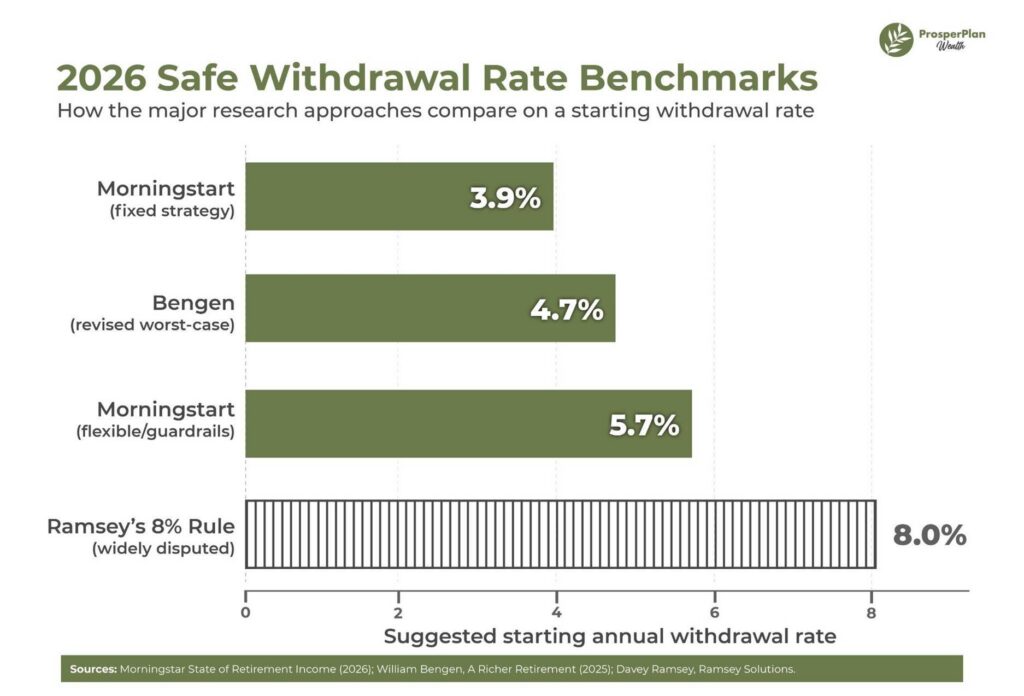
Since then, Bengen has revised his own estimate upward. In more recent research, he identified 4.7% as a reasonable worst-case starting point for a diversified portfolio that includes small-cap and international exposure.
But then the world changed. Inflation rose. Market swings became magnified. New types of assets like cryptocurrency and AI emerged.
So, more importantly, with our brave new investing world, while Bergen’s research only looked back in time, other researchers and industry models began to look forward.
What the 2026 Research Shows
Each year, Morningstar publishes one of the financial services industry’s most closely watched retirement-income studies. For 2026, Morningstar puts the highest safe starting withdrawal rate at 3.9% for retirees seeking consistent, inflation-adjusted income over a 30-year retirement, with a 90% probability that their money will last. (That is up slightly from the 3.7% figure in the previous report.)
So, why the difference between Morningstar’s 3.9% and Bengen’s 4.7%?
Because they are answering different questions.
While Bengen’s research looks backward at what actually happened in markets since 1926, Morningstar’s analysis is forward-looking, analyzing current bond yields, equity valuations, and inflation assumptions. That approach can produce a more conservative estimate when valuations are elevated. The safe withdrawal rate chart below summarizes these 2026 benchmarks.
But I’ve noticed that one finding in particular seems to surprise a lot of people: Morningstar’s highest safe withdrawal rates came from portfolios holding 30% to 50% in stocks, and not necessarily portfolios with the most equities.
That is a key distinction.
More stocks can mean more growth, but they can also mean greater exposure to “sequence-of-returns” risk early in retirement.
And That’s Why Sequence of Returns Matters
Average annual returns get most of the attention, but they aren’t what determines whether your money lasts. The sequence in which returns occur matters a great deal, especially during your first 5-to-10 years of retirement.
If the market falls sharply after you retire while you’re withdrawing money, you may have to sell shares at depressed prices. That permanently reduces the capital available to participate in a recovery. The same average return, arriving in a different order, can produce a vastly different outcome.
This is just one big reason why a rigid, one-size-fits-all safe withdrawal rate in retirement can be risky. It’s also why I generally encourage clients to build some spending flexibility into their plan. And it’s absolutely why no two plans are identical.
Everyone’s financial situation, expenses, plans, and risk tolerance are unique.
Fixed vs. Flexible Withdrawal Strategies
The traditional safe-withdrawal approach assumes you withdraw a set dollar amount in year one, increase it for inflation each year, and continue regardless of market conditions.
But my years of experience have shown me that very few people actually live this way. And, increasingly, research suggests they may not need to.
Now, this is merely hypothetical, but Morningstar found that retirees willing to adjust spending based on market conditions through a flexible or “guardrails” approach may be able to withdraw as much as 5.7% annually.
The tradeoff is straightforward: greater spending potential in exchange for being willing to reduce spending during downturns and potentially spend more during strong markets. For retirees with flexibility, this may be more realistic than committing to a number that never changes.
“The most dangerous number in retirement planning isn’t 3.9% or 4.7%, it’s the one you picked five years ago and never looked at again. Your withdrawal rate should be a living part of your plan, not a rule you set once and forget.”
— Lauren Williams, CFP®, MBA, CRPC®, Co-Founder, ProsperPlan Wealth
Safe Withdrawal Rate by Age and Retirement Length
Looking at a safe withdrawal rate by age is useful because your time horizon significantly affects the calculation. The 3.9% to 4.7% range is generally based on a 30-year retirement, which may fit someone retiring around age 65.
So, that means that:
- Retiring later, around age 75 or older: A shorter horizon generally supports a higher withdrawal rate because the portfolio has fewer years to fund.
- Retiring around age 62 to 67: This is where much of the published research is centered, using an approximate 30-year horizon.
- Retiring early, around age 45 to 55: A portfolio that must last 40 to 50 years faces more market cycles and inflation risk. Research focused on early retirees generally points to a lower starting rate, often around 3% to 3.5%.
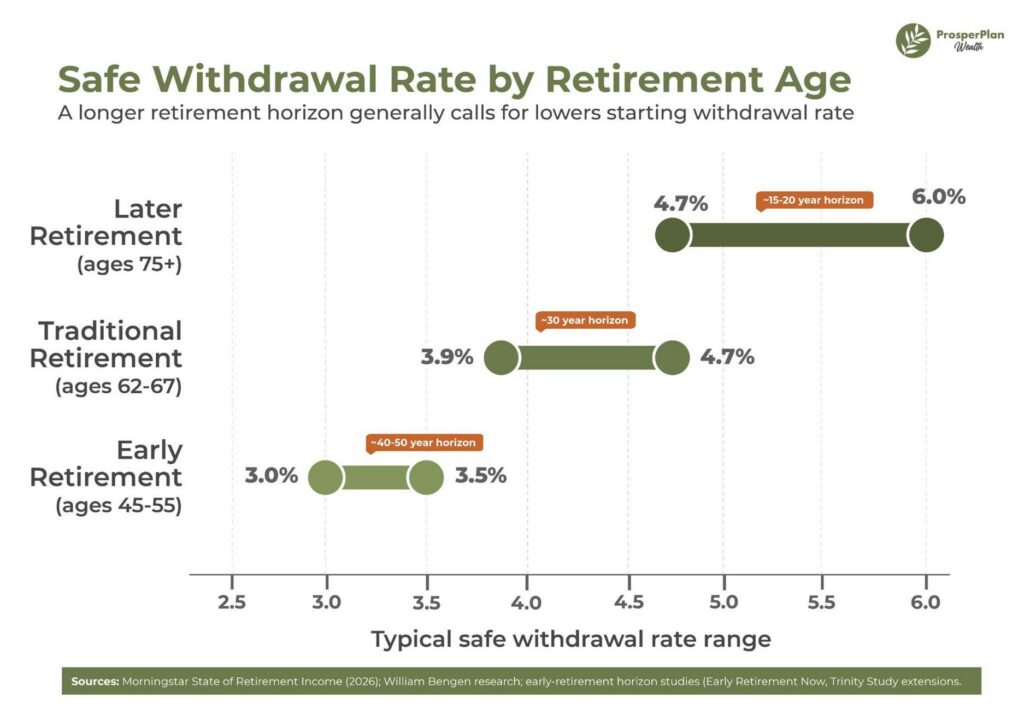
If early retirement is part of your plan, it’s worth exploring the numbers well before you stop working. That additional planning runway can make a meaningful difference.
Common Withdrawal-Rate Questions
What is Dave Ramsey’s 8% rule?
Dave Ramsey has argued that retirees can withdraw as much as 8% annually, based partly on an assumption of roughly 12% average stock-market returns and an all-equity portfolio.
Most retirement researchers, financial planners, and institutions disagree with this figure. The central concern is sequence-of-returns risk: an 8% withdrawal rate leaves little cushion if a downturn occurs early in retirement, while a 100% stock allocation increases volatility at precisely the wrong time.
The broader research generally supports a starting rate closer to 4% than 8%.
How many Americans have $1 million in retirement savings?
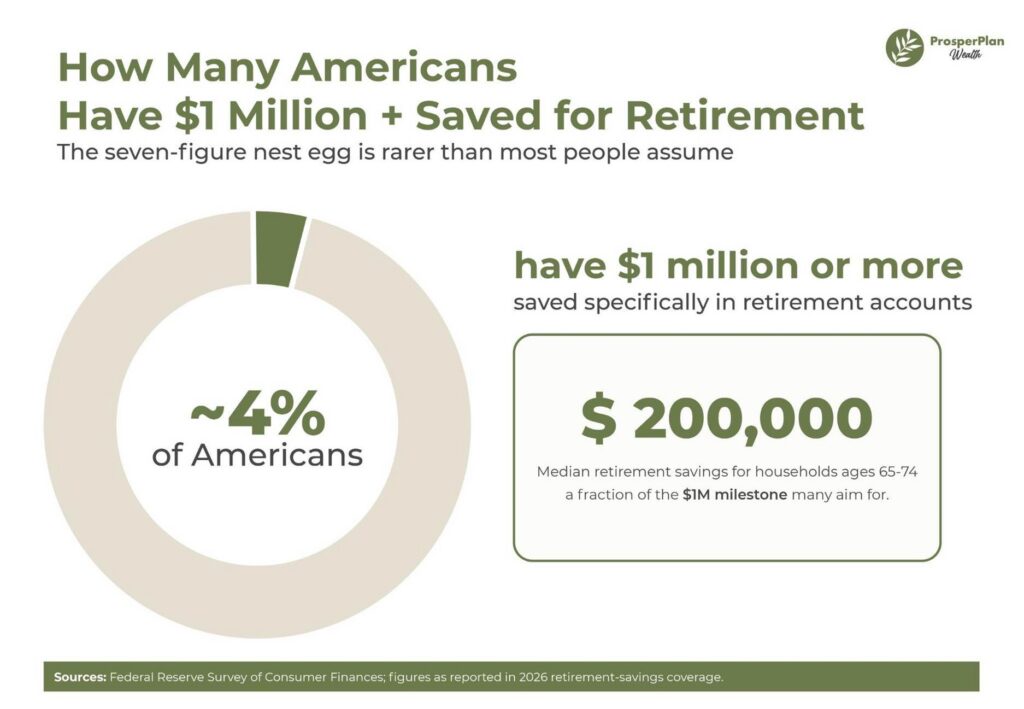
Federal Reserve Survey of Consumer Finances data suggests that only around 3% to 5% of Americans have reached $1 million in retirement-specific accounts. The figure is somewhat higher among retirees.
Median retirement savings for households ages 65 to 74 are closer to $200,000: a reminder that a personalized plan matters far more than reaching a round-number milestone.
What is the 7% withdrawal rule?
Just like it sounds, the 7% rule refers to withdrawing approximately 7% of your retirement savings annually. It is sometimes linked to Bengen’s observation that historical average safe withdrawal rates across different retirement start dates were closer to 7%, even though his published guideline focused on a 4% worst-case scenario.
Most planners consider 7% too aggressive for a standard 30-year retirement because it leaves little room for poor early returns.
How long will $500,000 last using the 4% rule?
Using the traditional 4% rule, a $500,000 portfolio would support an initial withdrawal of approximately $20,000, with that amount adjusted for inflation each year.
Following the rule as designed, the goal would be for the portfolio to last roughly 30 years. But the actual outcome depends on your asset allocation, market-return sequence, and willingness to adjust spending during difficult periods.
Building a Withdrawal Strategy That’s Yours
Here’s the key takeaway: 3.9%, 4.7%, and 5.7% are perfectly fine reference points, but they are not personal retirement plans.
Try never to forget that your sustainable withdrawal rate depends on your portfolio, other income sources, health, family history, tax situation, and the flexibility of your lifestyle spending.
This is the kind of question that benefits from looking at your actual numbers rather than relying on a national average or formula. Our retirement savings calculator can go a long way toward helping you see your entire picture more clearly.
If you’re ready for a deeper conversation, our retirement planning and broader financial planning services are designed to help you build a personalized income strategy and not simply adopt a number from a headline.
ProsperPlan Wealth was voted Sacramento’s Favorite Financial Planner because we’ve spent years helping Sacramento-area families turn research like this into practical, workable retirement plans.
And we’d be glad to help you build yours.