



If you’re self-employed like we are, building your own retirement plan is one more thing on an exceptionally long list. You are the accountant, the marketer, and the person who has to remember to actually pay yourself.
Who else is going to do it?
So, it’s no wonder many of the fabulous business owners we meet have put off retirement planning: not because they don’t want to save, but because they’re not sure which vehicles are the best match for their unique situation.
If this sounds like you, we want to introduce you to one of our favorite tools for self-employed savers: the Solo 401(k). It’s easily one of the most powerful, flexible retirement accounts available to business owners today, and in this article, I’ll walk through how it works, who qualifies, what you can contribute, and how to decide if it belongs in your arsenal.
What Is a Solo 401(k)?
A Solo 401(k) – also called an individual 401(k), a One-Participant 401(k), or a Self-Employed 401(k) – is a retirement plan designed specifically for business owners with no other full-time employees (other than possibly a spouse). It works very much like the 401(k) you may have had at a corporate job, but with a key difference: you get to wear two hats.
That’s because you’re both the “employee” and the “employer” of your business, so you can contribute to your Solo 401(k) in two distinct ways. First, you can make an employee elective deferral out of your compensation (the money you pay yourself) or self-employment earnings, just as you would at a traditional job. And second (and this is where it really ads up), you can make an employer profit-sharing contribution on behalf of your business. (Basically, you are wearing the second hat as you pay your employee-self.)
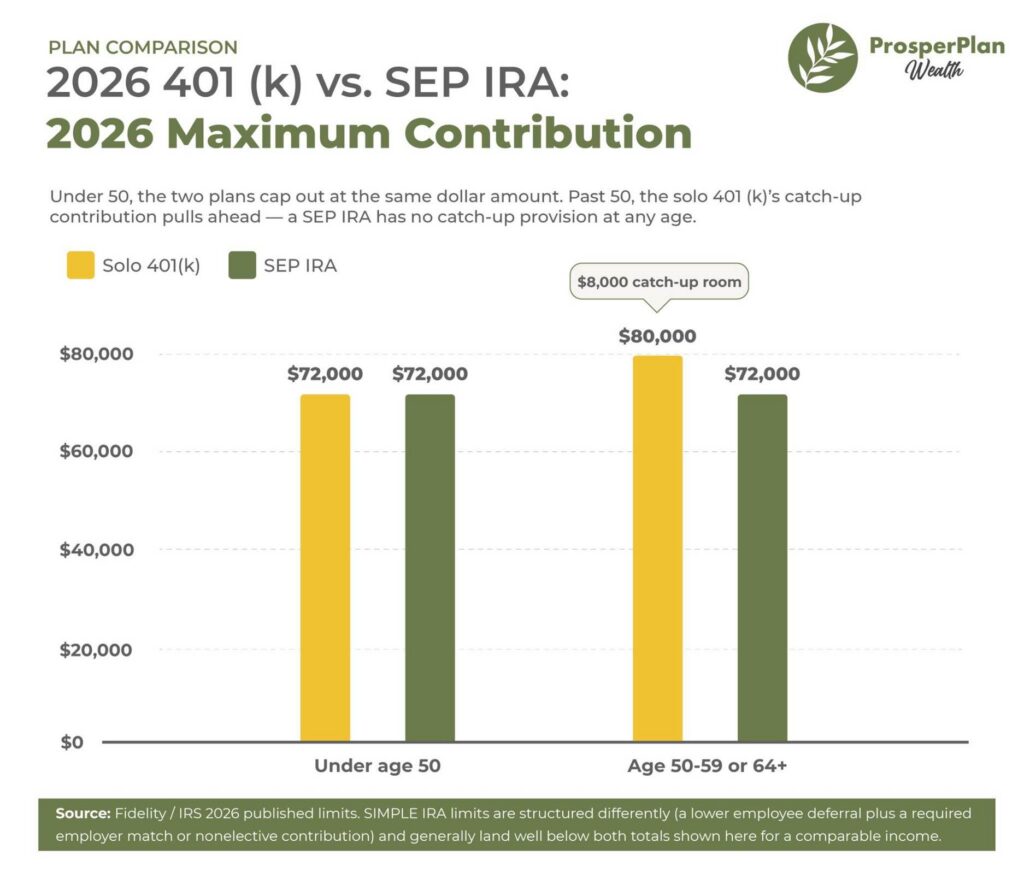
Stacking both of these types of contributions is what makes the Solo 401(k) so effective, because it can allow you to put away significantly more each year than a SEP IRA or a traditional IRA does.
Who Qualifies for a Solo 401(k)?
Solo 401(k) plans are built for a specific kind of small business situation: an owner-only business. You generally qualify if you have self-employment income and no full-time common-law employees other than your spouse. This includes:
- Sole proprietors and independent contractors
- Freelancers and consultants
- Single-member LLCs
- S-Corp and C-Corp owners with no outside employees
- Partnerships (as long as no one outside the ownership group works full-time for the business)
Now, here’s a reminder that if you bring on even one full-time employee (generally someone who works more than 1,000 hours a year and isn’t your spouse), you’ll probably need to transition to a different type of small business 401(k) plan that covers your staff, as well. (This is one of the first things we help clients think through: is a solo plan the right long-term fit, or should you look ahead for a plan that can grow as your firm evolves?)
Solo 401(k) Contribution Limits for 2026
One of the biggest benefits of a Solo 401(k) is how much you can put away each year. Here’s how the Solo 401k contribution limits break down for 2026:
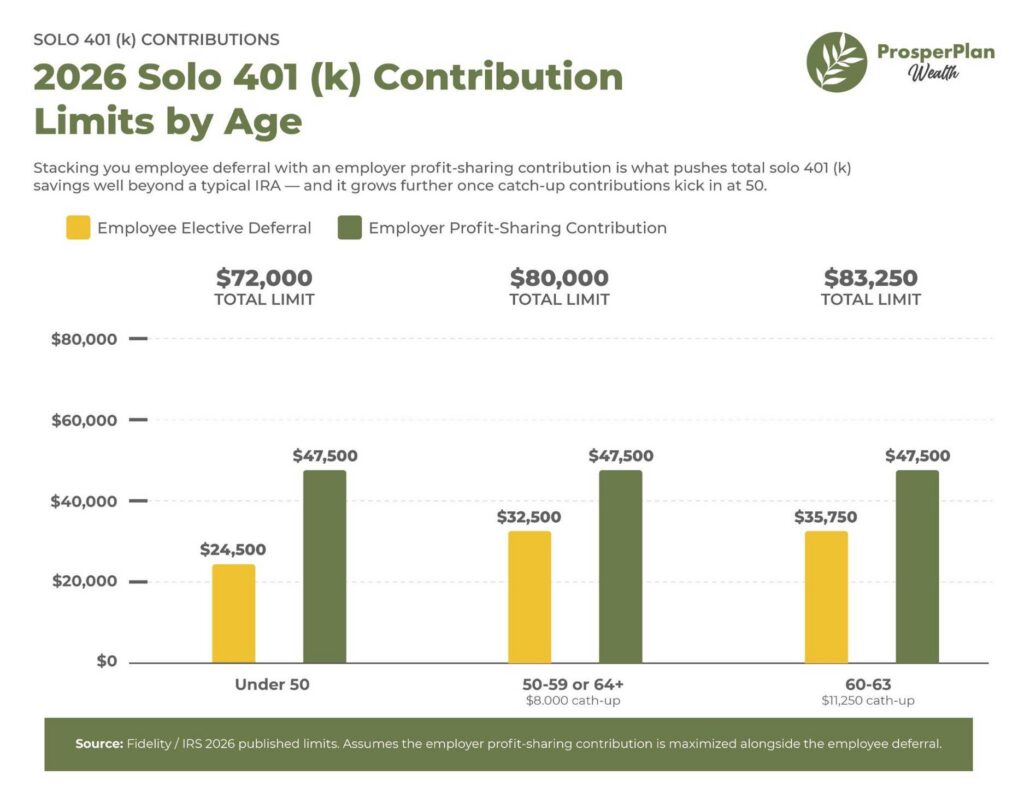
Employee elective deferral (you as the employee):
- Up to $24,500 if you’re under 50
- Up to $32,500 if you’re 50–59 or 64 and older (includes an $8,000 catch-up contribution)
- Up to $35,750 if you’re 60–63, thanks to a higher catch-up contribution allowed under current law (plan permitting)
Employer profit-sharing contribution:
- Up to 25% of your compensation (or a comparable calculation based on net self-employment earnings for sole proprietors), on up to $360,000 of compensation
Total combined Solo 401k limits for 2026:
- $72,000 if you’re under 50
- $80,000 if you’re 50–59 or 64 and older
- $83,250 if you’re 60–63
For sole proprietors and single-member LLC owners, Solo 401(k) contributions are generally deducted on Schedule 1 of Form 1040, on the line for self-employed retirement plan contributions – not as a business expense on Schedule C. Owners of S-corps or partnerships typically have contributions handled through payroll or the business’s tax filing. Because the details vary by entity type, it’s worth confirming the correct treatment with your tax preparer.
Do I need an EIN for a solo 401(k)?
Not always. There’s no formal IRS requirement that you obtain an EIN solely to establish a solo 401(k) – some providers will use your Social Security number as the plan’s tax identifier. That said, if you want to open a dedicated bank account for the plan (something many providers require or recommend), you’ll typically need an EIN to do so.
Who offers Solo 401(k) plans?
Many major brokerages and specialized retirement plan providers offer Solo 401(k) plans, including Fidelity, Charles Schwab, Vanguard, and a number of firms that specialize in self-directed and checkbook-control plans. Each provider’s plan document differs in what it allows, so it’s worth comparing features like loan provisions, Roth availability, and investment flexibility before choosing one.
This article is for educational purposes only and does not constitute tax, legal, or individualized financial advice. Contribution limits and tax rules are subject to change; please consult a qualified tax professional regarding your specific situation. ProsperPlan Wealth is not affiliated with nor endorsed by Fidelity, Charles Schwab, or Vanguard.