



I have received numerous calls from clients who are excited about the upcoming SpaceX IPO. But they aren’t only fired up about a rocket company. They are excited about the family of companies beneath the SpaceX umbrella (Starlink, the launch operation, the xAI compute footprint), and about the opportunity to finally own a piece of what is the most-watched private company in the world.
Here is what they tell me: “Lauren, I want to be a part of this.” Followed by a pause, and then, “And I’m thinking about investing somewhere between $20,000 and $50,000.”
The amount is sometimes referred to as “fun money.”
With good savers, “fun money” is less than one percent of their portfolio, and the kind of risk that investors are willing to take on something exciting without placing their retirement at peril.
If you’re interested in the SpaceX IPO, here’s what’s happening on June 12 – along with what could make this particular IPO worth getting excited about, as well as some words of caution – and how we as fiduciary financial advisors would suggest you approach both your timing and sizing if you decide to participate.
The Five-Minute Briefing
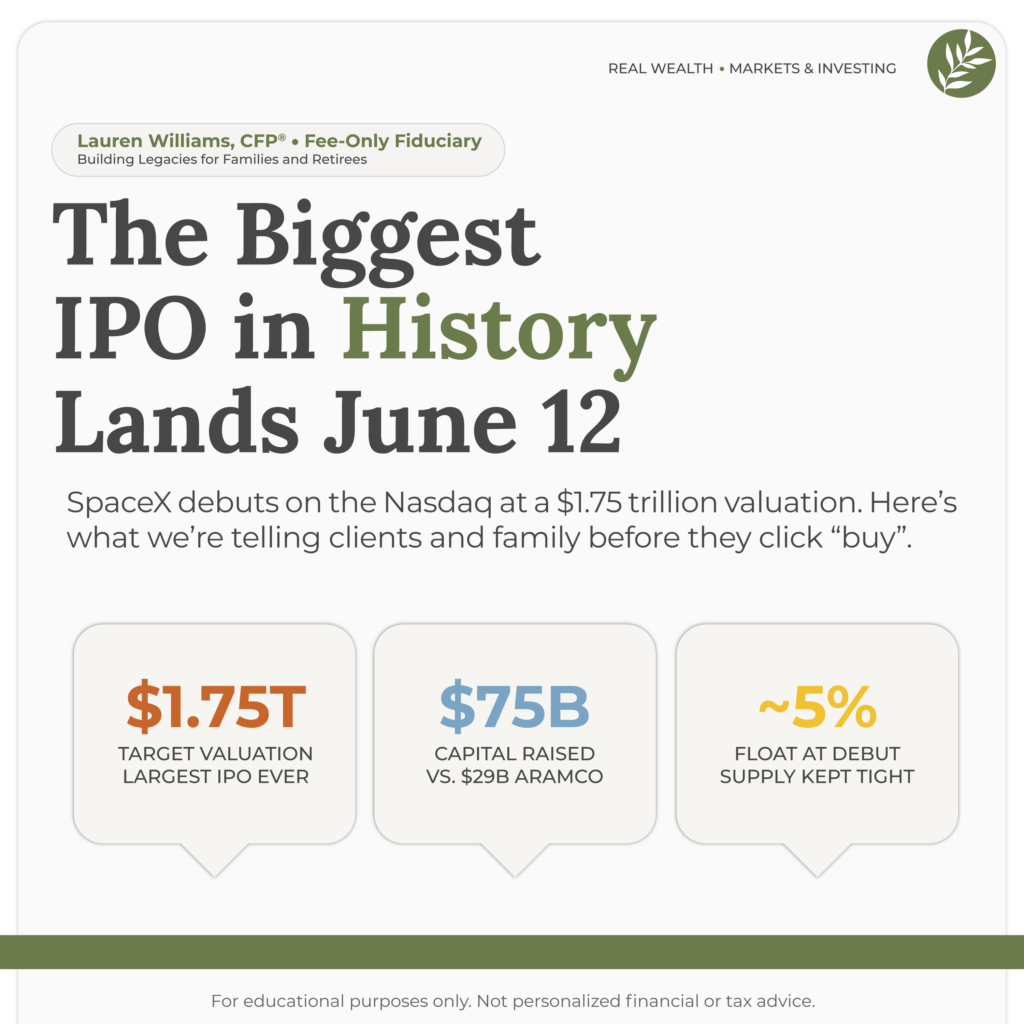
SpaceX is targeting June 12 for its debut on Nasdaq under the ticker SPCX. The deal aims to raise around $75 billion at a $1.77 trillion valuation, which, by a comfortable margin, would be the largest IPO in history. (The previous record-holder, Saudi Aramco, raised about $29 billion in 2019.)
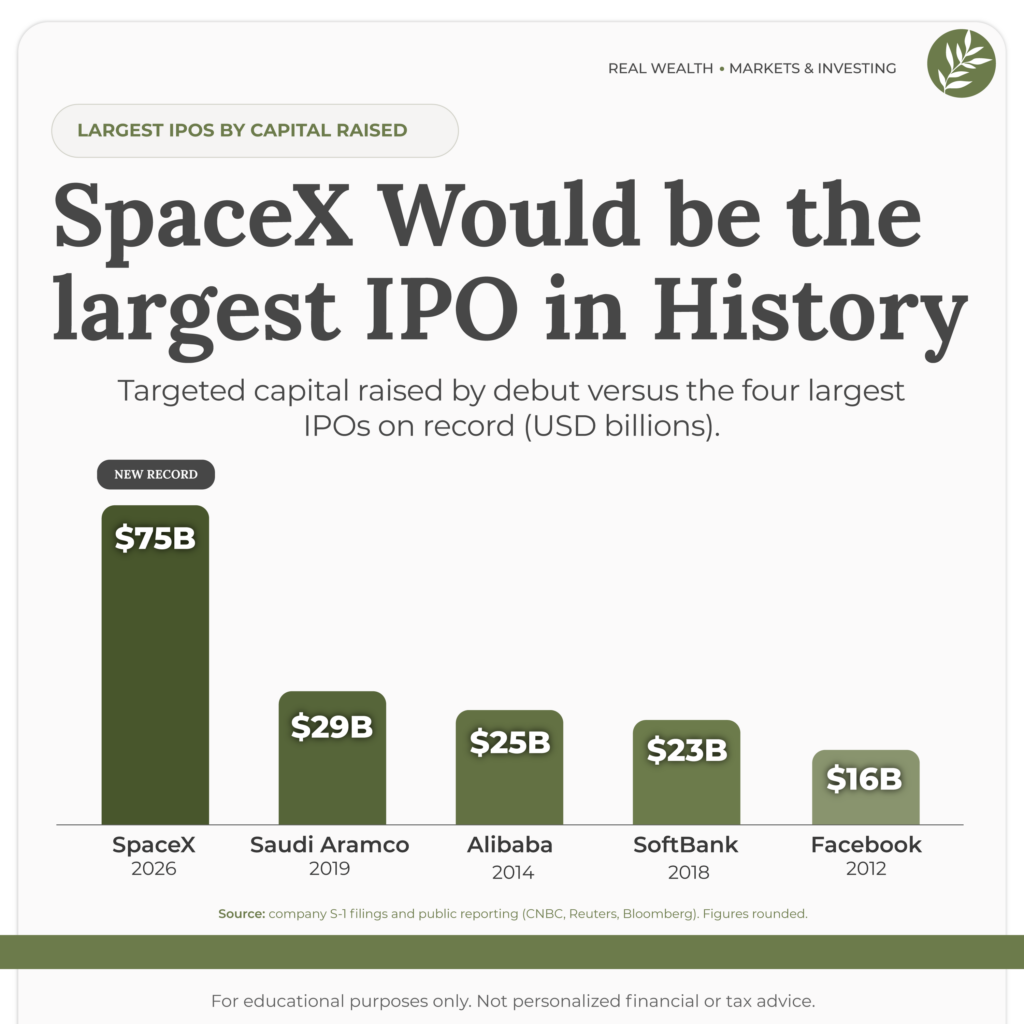
Figure 1: SpaceX’s targeted $75B raise versus the four largest IPOs on record.
While those are the flyover details, here are three things that do not make the headlines, but which actually matter.
Three Things That Make This IPO Unusual
1. The “float” has intentionally been engineered to be small.
What Wall Street calls the “float” (the number of shares available for public trading), for this IPO, SpaceX is only making about 5% of its supply of stock accessible to people like you and me.
Most IPOs release a much larger share.
This is supply and demand in its simplest form. That means SpaceX has deliberately engineered the constraint to keep supply low, so demand will be off the charts, and the price will climb.
Between the 5% float of the IPO, the staggered release schedule for other insiders, and Musk’s own 366-day restriction on his roughly 42% personal stake (more on all of this below), the available supply will be kept tight. And that’s why this stock may trade well above any rational valuation in its first year, and why the price may swing sharply every time a new tranche of supply releases.
2. The “lock-up” is staggered like a staircase.
“Lock-ups” are contractual restrictions that prevent insiders (executives, employees, etc.) from selling their shares in a newly public company for a set period of time after the IPO.
Most IPOs lock insiders in for a standard 180 days. Then the gates open, insiders can finally sell, and many head for the exits (and perhaps the Bahamas or the French Riviera).
That single-day flood of shares creates the classic “lock-up cliff” often seen six months after an IPO. Supply typically surges just as the initial investor excitement and demand have cooled.
But SpaceX has built something unique. Instead of one massive release, shares become available on five separate dates during the first six months, with two larger releases tied to quarterly earnings. The result is a steadier flow of shares into the market rather than a sudden flood.
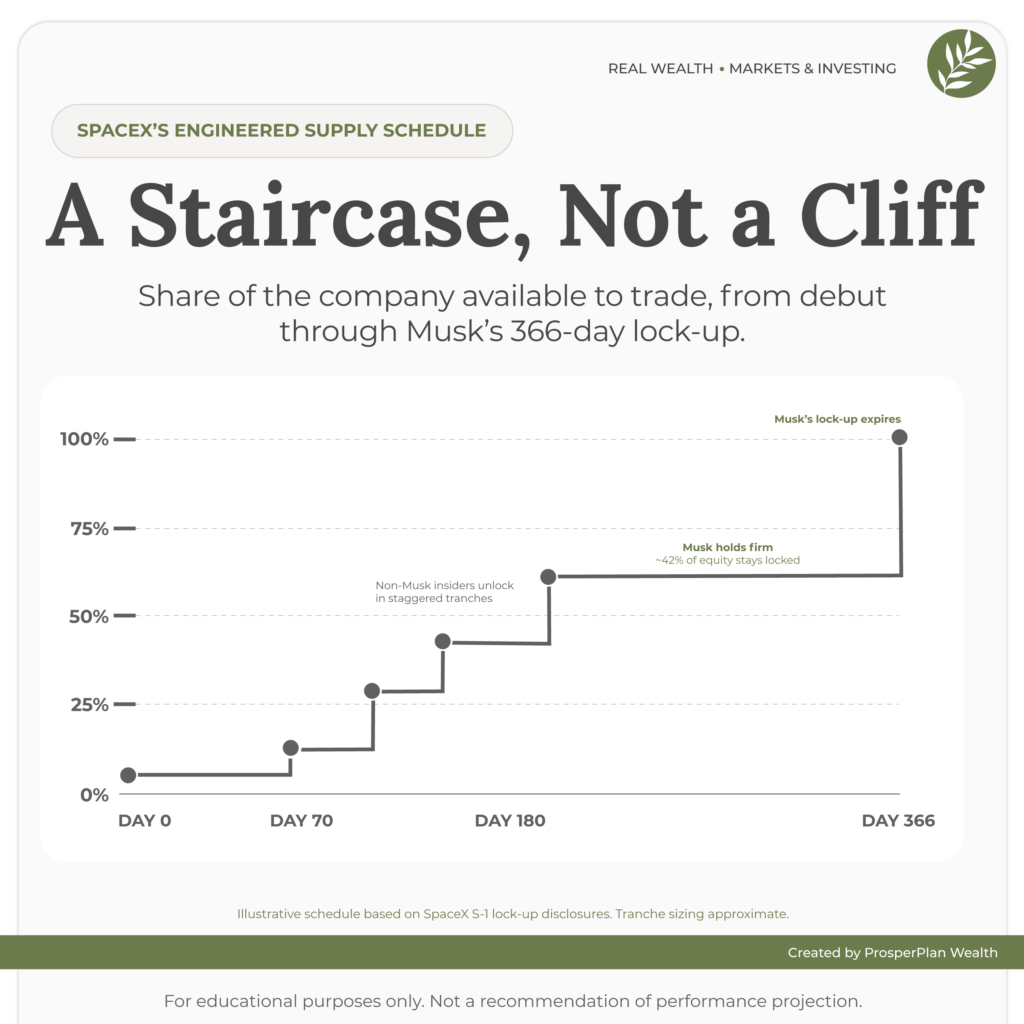
Figure 2: Share of the company available to trade, from debut through Musk’s 366-day lock-up.
The chart above explains the story visually. Even after every non-Musk insider is able to sell by day 180, more than 40% of the company stays off the market because Musk himself is holding.
That long flat stretch is his lock-up working. The steep jump at the right edge of the chart is when his shares finally come free.
3. At 366 days, Elon Musk’s own lock-up is roughly twice the standard.
This is a key detail that I point out to clients. Musk holds roughly 42% of SpaceX’s equity, and 85% of its voting power through super-voting Class B shares. He has voluntarily restricted himself from selling any of it for 366 days, which is about twice the standard window every other insider agrees to. 3
As my ProsperPlan Wealth Co-founder, Chris Grellas, CFP®, MSFA, said:
“That could be a meaningful signal, because Musk isn’t cashing out, he’s anchoring the deal.”
What You’re Actually Buying
Beyond the headlines, this business has momentum.
For example, not only does Starlink have more than 10 million subscribers across more than 150 countries, but the connectivity segment is throwing off $1.19 billion in operating profit a quarter, and it’s still adding around a million new subscribers every month.
For those of you who are technical geeks like we are, the launch business has reshaped the global aerospace cost curve. For example, Falcon 9 boosters are now qualified to conduct 40 or more reflights, while the cost per kilogram to low-Earth orbit has dropped to roughly $2,700 (from more than $54,000 in the Space Shuttle era).
While technical advances are hardly surprising, that is still impressive, because it is not merely a marginal improvement in performance and usability with lower costs, it is the wedge that built everything else that makes these aforementioned companies so exciting.
That, and the fact that after February’s xAI merger, SpaceX is now also one of the world’s largest AI compute operators. (Think of it as a second powerful economic engine added to a company that already had one.)
The Right Size for a Story Like This
The $20,000-to-$50,000 investment “fun money” number my clients keep floating (almost always less than 1% of their total portfolio) is a reasonable instinct, so much so, in fact, that I want to say so out loud.
Not to be cute, but this is figuratively a “satellite” position. Money you’re putting behind a specific idea you believe in, knowing it might surprise you in either direction. There is risk in every investment. There are never any guarantees. But viewed through the lens of “fun money” investing, this has the potential to sit next to the core of your portfolio – the diversified mix of equity, bonds, and other assets you actually retire on – without threatening it.
Simply, if SpaceX has the kind of decade some of the early-stage investors clearly expect, a 1% position can grow into a meaningful contribution to your wealth without you risking your future. But let me also point out, that while SpaceX had $18.5 billion in revenue in 2025, due in large part to the expenses of Musk’s AI startup, xAI, it still lost $5 billion.
Keep perspective, and remember, that if the stock has the brutal first year that many hyped IPOs have, a 1% position is a story you tell at dinner, knowing that you haven’t diverged from your long-term plan.
How I’d Place the Order in My Own Account
If you decide to participate, the practical mechanics are simpler than the hype surrounding them. The most difficult part isn’t whether to buy, it is the price you would be content owning the stock for.
Buying day one through a market order means accepting whatever the frenzy says the price is in the moment, which could be 50% above the offering price by the second hour.
The more disciplined approach is, say, once SPCX begins openly trading, you set a limit order (a specified ceiling for the price you are willing to pay) that feels suitable to you. You then let the volatility do its thing, keeping in mind that the market will be repricing this position for the entirety of the first year as the staggered share releases hit. This includes (but is not limited to) Q2 earnings in mid-August, the 7% tranches at days 70 through 135, Q3 earnings in early November, and the full unlock at day 180.
It’s dizzying. Each of the above is a date when more supply hits the market and the price often comes under pressure. Generally speaking, a patient limit order sitting in the book is probably best positioned to take advantage of the repricing.
Now, if you’d rather buy right out of the gate anyway, that’s also fine. Just remember what you’re signing up for: This is a moonshot piece of your portfolio, and more of an experience than a planning anchor.
What It Feels Like to Own a Single Stock
One more thing worth saying out loud before June 12: Owning individual stocks is a different emotional experience than owning a diversified portfolio.
Many ProsperPlan clients are in managed portfolios: a careful mix of passive and active ETFs built to do the steady, predictable work of compounding over decades. Statements typically move smoothly because the good days absorb the bad. Simply, unlike the value of a single stock, you do not watch your retirement plan drop 30% in an afternoon because a single name on a ticker had a rough earnings call.
A new IPO (and especially a SpaceX) could open 50% above the offering price and then give it all back by lunch. It could halve in a week, or it could double in three months. Whatever it does, behavioral finance says that your brain will probably assign more weight to those swings than they deserve, especially relative to your overall wealth.
It all depends on your personal situation and your tolerance for risk.
For some clients, that engagement and excitement are part of the fun, and a 1% position doesn’t disturb their sleep. For others, it is traumatic. And the fact of the matter is that we’ve had hundreds of honest conversations over the years with people who realized that they are happier not knowing what any single stock does on any given day.
You Will Likely Participate Either Way
Within fifteen trading days of listing, SpaceX will be added to the Nasdaq 100 under a rule change Nasdaq adopted on May 1, 2026. The S&P 500 is now reviewing similar changes that could let Mega Cap IPOs (companies with extremely large market values) enter that index after six months instead of the current twelve. The index machine is about to absorb SpaceX in waves, via Nasdaq 100 funds first, then S&P 500 funds, and eventually through every diversified large-cap fund on the market.
Because your portfolio participates through several paths, you’re likely involved, either way. The active managers at BAI (your AI and tech ETF) will almost certainly add SpaceX based on its AI infrastructure profile.
But this is also bigger than SpaceX. Anthropic and OpenAI are preparing for a potential listing later this year, so the AI-era IPO wave is just beginning. One thing is very clear: the pace of innovation is accelerating, and the investment opportunities emerging from it are evolving quickly.
One Final Note
Thinking about putting a small piece of your portfolio behind SpaceX?
We’re walking clients and families through this exact conversation every day this month. If you’d like to discuss position sizing, timing, and how a potential SpaceX investment fits into your broader financial plan before or after June 12, we’d be happy to help you think through your options. As fiduciary advisors, we do not make single stock purchase recommendations. Our role is to provide the education, perspective, and planning framework that helps you make a decision that aligns with your unique circumstances.
Disclosure: This article is for educational and informational purposes only and does not constitute personalized financial, legal, or tax advice. It is not a recommendation to buy or sell any security. Consult a qualified, fee-only fiduciary financial advisor before making any major financial decision. The charts in this material were prepared with the assistance of AI. All content has been reviewed, edited, and approved by ProsperPlan prior to use.