



You’ve probably heard about “Trump Accounts” in passing. Maybe a headline about a $1,000 government deposit for newborns, and not much else. Most of the coverage barely scratched the surface due to confusion about the name.
Is it a Trump business venture or a newly developed government sponsored savings opportunity? (It’s most assuredly the latter.)
Politics aside, if you have a child under 18, this new type of Trump Child Savings Account deserves a closer look. As a 100% fiduciary financial advisor, my job is to help you see past the headlines and understand what legislation like this actually means for your family, so you can make a confident, informed decision.
Let’s walk through what a Trump Account is, who qualifies, how to open one, and why – in my opinion – the real opportunity has very little to do with that initial free $1,000.
What Is a Trump Account?
Created under the One Big Beautiful Bill Act legislation, a Trump Account for children is a new type of tax-deferred custodial investment account – a dedicated account in your child’s name that grows over time, with taxes deferred until money is eventually withdrawn.
If you have a traditional IRA, some of this will feel familiar. But a Trump Child Investment Account isn’t just a junior version of one; it has its own distinct rules around who can contribute, what the money can be invested in, and when your child can access it.
And from my perspective, this is a golden opportunity to jumpstart someone’s financial future.
We like to describe it to clients as a purpose-built head start: a Trump Baby Account (or Trump Child Account, if your kids are past the baby stage) designed to give the next generation a financial running start — one that, with the right planning, can become something genuinely remarkable by the time your child reaches adulthood.
“Most families hear ‘$1,000 for babies’ and stop listening right there,” says Chris Grellas, CFP®, MSFA, my co-founder at ProsperPlan Wealth. “But the seed deposit is really just the door-opener. The account structure behind it – decades of tax-deferred growth followed by a Roth conversion – is where the real value lives.”
Trump Account Eligibility: Which Children Qualify
Let’s start with Trump Account eligibility, since this is where most families have questions.
Your child qualifies for a Trump Account if they meet all three of the following:
- They are a U.S. citizen
- They have a valid Social Security number
- They are under the age of 18
That last point is worth repeating: Trump Account for kids eligibility is not limited to babies. Any child under 18 who is a U.S. citizen with a Social Security number can have an account opened in their name. Only one may exist per child.
The $1,000 Federal Seed Deposit
The federal government’s $1,000 seed contribution is the piece that turned the Trump baby account into a headline, and it is available for children born between January 1, 2025 and December 31, 2028. This is a pilot program, and only one election per child can be made. Better still, this seed money doesn’t count against your annual personal contributions – it’s free. It’s nothing short of a pure head start, deposited at no cost to your family.
What About Older Kids? The Trump Baby Savings Account Isn’t the Whole Story
If your child was born before 2025, you may be wondering whether a Trump Account for older kids even makes sense, since they won’t qualify for the federal $1,000. Here’s some nuance for perspective:
- Children age 10 or younger, born before January 1, 2025, in ZIP codes with median household incomes below $150,000, may qualify for a separate $250 charitable gift from the Dell Foundation (subject to funding availability).
- Other charitable and state-level contributions may apply to specific groups of children, depending on where you live.
- Even without a seed deposit, any child under 18 can still have an account opened in their name and receive family contributions, with the same tax-deferred growth and eventual Roth conversion opportunity available to newborns.
In other words, a Trump Savings Account for kids already in elementary or middle school can still be a meaningful part of your planning – the growth clock simply starts a bit later.
“Don’t let the word ‘baby’ in the headlines fool you into thinking this is only for newborns,” Chris adds. “We’re already opening these accounts for clients’ ten- and twelve-year-olds. You lose some of the compounding runway, but you don’t lose the strategy.”
How to Open a Trump Account
A lot of parents ask us how to open a Trump Account, so here’s the practical version.
- Confirm eligibility. Your child needs a Social Security number and must be under 18.
- File IRS Form 4547. This official election form both establishes the account and elects the $1,000 pilot contribution, if eligible. You can also file through the online portal at trumpaccounts.gov.
- Use the mobile app if you prefer. The official Trump Accounts app launched in app stores in late May 2026.
- Start contributing. Accounts officially launched July 4th, 2026, so if you’re opening one today, you can begin contributing right away.
That’s the answer to how to sign up for Trump Account, in broad strokes – and it’s the same whether you’re asking how to open a Trump Account for baby (a newborn born within the 2025–2028 window, who’ll also elect the $1,000 seed deposit) or how to open Trump Account for older kids. The only real difference is which deposits your child is eligible to receive alongside your own contributions.
Should I Open a Trump Account for My Child?
For most families, there isn’t much downside to opening a Trump Account and claiming any seed money your child qualifies for, even without further contributions right away – the account costs nothing to open, and free money growing tax-deferred for close to two decades is hard to argue with.
Where it gets more personal is deciding how much, if anything, to contribute annually beyond that. That depends on your broader goals: Are you already maxing out a 529 for college? Do you have other savings priorities? Is this money you’d genuinely earmark for your child’s future rather than your own near-term needs? These are exactly the questions we work through with clients as part of a broader financial plan, not in isolation.
Who Can Contribute, and How Much?
Beyond the government’s $1,000 seed deposit, families and others can contribute up to $5,000 per year, per child, with that cap indexed for inflation after 2027.
Here’s how contributions break down:
- You and family members can contribute up to the combined $5,000 annual limit per child.
- Employers can contribute up to $2,500 per employee per year on your behalf, which counts toward the $5,000 annual limit. These contributions are tax-deductible to the business and excluded from your taxable income – worth bringing up at your next compensation conversation.
- State or local governments, and qualified nonprofits, can contribute to broad groups of children without those gifts counting against your family’s $5,000 cap.
- The federal $1,000 pilot contribution and the Dell Foundation’s $250 gift also sit outside the annual cap.
What Can a Trump Account Invest In?
Unlike a standard brokerage account, a Trump Account is intentionally limited to a low-cost, broadly diversified U.S. stock index fund or ETF, with an expense ratio capped at 0.10%. No international funds, bonds, individual stocks, or alternative investments.
For most families, that’s not a drawback – it’s a feature. A low-cost total market index fund is a sound, simple long-term holding, and the expense cap keeps the account efficient by design.
Still, these accounts work best as one piece of a broader strategy rather than a standalone solution. If you’re weighing how a Trump Account fits alongside your other holdings, our investment management services team can help you see the full picture.
We tend to describe the ideal setup to clients as a layered approach:
- The Trump Account serves as a long-term, retirement-oriented savings vehicle.
- A 529 plan remains the most effective tool for education funding specifically.
- A UTMA account is often better suited for near-term goals, like a first car or a home down payment.
When Can Your Child Access the Money?
With very few exceptions, no withdrawals are permitted before January 1 of the year your child turns 18. At that point, the account begins to function similarly to a traditional IRA:
- Withdrawals are subject to ordinary income tax.
- A 10% early withdrawal penalty may apply to non-qualified distributions taken before age 59½, with some exceptions.
Penalty-free withdrawals may be available for:
- Qualified higher education expenses
- A first-time home purchase (up to a $10,000 lifetime limit)
- Standard IRA exceptions, such as disability or certain unreimbursed medical expenses
The Roth Conversion Strategy: The Real Opportunity
Here’s the part that gets us genuinely excited when we talk with clients about this.
When your child turns 18, their Trump Account can be converted into a traditional IRA, which can then be converted into a Roth IRA. The order matters enormously.
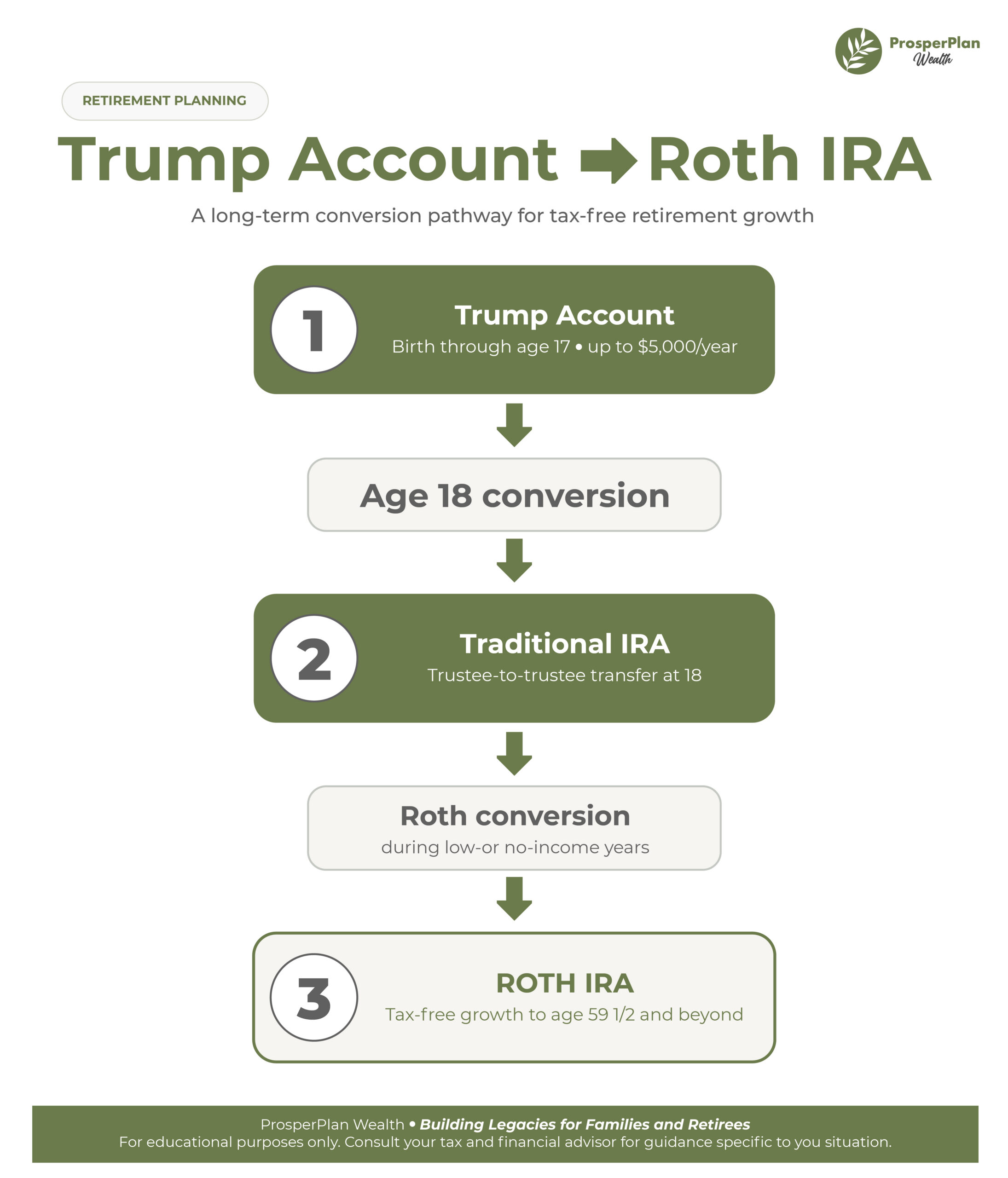
A Roth IRA is one of the most valuable accounts in the entire tax code: money grows completely tax-free, and qualified withdrawals after 59½ are tax-free too. The usual catch is that your child needs earned income to contribute directly – but a Trump Account sidesteps that entirely. Money builds tax-deferred from birth, with no earned income required, then converts at 18.
“This is the piece most families miss entirely,” Chris told me recently. “You’re essentially giving your child two decades of tax-deferred compounding, and then handing them the keys to a Roth IRA before they’ve even started their career. I don’t know of another legal way to do that.”
The ideal timing is shortly after your child turns 18, when many young adults have little or no taxable income of their own. With careful planning – often spreading the conversion across two or three years to stay at or under the standard deduction – it’s possible to move the entire balance into a Roth IRA with little to no federal tax owed.
One nuance: the “Kiddie Tax” applies to unearned income for children under 19 (or full-time students under 24 who don’t cover half their own support), and Roth conversions count as your child’s income under this rule. Some families cover that tax cost as a gift to their child, so the full balance stays inside the Roth uninterrupted — worth modeling with an advisor before you act.
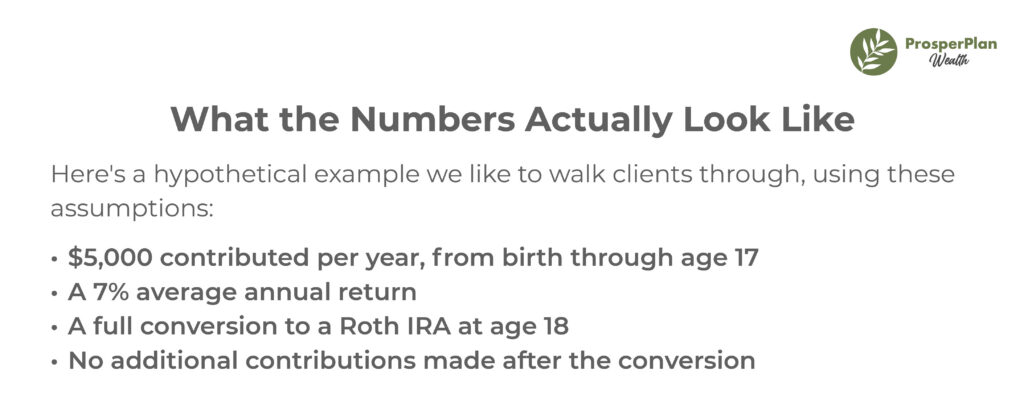
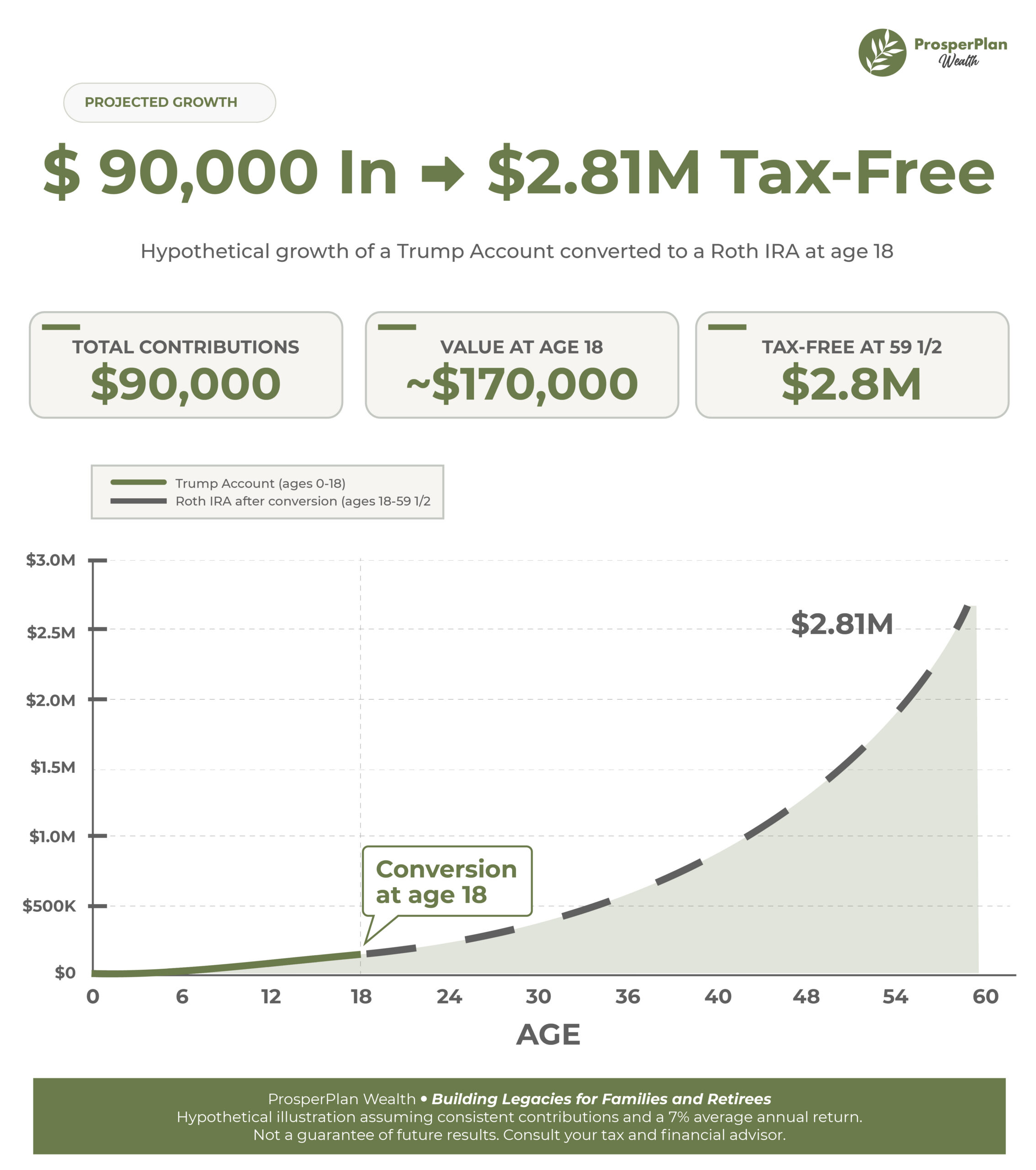
Under those assumptions, 18 years of contributions total $90,000 and grow to roughly $170,000 by your child’s 18th birthday. Left invested inside a Roth IRA through age 59½ at the same 7% return, that balance could grow to over $2.81 million – entirely tax-free.
That projection isn’t guaranteed, and markets don’t move in a straight line. But it illustrates what starting early, combined with well-timed Roth conversion planning, can accomplish. The contributions are modest. The outcome, over four decades, is not.
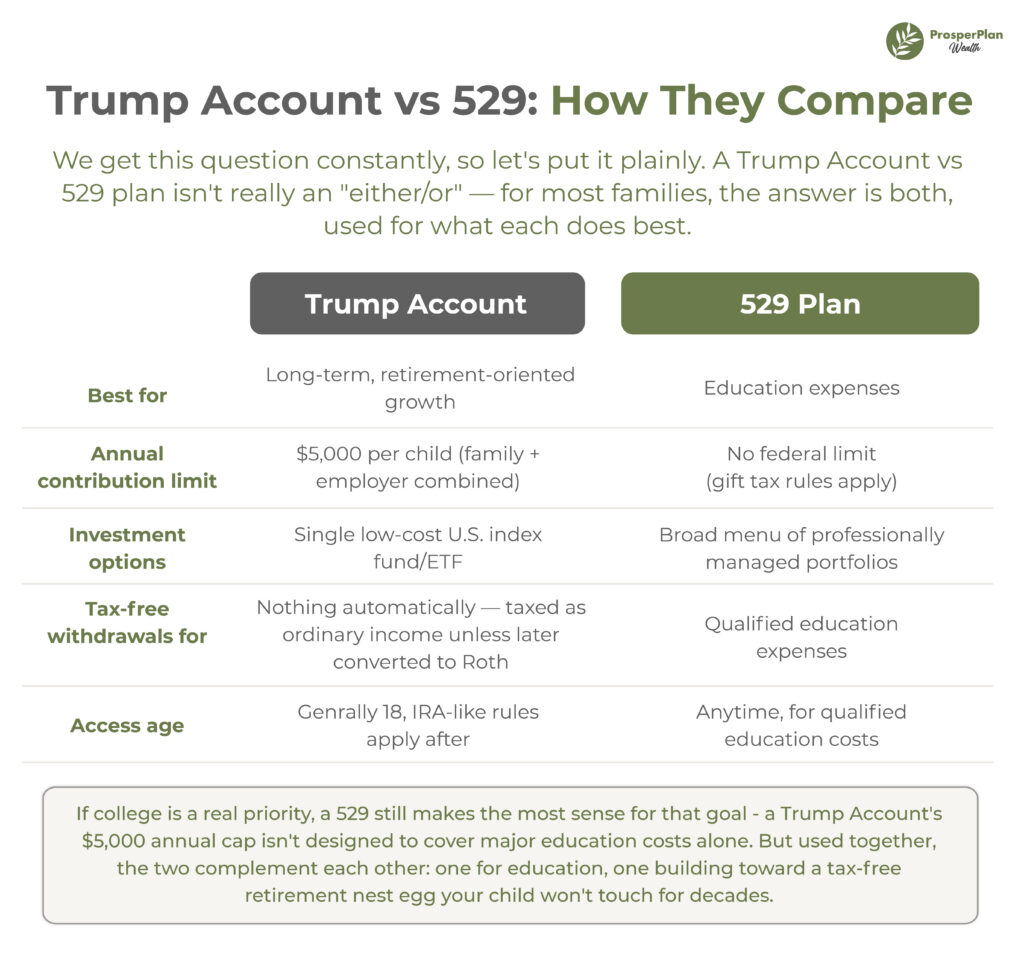
If college is a real priority, a 529 still makes the most sense for that goal – a Trump Account’s $5,000 annual cap isn’t designed to cover major education costs alone. But used together, the two complement each other: one for education, one building toward a tax-free retirement nest egg your child won’t touch for decades.
How This Fits Into Your Family’s Bigger Legacy Plan
A Trump Account for kids is a genuinely useful new tool, but it’s one tool, not a complete plan:
- UTMA and UGMA custodial accounts offer more investment flexibility and no withdrawal restrictions, useful for goals like a first car or early adulthood expenses.
- If you’re already working with more sophisticated estate planning structures, a Trump Account should complement those tools, not replace them.
- The smartest approach is almost always to layer these vehicles together, matching each one to a specific goal.
This is precisely the kind of multi-account, multi-goal thinking we help families work through as part of our financial planning services — because a Trump Account, a 529, a custodial account, and your own retirement savings all need to work together.
Trump Accounts FAQs
How to open a Trump Account for a baby?
The process is identical to opening one for an older child: confirm your newborn has a Social Security number, then file IRS Form 4547 and activate the account through the official Trump Accounts app. The one difference is that a baby born between January 1, 2025 and December 31, 2028 is also eligible to elect the $1,000 federal seed deposit on that same form.
How to sign up for a Trump Account?
There are two steps, and most families only hear about the first one.
Step one: file IRS Form 4547, “Trump Account Election(s).” You have four ways to do it — file it with your federal tax return, submit it through your IRS Individual Online Account (you’ll verify your identity with ID.me), file it in the Trump Accounts app, or file it at trumpaccount.com. All four take the same one to three business days to process. If your child qualifies for the $1,000 seed, elect it on the same form — you have to check the box, and it isn’t automatic.
Step two: activate the account. Once the IRS processes your election, you’ll get an activation email from no-reply@trumpaccounts.treasury.gov, sent to the address you used on the form. From there you verify your identity, create your login, and enter your information and your child’s exactly as they appear on Form 4547. The app is on the Apple App Store and Google Play, and both are linked from TrumpAccounts.gov.
Only one Trump Account is permitted per child. If two people file for the same child, whoever completes activation first becomes the responsible party.
Who is actually allowed to open the account?
This depends on whether you’re electing the $1,000 seed at the same time, and it’s worth getting right.
If you are electing the seed, the person opening the account has to be someone who expects the child to be their qualifying child under IRC §152(c) for that tax year. In practice, that’s the parent.
If you are not electing the seed, the rules set a strict priority order: legal guardian first, then parent, then adult sibling, then grandparent. Where two people share the same priority — two parents, say — either can file, and the first to file prevails. You’re signing under penalties of perjury that no higher-priority person is available.
So “only a parent or legal guardian can open it” is too narrow. Adult siblings and grandparents can open an account — they just can’t jump ahead of someone with higher priority.
Can my financial advisor open the account for me?
No. The responsible party has to be an authorized individual — a parent, legal guardian, adult sibling, or grandparent, age 18 or older. We can walk you through Form 4547 and sit with you while you file it, but the account has to be registered under your own information, including your email address, since that’s where activation and every account notice after it will go.
When can I actually put money in?
Funding opened July 4, 2026. Before that date nothing moved — not your contributions, not the $1,000 seed — no matter how early you filed Form 4547. Once the account is activated, you link a bank account or debit card in the app and contribute from there.
One thing to flag for older kids: contributions stop after December 31 of the year your child turns 17. The account then sits invested until they turn 18 and it converts to a traditional IRA.
How do I know I’m on the official site, and what do the scams look like?
Type TrumpAccounts.gov into your browser yourself rather than clicking a link someone sent you. That’s Treasury’s site, and it links to the official app and to the account portal at trumpaccount.com. Only download the app from the Apple App Store, Google Play, or a link on one of those two sites.
Initial activation emails come only from no-reply@trumpaccounts.treasury.gov. After that, official messages arrive in the app or from addresses ending in @trumpaccount.com. Treasury and its service providers will never ask you for a password or a one-time verification code by email, text, or phone. If you get a call or text about a Trump Account, treat it as a scam. Support is 1-866-USA-4547 — and don’t use a number you found in search results.
I’m a grandparent. Can I fund my grandchild’s account?
Yes. Once the account is open, anyone can contribute — but everyone shares the same $5,000 annual cap per child, and that trips families up constantly. If both grandparents and both parents each try to put in $5,000, the excess gets kicked back.
The cleanest path is usually to gift the money to your adult child and let them contribute through the app they already control. One person manages the account, one person watches the cap.
Does contributing to a grandchild’s account trigger a gift tax return?
Usually not, thanks to Revenue Procedure 2026-25, issued June 29, 2026. But it’s a safe harbor, not a blanket rule. Your contribution is treated as a completed present-interest gift — no Form 709 required — only if your total gifts to that child for the year, including the Trump Account contribution, stay within the annual exclusion ($19,000 for 2026); the contribution creates no gift or GST tax liability after your remaining credit; and you aren’t otherwise required to file a gift tax return that year.
Miss any one of those and the safe harbor fails for every Trump Account contribution you made that year. If you’re gift-splitting, superfunding a 529, or making larger gifts to the same grandchild, let’s talk before you write the checks.
Does California tax a Trump Account the way the IRS does?
Not necessarily — and this one matters here in Sacramento. Federally, a Trump Account grows tax-deferred. California does not automatically conform to the section of the 2025 federal law that created these accounts, according to the Franchise Tax Board. Until the state conforms, the account can be treated differently on your California return than on your federal one, which can mean keeping two sets of records for the same account.
The Legislature could still act on this. Check current FTB guidance, or just ask us, before you assume your state and federal treatment line up.
What if the money gets tapped while my child is still young?
Withdrawals are generally blocked until January 1 of the year your child turns 18. After that, the kiddie tax is the thing to watch — it applies to unearned income for children under 19, or full-time students under 24 who don’t provide half their own support. A withdrawal or a Roth conversion during the college years can land at your rate rather than your child’s. Worth modeling before anyone touches the account.
How to open a Trump Account for a child already in school?
Any child under 18 with U.S. citizenship and a Social Security number qualifies, so a child in elementary or middle school can have an account opened the same way. They will not receive the federal $1,000 seed deposit if they were born before 2025, but they may qualify for the $250 Dell Foundation gift, and the tax-deferred growth and Roth conversion opportunity are unchanged.
You Don’t Have To Figure This Out Alone
Schedule a complimentary 30-minute Trump Account strategy call with our team, and we’ll help you determine whether to open an account, how much to contribute, and how it fits alongside your 529, custodial accounts, and retirement savings. Call us at (916) 909-3993, email advice@prosperplan.com, or reach out through our website to get started this week – the sooner your child’s account is open, the sooner that money starts working.
Sources: IRS IR-2025-117, IRS IR-2026-31, Notice 2025-68, Prop. Reg. § 1.530A-1, Rev. Proc. 2026-25, trumpaccounts.gov. This article is for general educational purposes and does not constitute tax or legal advice. Please consult a qualified fiduciary financial advisor at ProsperPlan Wealth regarding your individual circumstances.