



The Ultimate Guide to the Question That Matters Most
At the root of every retirement plan is a much more personal question:
Will everything be okay?
We find that this question rarely comes from a lack of effort or discipline. In fact, most of the people we work with have done a lot right.
Most of the people we work with have religiously contributed to their 401(k)s, paid down (or finished off) their mortgages, lived within their means, and resisted the temptation to chase short-term market trends.
And yet, as retirement draws near, a new kind of uncertainty emerges: “Will everything that I’ve done translate into enough monthly retirement income?”
That worrisome transition – moving from the accumulation stage to the retirement income stage – is where planning and execution matter most.
In some combination, Social Security (or a pension), and assets such as your investment portfolios, retirement accounts, and real estate, all these things contribute to your monthly retirement income.
But without seamless coordination, they can remain separate pieces rather than a unified strategy.
Many people begin their transition by using a Retirement Calculator to estimate what their income could look like. That’s a good first step because it lends perspective and gives you a glimpse of what the future might look like.
But, as you probably realize, confidence doesn’t come from numbers alone.
It comes from understanding how each income source interacts with the others. How they are taxed, how they change over time, and how they support your lifestyle over the years and decades.
Think of it this way: Through market cycles, health challenges, and your family’s evolving needs, your plan needs to work perfectly at 65 but also hold up at age 75 or 85.
Our role at ProsperPlan Wealth is to partner with you to bring those pieces together into a cohesive, sustainable monthly income that supports you in the manner to which you aspire.
Because when the day of your retirement arrives, we don’t want you to have to guess if everything is going to be okay.
What Is Considered a Good Monthly Retirement Income?
In a high-cost state like California, defining a good monthly income requires more than merely considering what is average. It requires context that takes into consideration your career savings and investments, along with your lifestyle and goals, and, finally, the economic environment you live in.
From our experience, as a general overview, a comfortable retirement monthly income for many households in the Sacramento region typically falls within:
- $7,000 to $15,000, or more, per month for individuals and couples with $1M to $3M+
- But this number can easily be higher for people with vacation homes, significant travel plans, ongoing support of children, or philanthropic commitments
This stands in sharp contrast to the national average retirement monthly income, which is often closer to $4,000 to $5,000 per month (a figure that reflects an entirely distinct set of cost-of-living realities).1
The gap reflects several layers of reality that are specific to California residents:
- Our state’s substantially higher cost of living (particularly in housing, healthcare, and everyday expenses)
- Our state’s taxation on most forms of retirement income, which reduces purchasing power in ways that out-of-state averages don’t have
- The personal lifestyle preferences and expectations that are entirely reasonable and worth carefully planning around
“We often see clients come in anchored to a number they’ve heard, say, $5,000 or $6,000 a month, only to soon realize that in California, that might not fully support the lifestyle they’ve envisioned. For many households with $1 million to $3+ million saved, a realistic retirement monthly income tends to fall between $8,000 and $15,000 per month. The goal is not to match an average but is instead to create clarity around what your life actually requires.” – Lauren Williams, CFP®, CRPC®, MBA
A good monthly income is not defined by a benchmark or standard. It’s defined by alignment between your resources and the life you want to live.
What Is a Good Monthly Retirement Income for a Couple?
Housing, utilities, transportation, insurance: On one hand, couples typically share some living expenses. So, by extension, this arrangement can make each dollar of income stretch further than it would for a single person.
On the other hand, planning needs to account for things such as longevity differences between spouses, survivor income needs, healthcare costs that tend to increase with age, and the evolving financial demands that come with decades of shared life.
In California, we typically see a good monthly retirement income for a couple fall within:
$10,000 to $18,000+ per month.2
This income typically flows from multiple coordinated monthly income funds, including:
- Social Security benefits for both spouses (often $5,000–$8,000 combined when maximized through planning)
- Systematic investment portfolio withdrawals
- Rental property income or pension distributions
“For many couples, Social Security alone can provide $6,000 to $9,000 per month when optimized. That creates a meaningful baseline. But the real value comes from how that income is integrated with investments and tax strategy. When coordinated well, the difference in lifetime income can easily exceed $100,000.” – Chris Grellas, CFP®, MFSA
Probably the most crucial factor in couple-centered planning is durability. A well-designed plan ensures that income continues seamlessly for the surviving spouse, without interrupting their standard of living, while still covering healthcare costs and preserving financial independence.
Chapter 1: Building Monthly Income Funds That Work Together
We strongly believe that retirement income should feel structured and intentional and not assembled piecemeal from whatever is most convenient in each month.
We call this, “Achieving prosperity.”
As mentioned above, most households nearing retirement have several monthly income sources available to them:
- Social Security
- Taxable investment accounts
- Retirement plans (Traditional IRAs, 401(k)s, Roth accounts)
- Real estate income or defined benefit pensions
- And even inheritances
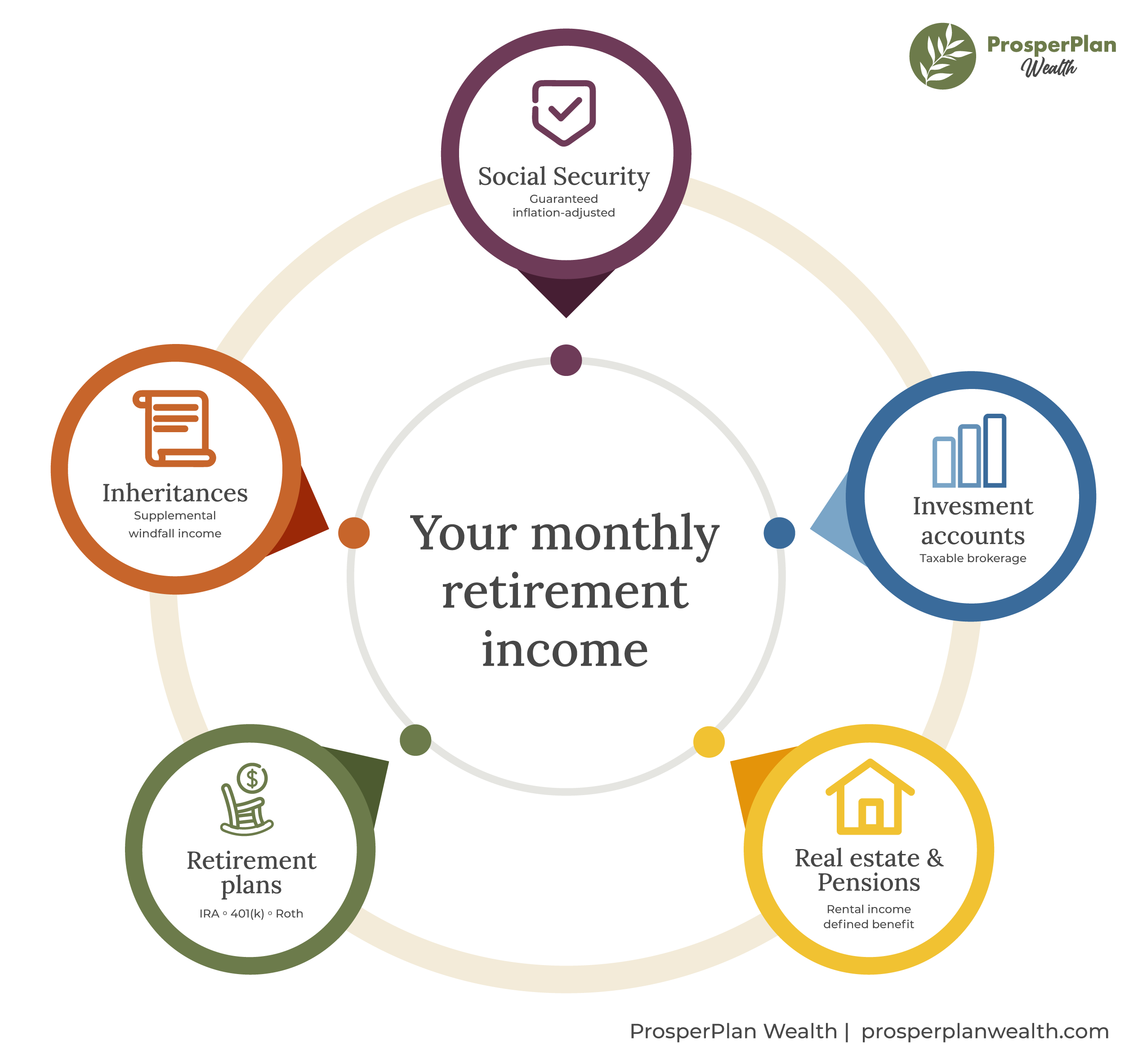
Individually, each of these serves a purpose. But without deliberate coordination, they can generate significant inefficiencies and unnecessary costs. These can include things such as drawing from the wrong accounts at the wrong time (which trigger unnecessary tax liabilities or expose the plan to risks that could have been avoided with better sequencing).
Our focus is to bring these revenue streams together into a coordinated monthly income; one that balances stability, flexibility, and tax efficiency across the distinct phases of your retirement.
Remember: the early years of retirement often look a lot different than the middle years and the later years. But not to worry. Because a strong plan can account for all of that.
For those of you who are looking to take a more structured and proactive approach, our Retirement Planning Services are designed to create that alignment, so that every income decision supports the larger plan rather than working against it.
Chapter 2: How Much Should I Save Monthly for Retirement?
During your working years, this question shapes everything that comes later.
Your savings rate determines your average monthly retirement savings, which ultimately becomes the foundation for your future income. For high earners, a common guideline is to save 15% to 25% or more of income each year. This is a range that, when achieved consistently, builds real wealth over time.
“We often remind clients that saving is only part of the equation. Someone saving $2,000 per month over 25 years can build a portfolio capable of generating $5,000 to $8,000 per month in retirement income. But without a plan for how that income is structured, taxed, and distributed, a significant amount of value can be lost.” – Lauren Williams, CFP®, CRPC®, MBA
Always remember that consistent saving builds your asset base. And a good income strategy not only determines how much of that base actually reaches your bank account, but how long it will last.
Chapter 3: Social Security: A Foundation You Can Optimize
Social Security plays a foundational role in most retirement income plans, and it offers something that very few other income sources can match: Guaranteed lifetime income with annual cost-of-living adjustments and zero exposure to market volatility.
Simply, Social Security cannot be outlived. It rises with inflation. And it requires no management once it begins.
Yet despite its importance and its irreplaceable place in retirement income, Social Security is consistently one of the least understood, and most under-optimized, components of a retirement income plan.
“Not everyone should wait to take Social Security, even if they have substantial savings. Though waiting does mean more income. The difference between claiming Social Security at 62 versus 70 can mean the difference between roughly $2,500 and over $4,500 per month per person. Over a 25-year retirement, that’s a decision that can impact your total income by hundreds of thousands of dollars.” – Chris Grellas, CFP®, MFSA
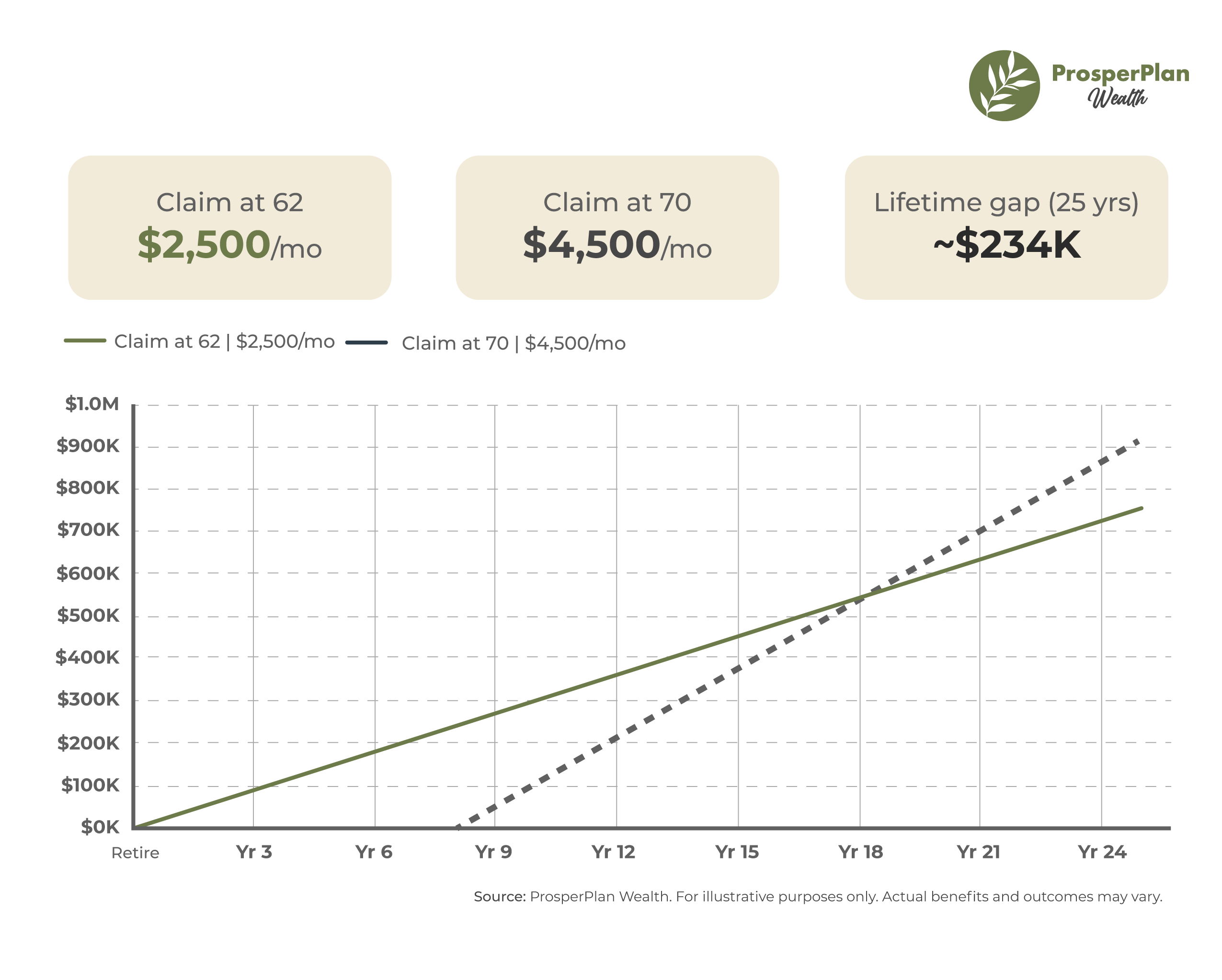
However, the claiming decision is only a starting point. For couples, coordination between spouses (including spousal benefit strategies and survivor benefit planning) can dramatically increase the lifetime income generated by Social Security alone. When optimized correctly within a broader income plan, Social Security becomes a powerful, dependable, and inflation-protected cornerstone of monthly income in retirement.
Chapter 4: Investment Income: Turning Savings into Sustainable Income
Your investment portfolio is where your average monthly retirement savings are transformed into ongoing, usable income. For general, illustrative purposes only:
- A $1.5 million portfolio can support approximately $5,000 per month in withdrawals
- A $2.5 million portfolio can support approximately $8,000 or more per month
These withdrawal amounts form a core part of your monthly retirement income and must be built to last, not only for the first decade of your retirement, but for 25 or 30 years or even more.
“Research from Vanguard shows that coordinated financial planning, what they call ‘Advisor Alpha’, can add approximately 3% in annual net returns.3 So, just for example, on a $2 million portfolio, that’s roughly $60,000 more per year. Over time, that translates directly into higher and more sustainable monthly income.” – Chris Grellas, CFP®, MFSA
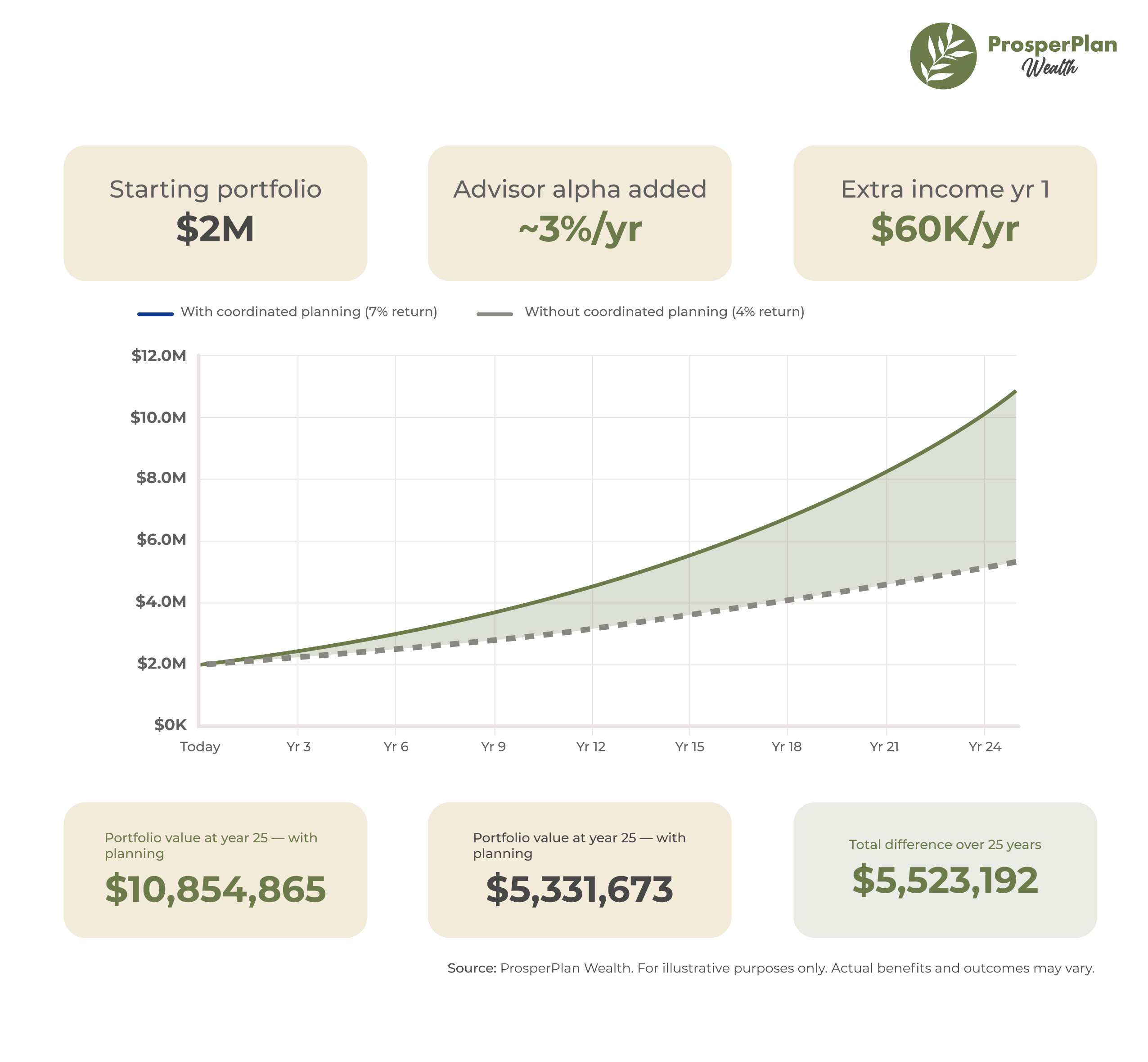
A thoughtful withdrawal strategy considers which accounts to draw from first, how to sequence withdrawals across market cycles, and how to balance your income needs today while preserving your portfolio for the future.
The difference between a structured approach, and an approach that isn’t coordinated, can be life changing. It affects both the total income you receive over your retirement and the financial resilience you need to weather downturns (without permanently derailing your plan).
Chapter 5: Tax Strategy: Where Income Is Preserved or Lost
While we say this to clients almost every day, even then, it would be impossible to overstate, but taxes are one of the most consequential – and most overlooked – factors affecting your net monthly income during retirement. In California, the tax landscape for retirees has several important characteristics you need to understand:
- Withdrawals from Traditional IRAs and 401(k)s are taxed as ordinary income at both the federal and the state level (Yes).
- But Social Security benefits are not taxed at the California state level, which provides meaningful relief.
- Capital gains (investment income), Roth conversions, and required minimum distributions each interact with one another in ways that can either increase or reduce your effective tax rate.
Without deliberate planning, many retirees end up unintentionally increasing their tax burden, and this reduces their effective monthly income, not through any change in their portfolio, but simply through inefficient sequencing of withdrawals.
We focus on coordinating withdrawals across different account types such as taxable accounts, tax-deferred accounts, and tax-free Roth accounts. We do this to preserve more of your monthly income funds and improve long-term outcomes without taking on additional investment risk. For example, strategic Roth conversions in the years before Social Security begins can greatly reduce your taxable income over the full course of retirement.
Chapter 6: Additional Income Streams: Expanding the Foundation
Many retirees benefit meaningfully from additional monthly income funds that enhance both stability and flexibility. These supplemental sources can make a substantial difference in your day-to-day financial comfort and long-term security.
Rental income, particularly in strong California real estate markets such as Sacramento, can generate significant cash flow. Some advantages are that this income tends to be relatively stable, it often rises with inflation over time, and it is not correlated with stock market movements.
This makes real estate a valuable complement to investment withdrawals.
Defined benefit pensions, while less common than they used to be, offer predictable and guaranteed monthly income that can anchor an entire retirement plan. For those fortunate enough to have one, a pension can function similarly to a private annuity; providing a reliable base of income that reduces the pressure on investment portfolios to produce short-term cash flow.
And so, this too brings an added sense of prosperity to your life.
When these additional sources are thoughtfully integrated into the broader income plan, they strengthen overall retirement monthly income, add resilience, and provide meaningful layers of financial security that pure portfolio strategies alone cannot replicate.
Chapter 7: Understanding Average Monthly Retirement Income by State
While looking at average monthly retirement income by state provides useful perspective for your own approach to planning, it rarely tells the full story for higher-wealth households.
This is especially true in California.
- National averages: approximately $3,000–$4,000 per month4
- California averages: approximately $3,800–$4,500 per month5
These figures primarily reflect households with modest levels of savings, lower lifetime incomes, and simpler financial situations. They are useful as a baseline reference, but they should not serve as a planning target for households with $1 million or more in savings and a lifestyle built on higher lifetime earnings.
For those with greater levels of accumulated wealth, monthly income in retirement is typically much higher, but also a lot more complex to manage effectively. The coordination of multiple income streams, tax strategies across different account types, Social Security optimization, and healthcare planning, all require a level of intentionality that goes well beyond what average figures can convey.
Chapter 8: Healthcare and Long-Term Planning
Healthcare is another significant but misunderstood variable that affects retirement monthly income over the long haul. Estimates consistently suggest that a couple may spend more than $300,000 on healthcare expenses throughout the course of their retirement; this is a figure that encompasses Medicare premiums, supplemental coverage, potential out-of-pocket costs, dental and vision expenses, and the possibility of long-term care needs.6
With the above in mind, we incorporate healthcare cost planning into every income strategy we develop, which helps ensure that it is accounted for early and thoughtfully, and not treated as an afterthought once the plan is already in motion.
Chapter 9: The Role of a Fee-Only, Fiduciary Advisor
As a fee-only, 100% fiduciary firm, our responsibility is clearly defined: every recommendation we make must serve the client’s best interests. We do not earn commissions or have quotas of any kind. We do not benefit from recommending one product over another. Our only incentive is to help our clients achieve the outcomes they’re working toward.
That means we help clients:
- Structure retirement monthly income that lasts across multiple decades
- Coordinate all monthly income into a cohesive and tax-efficient plan
- Optimize Social Security strategies for both individuals and couples
- Implement tax planning that preserves more of every dollar earned
- Adjust plans as life circumstances inevitably evolve
This is how average monthly retirement savings become a dependable, lasting, and genuinely confidence-inspiring income strategy: not by accident, but by design.
This is how we help you achieve prosperity.
Conclusion: From Accumulation to Confidence
As you well know, building wealth takes time, discipline, and a long series of thoughtful decisions made across decades. Turning that wealth into sustainable monthly income during retirement requires a different, and in many ways more nuanced, kind of planning.
Remember, the skills that built your portfolio are not always the same skills needed to draw it down wisely.
The decisions made in the years immediately surrounding retirement, when to claim Social Security, how to sequence withdrawals, which accounts to draw from first, and how to manage taxes through the transition, will have a lasting and compounding impact on your retirement monthly income.
Getting it right matters.
Whether you’re starting with our Retirement Calculator to explore what your numbers might look like, or you’re ready to work with a team that provides comprehensive Retirement Planning Services, the goal is ultimately the same: To create a good monthly income that fully supports your life comfortably, sustainably, and with the confidence that comes from knowing everything has been carefully considered and thought through.
At ProsperPlan Wealth, that is exactly what we help our clients do.